I have a probably quite dumb question about center-to-center distance (cc) between studs when building walls:
I know that, for example, cc 30 means that it should generally be 30cm from the center of one stud to the center of the next. My question is whether this also applies to the distance between the first and second stud, so to speak. It seems obvious that it should be so, but is that really what you want practically speaking?
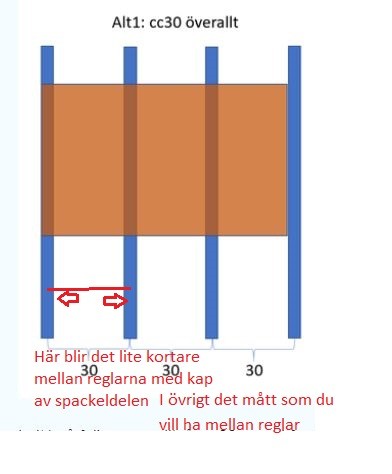
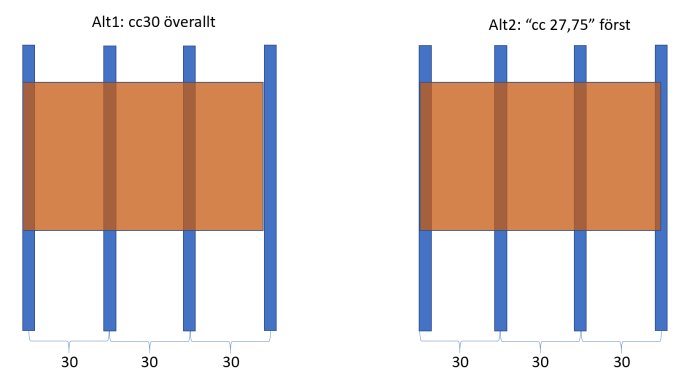
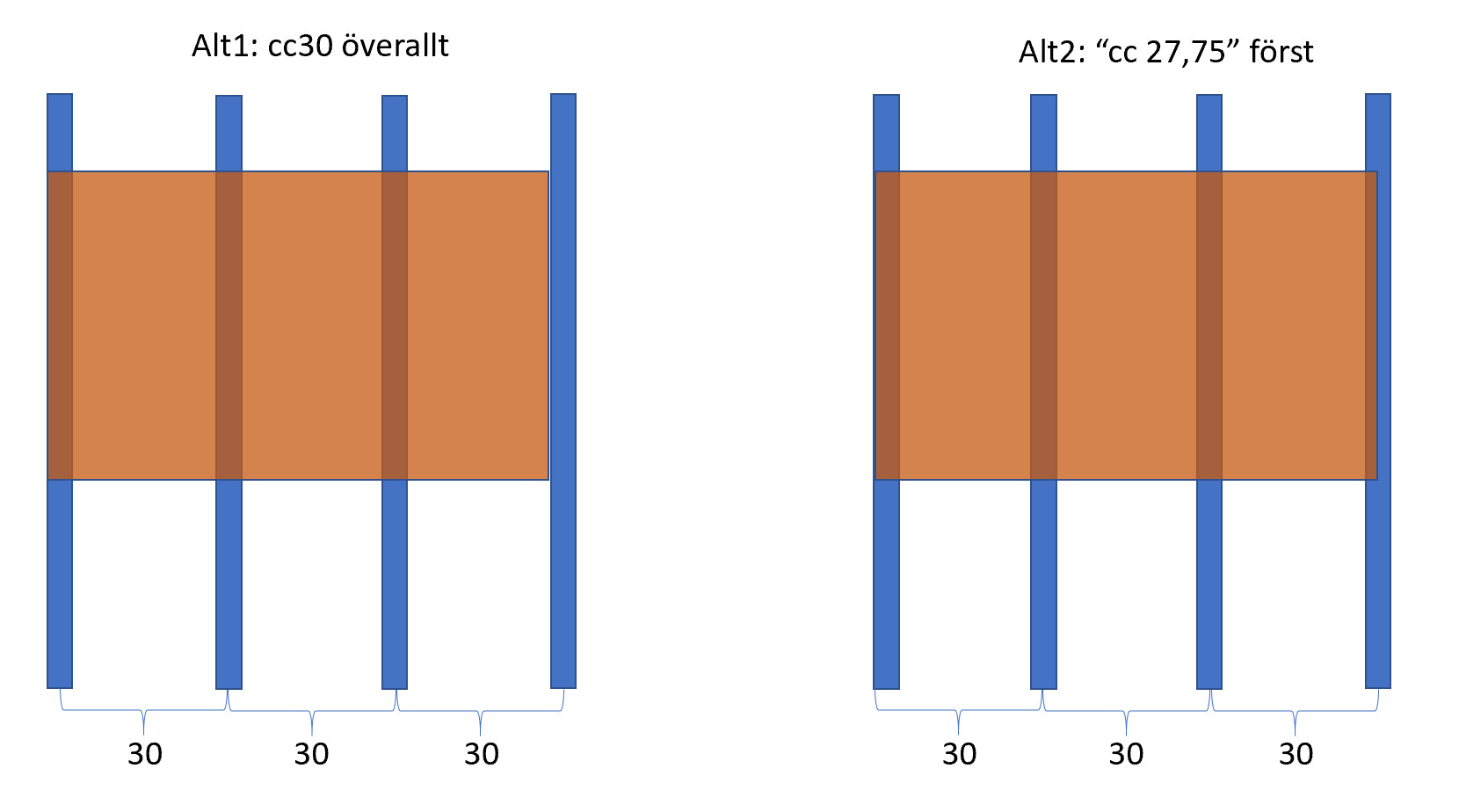
My thought is mostly that if you maintain cc 30 between all the studs and then go to put on, for example, a 90cm wide drywall sheet on the studs, the sheet will just miss the fourth stud when you actually want to be able to cover half of that stud to anchor the sheet there. I am attaching an image of what I mean:
In alt1, you follow cc 30 even between the first and second stud, and then, as said, you miss the fourth stud and will be forced to start with a cut sheet. If you go according to alt2, you can start with a full sheet and still go on and start the next sheet halfway into stud 4.
I myself have mostly gone according to alt2, but what do people usually do and what do craftsmen expect who might continue with builds you've started?
Start the first disc in the middle of the first rule, and it will fit. At the first rule, another wall section follows anyway, which it should be adjusted to, right?
Otherwise, it is customary to use cc45 studs when using 900 boards or cc60 when using 1200 boards. My impression is that most people do it this way and therefore you have to adapt the board.
Otherwise, it is customary to space at cc45 when using 900 boards or cc60 when using 120 boards. My impression is that most do so and that you therefore have to adjust the board accordingly.
Well, if you're going to tile, it's probably common with c-c- 300 between the studs.
Start the first board in the middle of the first rule, then it will fit.
At the first rule, there is another wall section to adjust to anyway, right?
Well, maybe not always. If the first rule directly connects to an existing wall, for example, then there will be a 2.25cm gap left to the wall. Is that good?
Otherwise, it is customary to rule cc45 when using 900 boards or cc60 when using 120 boards. My view is that most people do so and that you should therefore adapt the board accordingly.
My example came right after boarding for tiling, hence cc 30. But even with cc 45, the exact same question remains, just with different measurements. If you go "cc 42.75" between the first and second joist, you get a 90 board to end in the middle of the third joist, and you "don't quite reach" the third joist if you go cc 45 even between the first and second joist (unless you offset the first board by 2.25cm as KnockOnWood suggests, of course)...
Start by setting the first stud and measuring in C/C for the next one. Begin by placing a sheet from the left or right, but you should cut off the spackle phase. It's a hassle to spackle it up in a corner, so the sheet will be a few centimeters narrower and the other stud is measured based on that dimension. When you reach the next wall, the sheet will be whatever size it turns out to be, just measure.
It will be necessary to set the first rule and measure in C/C for the next. Start by setting a board from the left or right, but you should cut away the jointing edge, it's a pain to fill it in a corner, then the board will be a few centimeters narrower and the second rule is measured in after that measurement. When reaching the next wall, it will be what it will be in terms of board measurement, just measure.
So do I understand you correctly if I interpret your answer as that it's cc 30 everywhere that's required and the boards are adjusted somehow after that? (I realize there are many variations on how this is done, as mentioned, it's mainly the center spacing I'm considering here) So "Alt1" according to my pictures above, except that in some way the first board is adjusted to fit the studs?
In this case, there will be tiles later (I myself will not be installing plywood/moisture barrier/tiles). But my question was intended to be general regardless of the surface layer to be applied. Do you mean it makes a difference whether I end up installing a regular interior wall with OSB+gypsum or if it should be a wet room wall?
Then it's C/C 30 that applies, and double gypsum 13 mm is installed staggered with the seams, behind tiles/clinker it must be rigid otherwise the joints will crack.
Well, maybe not always. If the first rule directly connects to an existing wall, for example, there will be a 2.25 cm gap left to the wall. Is that good?
It entirely depends on where/how the first rule is placed.
It's advisable to set it so that it is attached to the connecting wall's rule,
otherwise, it will be unstably built.
Try drawing how you want to build it!
Then it is C/C 30 that applies and double gypsum 13 mm that is staggered at the seams; behind tiles/clinker it must be solid, otherwise the joints crack.
Oh, you misunderstood my question unfortunately. Yes, I know that it is indeed cc 30 (and not cc 45 or 60) that is generally applicable in this case. But if you look at my original question, it's in both "Alt1" and "Alt2" that I have sketched up, never mentioning having more than 30. Rather, the question is whether the second stud should really be placed so far out (since one must somehow adjust the first board to get all board seams against a stud, for example, starting with slightly more than half a board in the first layer) or if the first distance is actually "cc 27.75" (and yes, I know that it's not a real term, so to speak) to be able to start with a whole board and yet get the first seam over a stud.
Am I right in assuming that you advocate for alt1, with the exact same center distance and adjusting the first board in some way?
Yep, the first board will be a bit narrower to remove the filler section. If you're tiling the entire wall, the board can be full width, but the next stud will be approximately a few centimeters to the left if you start from the left since it will be in the corner and not centered on the first stud. After that, it will be C(C measurement, 90 board is C/C 30
Vi vill skicka notiser för ämnen du bevakar och händelser som berör dig.



KnockOnWood said: