I am renovating an exterior wall (inside) in a 70s house. The usual practice is to put a vapor barrier/plastic on the frame (over the insulation) and then nail 45x45 furring strips mainly as the (electrical) installation layer (with or without 45mm insulation) and then nail drywall.
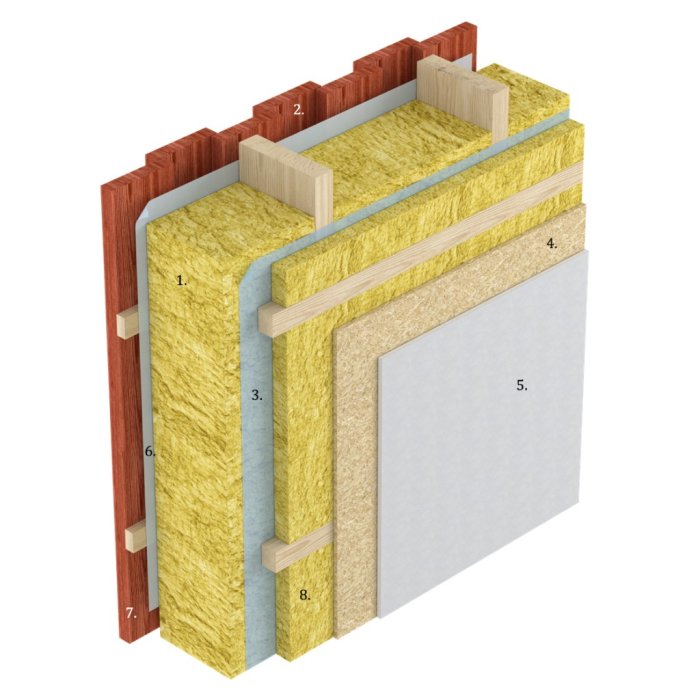
My question is whether you can skip the installation layer and put drywall directly on the plastic. That is, if you look at this image
then you put the drywall (5) directly on the plastic (3) without layers 8 and 4. Is that possible?
That's how it has been done for the past 40 years before the installation layer was invented, so it shouldn't be a problem. But I would probably have put an osb or chipboard behind it to make it a little more stable.
I have the same in my house from 2008 with only one layer of plasterboard.
I feel a bit wiser today. At every electrical outlet, etc., there's a potential leakage. For example, if you want to make a hole in the outer wall for a painting or something similar, you make a hole in the moisture barrier.
One layer of plasterboard is too little, poorly soundproofed, the wall becomes a bit wavy, the wall becomes noisy/hollow.
If you have functioning ventilation, then a few holes in the plastic do not matter. The installation layer has been introduced in recent years when people started measuring the airtightness of houses.
Thank you for the answer! As I understood from the answer, there's no moisture-related problem in doing so. I will be careful not to make deep holes for hanging things on the wall. I'll see if I manage to do it according to practice!






 with only one layer of plasterboard.