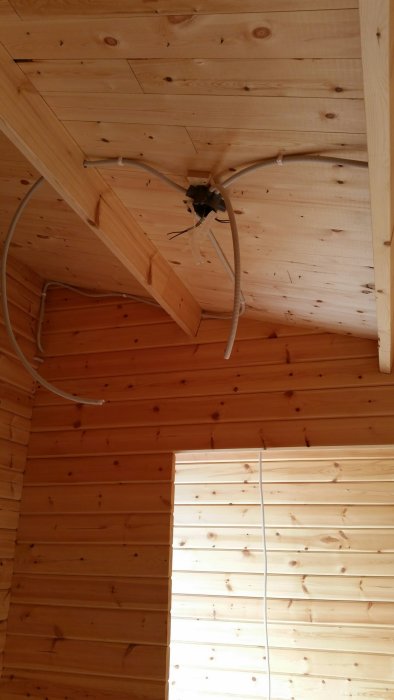
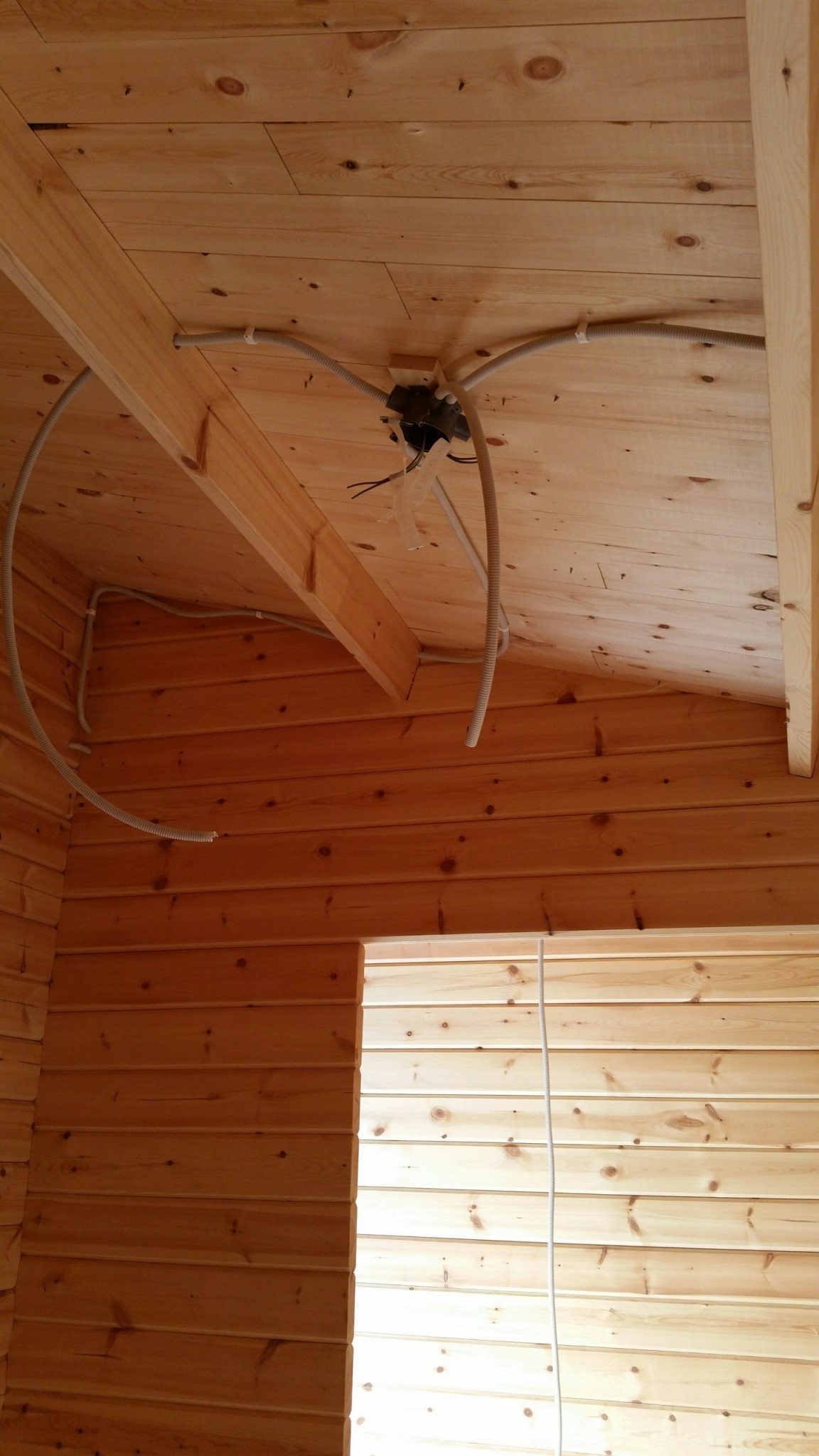
In preparation for preliminary electrical wiring in the ceiling, there was a misstep of running the conduit through the ceiling beams 145mm. The conduits should, of course, have been run in the sparse panel. The question is whether the 20mm diameter holes that can be seen in the picture, 2 in one beam and 3 in the other, significantly affect the load-bearing capacity so that they need to be replaced? I also realize that it would have been better to place the holes in the neutral layer, but now they are where they are. Do I need to worry about the ceiling collapsing? The rest of the roof structure is tongue and groove boards, counter battens, load battens, and metal roofing. Snow loads are to be expected.
20 mm holes in beams usually do not matter in 145 mm high beams. One should avoid placing the holes too close to the top and bottom edges of the beams.
It is better for the holes to be at the top than at the bottom. Wood withstands compression better than tension. But ideally, the holes should be in the middle. Then it's not a bad idea to figure out a completely different path for the electrical pipes.
The electrical conduits will end up in the sparse paneling. Unfortunately, the holes are already drilled, but hopefully, no major harm to the ceiling beams. I will take the experiences from this with me.
The hole also appears to be located in the middle of the length, where the turnover moment is highest. You can probably consider it as if there's a 120 regel there. But it certainly won't collapse. There are usually good margins.
The sharp bend on the hose in the upper part of the image is completely impossible. You will never be able to thread anything there.
Take a regular 1-liter paint can as a template. If you bend the hose around the can, that's about as sharp as it should be; ideally, it should have an even larger bend radius.
I'm not sure if I understand the intended construction. But if the plan is to have sparse paneling under the beams, the junction box is way too deep. The junction box should be level with the finished ceiling.
Additionally, the junction box should be mounted so there is insulation between it and the outer roof; otherwise, you'll have a thermal bridge and condensation inside the junction box.
The same applies to the conduit. If it is on the cold side of the insulation, there can be condensation inside the conduit.
It should also not be embedded in insulation, like in the middle, because then it gets too warm inside the conduit when a lot of current flows through it.
The conduit with the sharp bend at the roof also seems to have quite a sharp bend where it enters the junction box, which isn't good either.
Last edited:
Click here to reply
Vi vill skicka notiser för ämnen du bevakar och händelser som berör dig.