I'm calculating the material requirements for a deck construction and would need some input from you experienced deck builders.
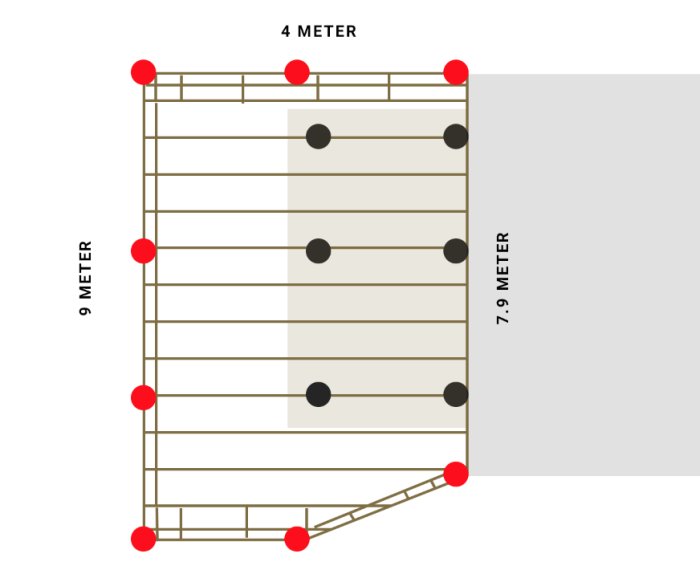
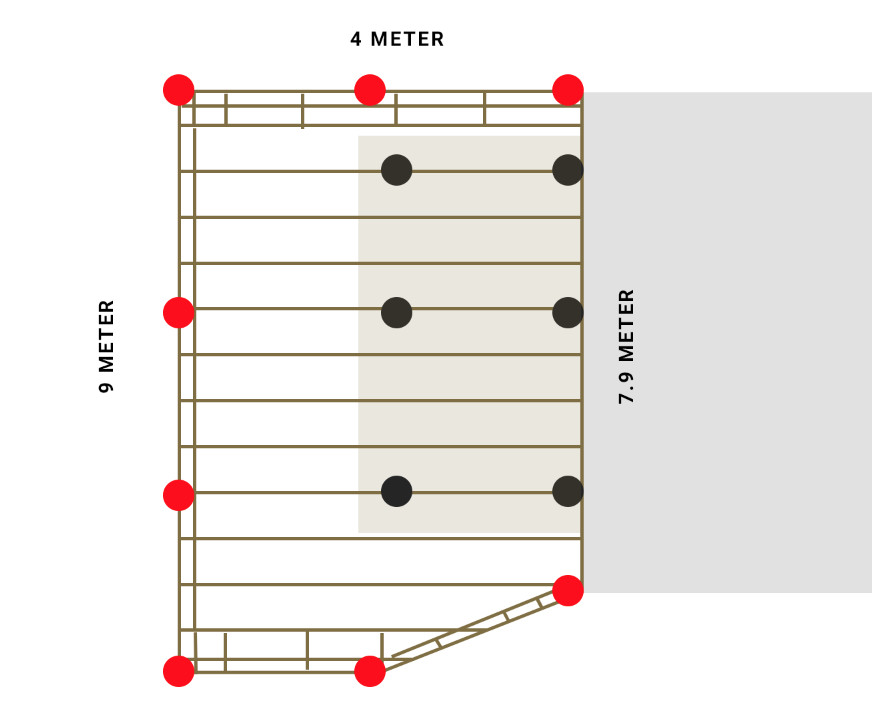
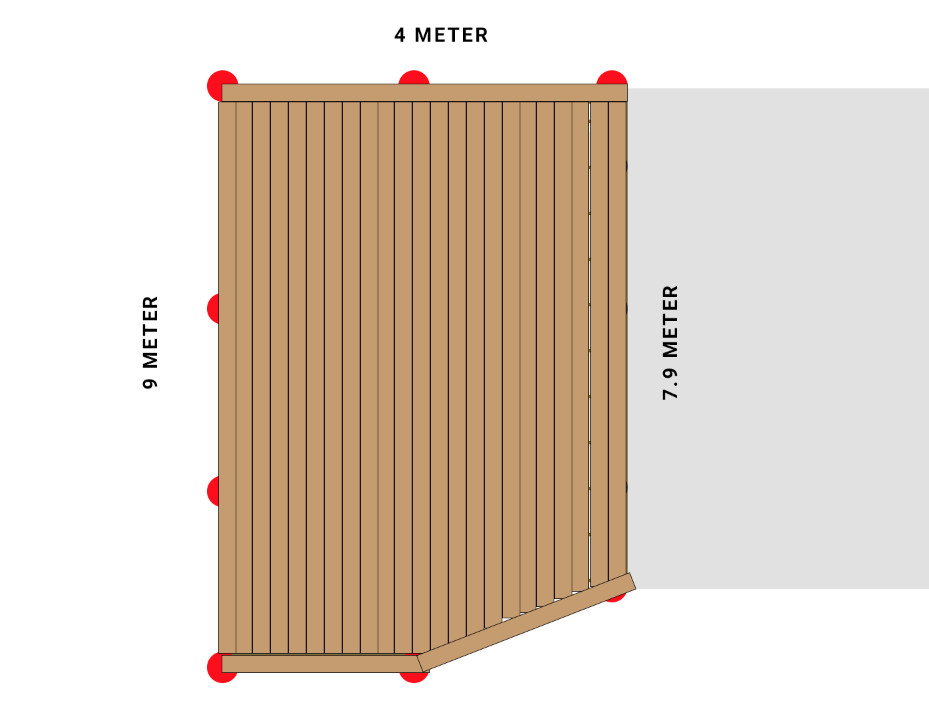
Here is a sketch of roughly how I'm envisioning it. The placement of the footings is not entirely exact as there is an old deck there now that needs to be demolished (shaded slab), but I plan to reuse the footings (black circles) and add new ones (red).
I'm trying to stick to CC 60 as much as possible, considering I need to align it with the existing footings. I'm thinking of using 45x170 throughout the entire frame, but one question that came up is whether blocking is needed between the joists, or when and why would one use it?
Next year, the plan is to build a simple enclosed sunroom on top of parts of this decking, so I'd like to make it extra sturdy and stable. (The room will be at the top in this sketch, on the non-angled side)
Thoughts on the sketch? Does it seem sensible, or is the span too long between the old footing and the new footing on the long side? Does blocking add anything in such a scenario?
I've never built a deck with a border frame but I imagine it has to be something like this construction-wise? So, you make a section on the outer edge to place a single board there as a frame. Then the actual decking goes inside this. Am I overcomplicating it, or does it seem reasonable?
Don't know exactly what you had in mind, but the "frisen" on the outer edge, going in the same direction as the rest of the decking, doesn't need any extra joists. "Kortlingarna" might be good there and in other places, but most are satisfied with brackets against the beam.
How have you planned the groundwork? If you lay a separate floor for the conservatory with insulation, you will be able to use it for a much longer time in the fall, and also be able to heat it with a simple fan heater and start using it earlier in the spring. Dad has single glazing and an insulated floor, using it from March to October. The neighbor has double glazing and an uninsulated floor, their time is from May to September, because it blows so cold from underneath.
Don't know exactly how you planned it, but the "frieze" on the outer part going in the same direction as the rest of the deck doesn't need extra joists. The blocking can be good there and in other places, but most people settle for angles against the bearing beam.
Good tips, I didn't really think about the fact that they go in the same direction, so it would be redundant to add extra joists there. Does it look okay otherwise, do you think, purely construction-wise, or is there something I've missed?
Anna_H said:
How have you thought about the groundwork? If you lay a separate floor for the patio with insulation, you will be able to use it much longer in the fall and also heat it with a simple heater to start using it earlier in the spring. Dad has single glazing and an insulated floor, uses it from March to October. The neighbor has double glazing and an uninsulated floor; their time is from May to September because it gets so cold underneath.
The idea is to go for a simpler style without an insulated floor. Like adding some "outdoor carpet" to block a little bit of the draft from underneath. I had previously considered doing proper insulation, but I think I've concluded that the extra work and cost aren't really justified.
You need support beams unless I misunderstand your drawing. Otherwise, many more foundation blocks...
Isn't the outer support beam enough? And then screw the decking directly into the joists? I was thinking of using 28/120 or possibly 34/145 mm decking for this.
Edit:
Found a picture online of someone who did roughly what I have in mind. This should work for me too, right?
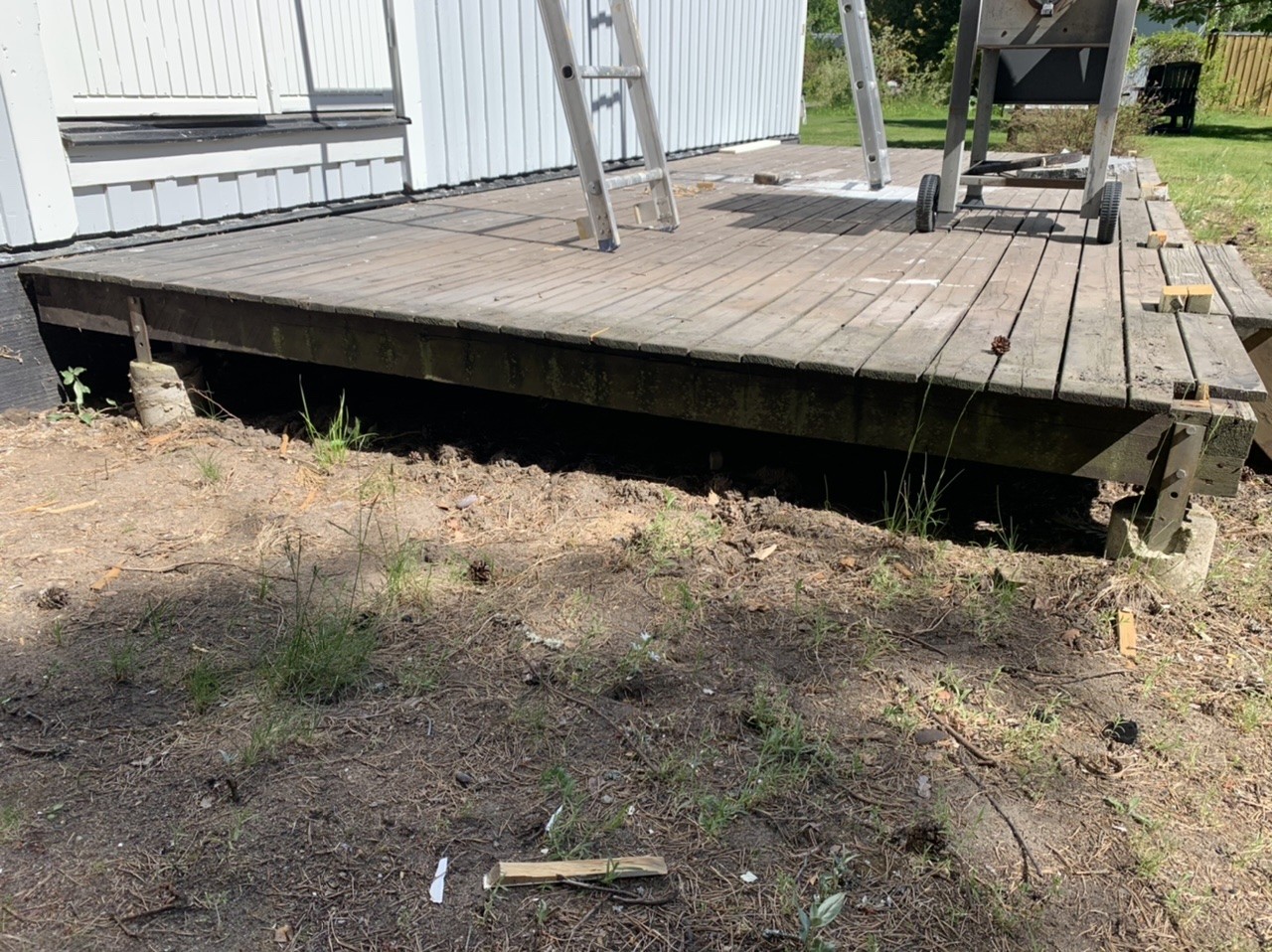
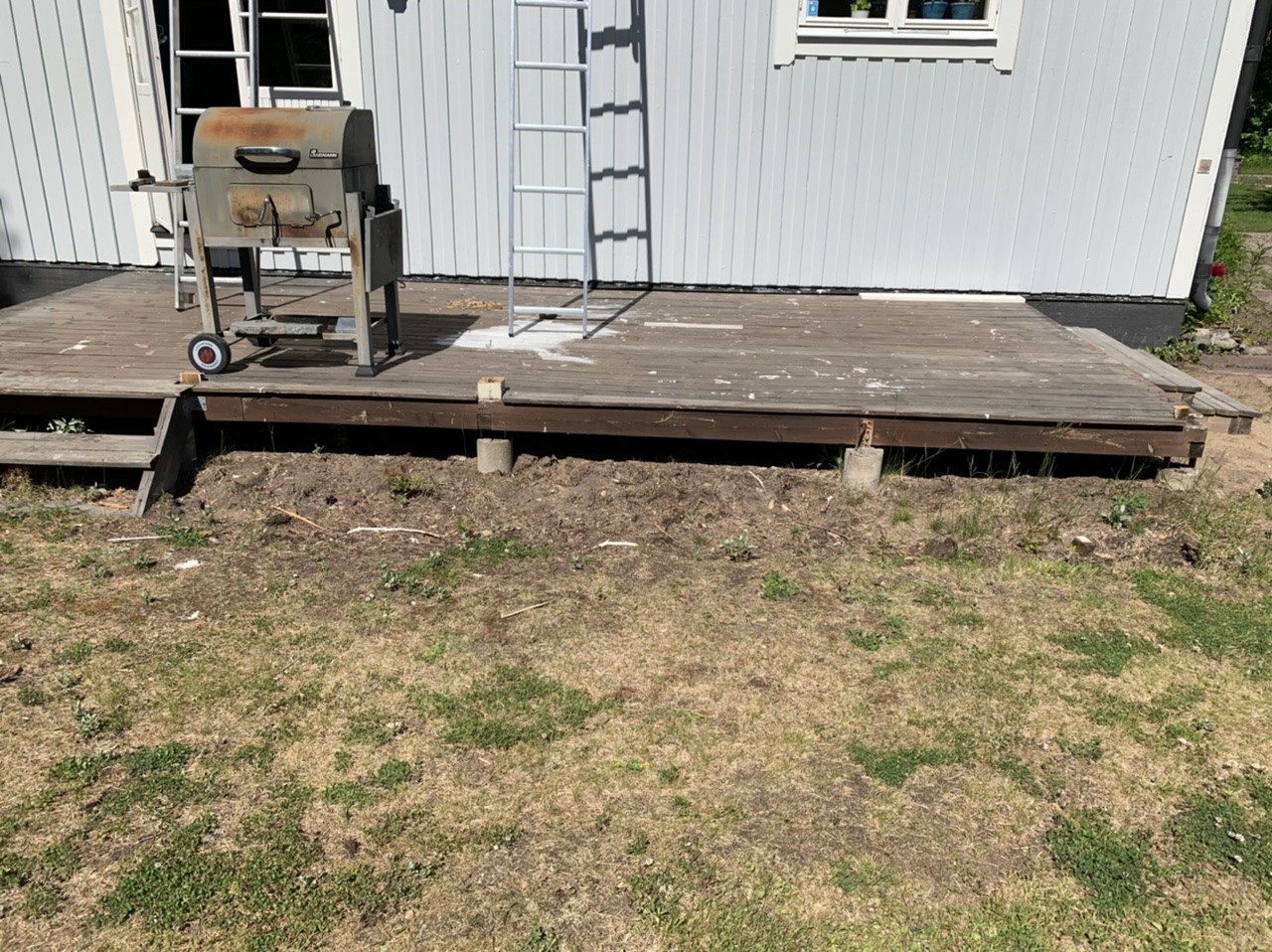
I was out taking a few pictures of the existing deck that I'm in the process of demolishing. I would prefer to end up at the same height as this one, which makes it a bit tricky to fit the support beams and then screw battens on top of that.
Isn't it possible to achieve a sturdy construction while building both support beams and screw battens on the same level? Like the picture above, for example. I understand that I might need to add a few more concrete pillars compared to my sketch, but in principle, it should work, right?
Yes, well, maybe..
170 timber is recommended for a maximum span of about 3000. So it will probably work with yours (3500??)
There is some risk that the deck might sag a bit in the middle.
But why not have a support beam over the black points in your drawing and divide the deck into two sections?
Yes, well maybe..
170 timber is recommended for spans of no more than about 3000. So it will probably work with yours (3500??)
There is a bit of a risk that the deck might sag a little in the middle.
But why not have a beam over the black points in your drawing and divide the deck into two sections?
Okay, yeah I would prefer to avoid a sagging deck in the middle. So it seems like I'll have to dig up the existing posts and do it right from the start maybe. I was hoping to save myself the work of digging 8-10 posts/holes in that way
I'm trying to picture how it would be to do as you say with a beam over the existing ones (black in the picture) but I can't quite figure it out. The middle of the deck is kind of where the post you see on the far right of my first picture is, and it's pointing outward so I can't really lay a longitudinal beam in that. Or am I thinking completely wrong?
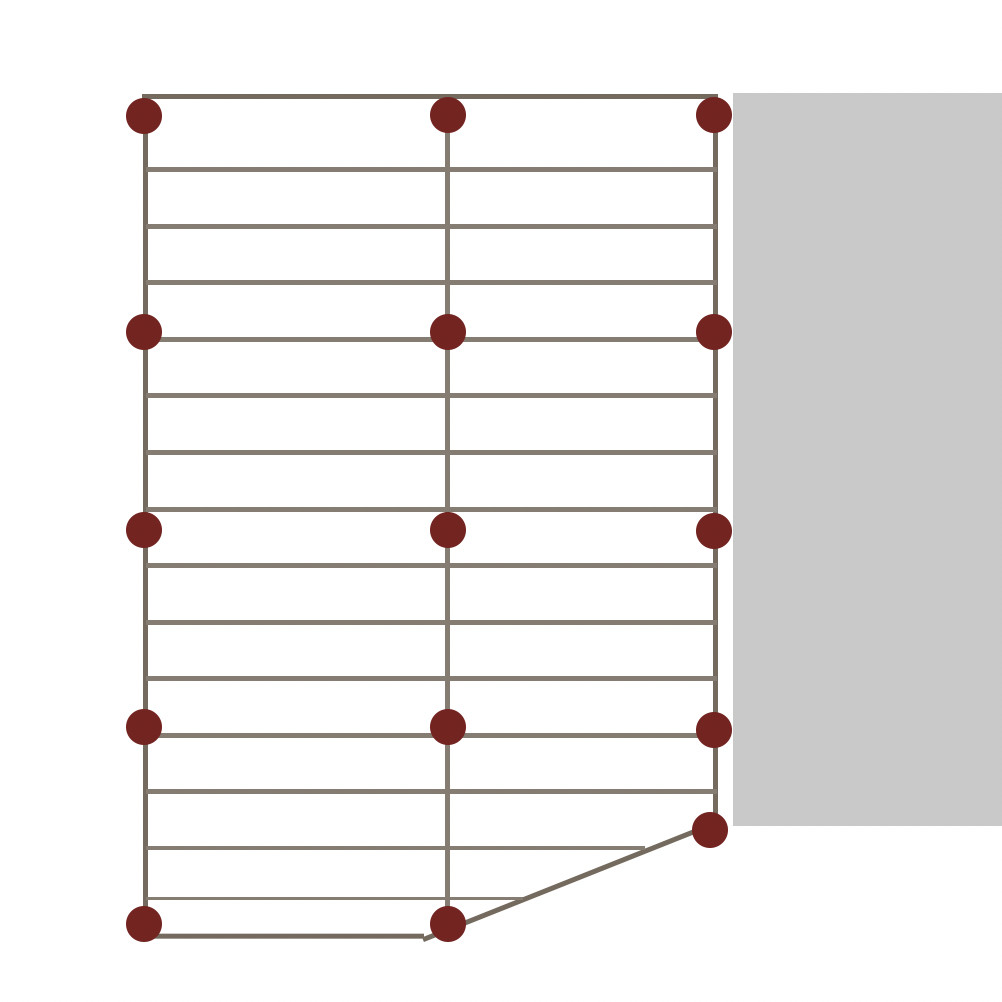
Optimally it would probably be something like this, I guess. Plenty of posts but then you have a whole beam in the middle as well and then screws on each side of it. That must be the best, right?
Ok, I would prefer not to have a sagging deck in the middle. So, it seems I might have to dig up the existing plinths and do it right from the start. I had hoped to save myself the work of digging 8-10 plinths/holes that way
I'm trying to imagine how it would be to do as you say with a beam over the existing ones (black in the picture) but I can't really piece it together. The middle of the deck will be where the plinth you see furthest to the right in my first picture is, and it points outward so I can't really place a longitudinal beam in it. Or am I thinking completely wrong?
Ideally, it would be something like this I guess. Plenty of plinths but then you have a whole beam in the middle too and then screws on each side of it. Must be just the best?
[image]
The beam, as I see it, doesn't have to be straight and doesn't have to be the same all the way, it's only there so you don't take up the entire span on just 2 points. If it becomes 1.5m plus 2.0m, that's perfectly fine, if the existing plinths are the correct height, of course. Then I would use the 3 left black ones according to your first drawing for the beam, then angle out from the 2 outermost to the edges with the beam.
Then preferably build a little beyond the plinths, about 20-30 cm, so you avoid seeing them and they don't get in the way for any possible skirt around. The small overhang won't sway.
Ok, yes, a sagging deck in the middle is something I'd rather avoid. It seems I might have to dig up the existing piers and do it right from the beginning then. I had hoped to save myself the effort of digging 8-10 piers/holes that way
Trying to imagine how it would be to follow your advice with a beam over the existing ones (black in the picture) but can't quite figure it out. The middle of the deck is basically where the pier you see furthest to the right in my first picture is, and it points outward, so I can't really place a longitudinal beam there. Or am I completely off track?
Optimally, it would be something like this, I suppose. Plenty of piers, but then you have a whole beam in the middle and then joists on either side of it. That must be the best?
[image]
Yes, exactly like that. That's how I would do it.
And move the two outermost piers like that.
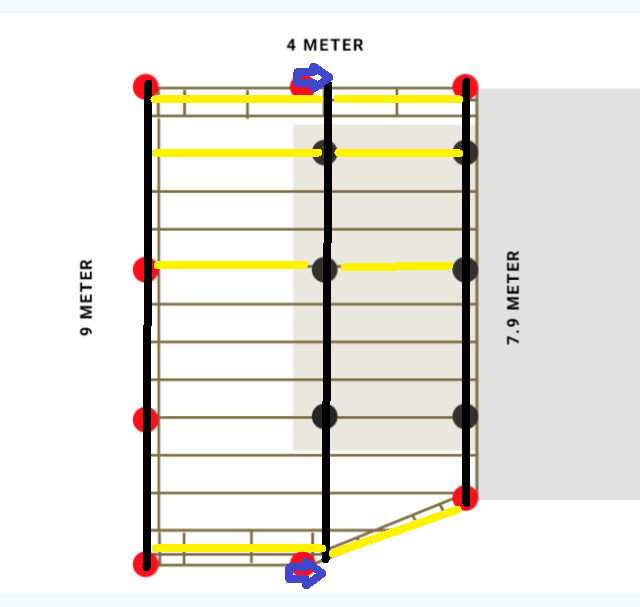
So black are beams. The yellow are joists that you attach to the beams with the help of joist hangers.
It might cost a few extra euros, but everything will be built more correctly, and if you sell sometime in the future, the buyer will definitely give you a thumbs up!
Yes, exactly like that. That's how I would have done it.
And moved the two outermost plinths like that.
So black are the support beams. The yellow are joists that you attach to the support beams using joist hangers.
[image]
[image]
Might cost a few extra bucks, but everything will be more correctly built and if you ever decide to sell in the future, the buyer will give you more thumbs up!
Thanks for the good tips
After thinking it over again, I've realized that I can instead attach the first support beam directly to the house foundation. It should be very stable, and I can avoid dealing with a row of plinths closest to the house. If I attach a 45x170 directly to the concrete wall with strong expansion bolts, it should be just as good as placing it on plinths, right?


Peter1986 said:
Anna_H said:
How have you thought about the groundwork? If you lay a separate floor for the patio with insulation, you will be able to use it much longer in the fall and also heat it with a simple heater to start using it earlier in the spring. Dad has single glazing and an insulated floor, uses it from March to October. The neighbor has double glazing and an uninsulated floor; their time is from May to September because it gets so cold underneath.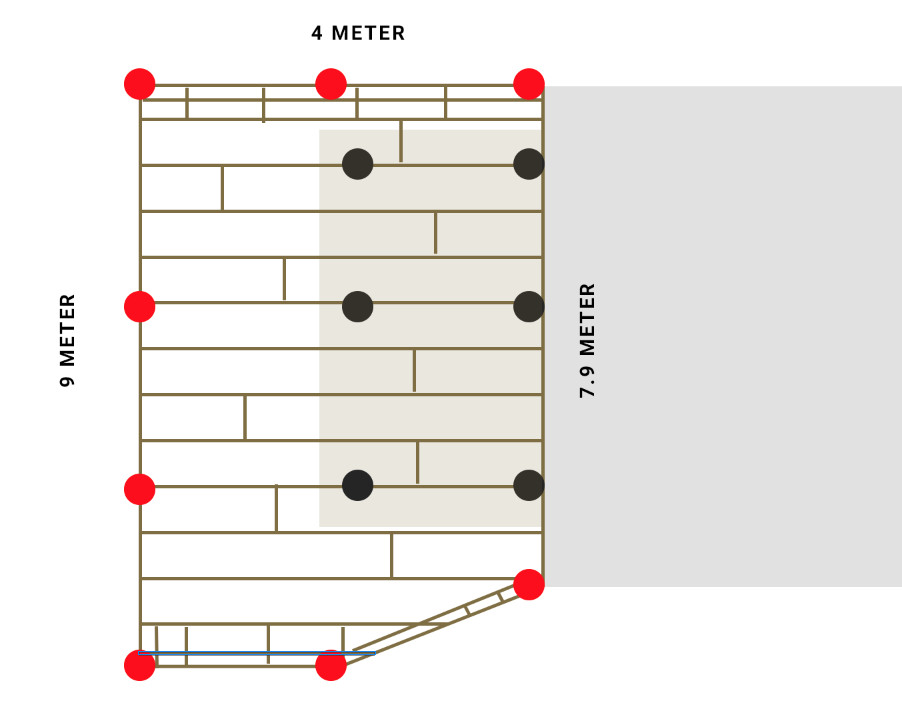

berisen said:
Ok, I would prefer not to have a sagging deck in the middle. So, it seems I might have to dig up the existing plinths and do it right from the start. I had hoped to save myself the work of digging 8-10 plinths/holes that way