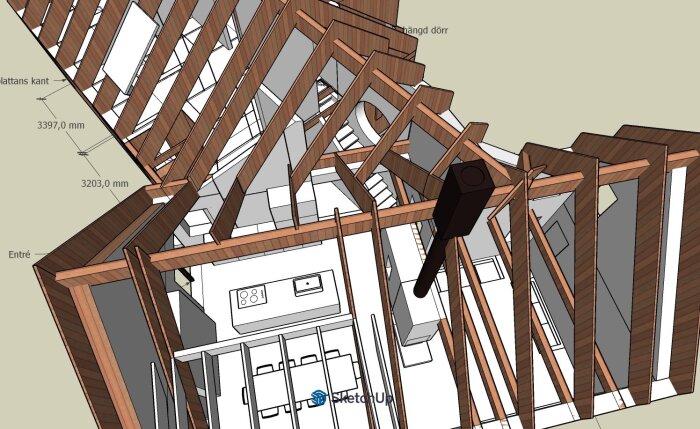
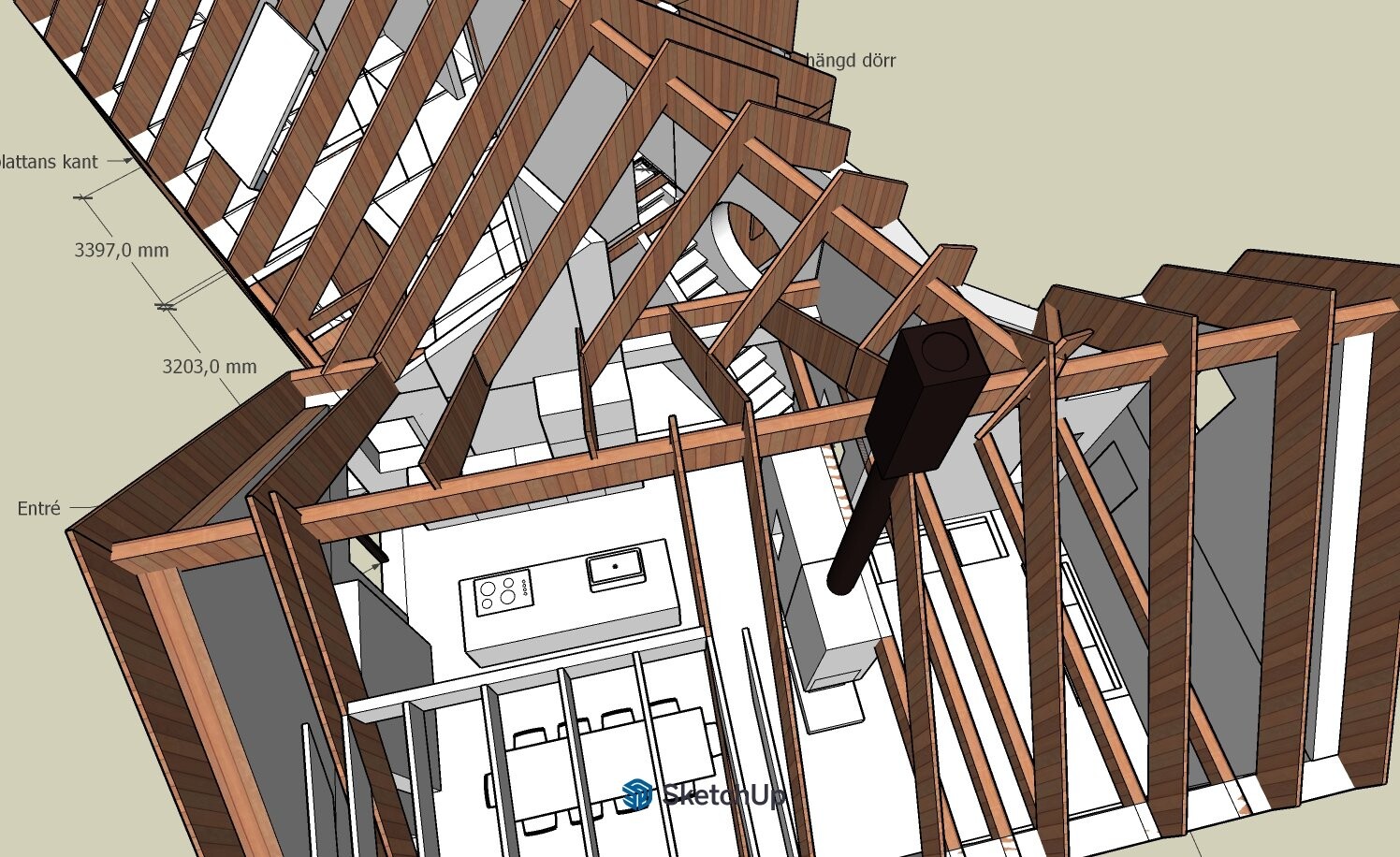
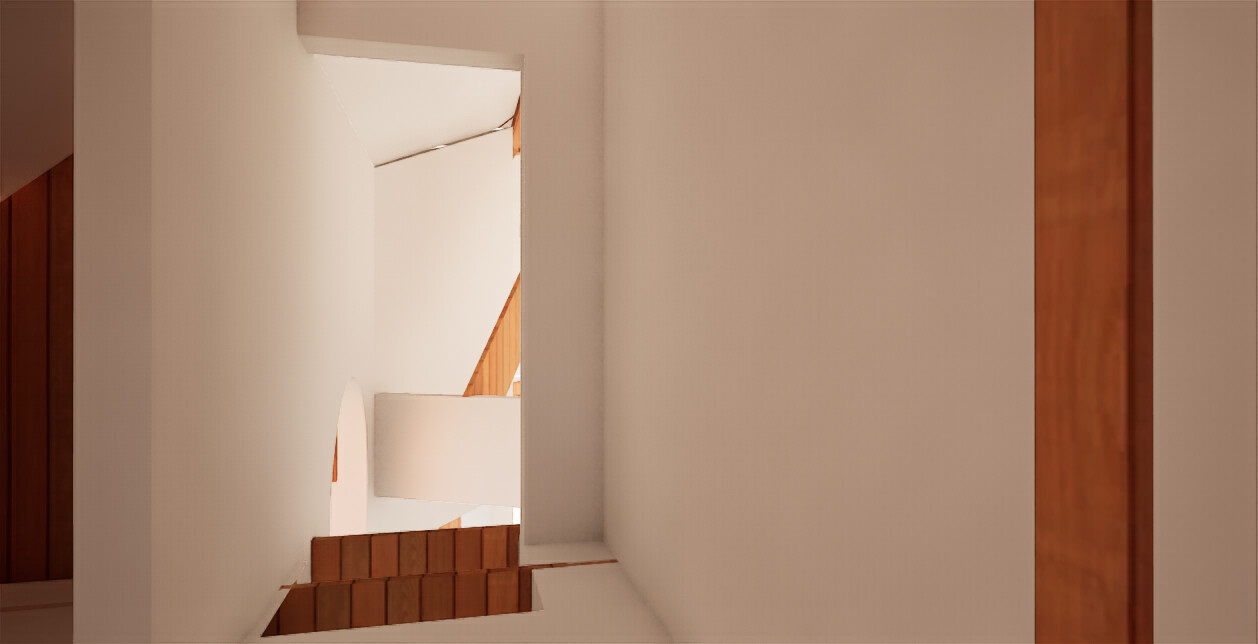
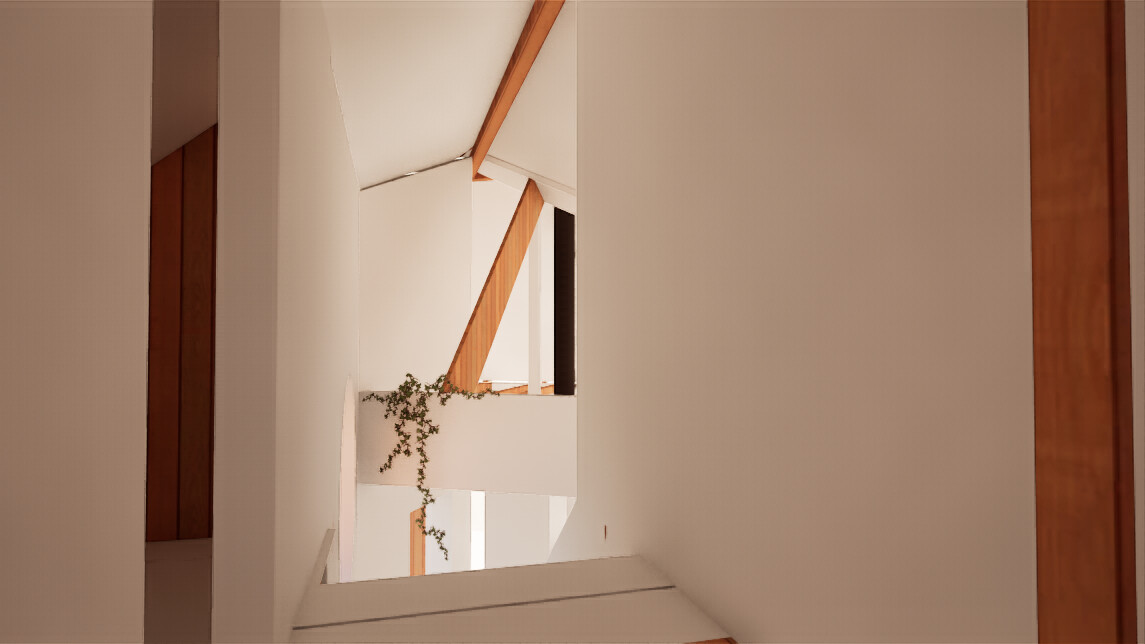
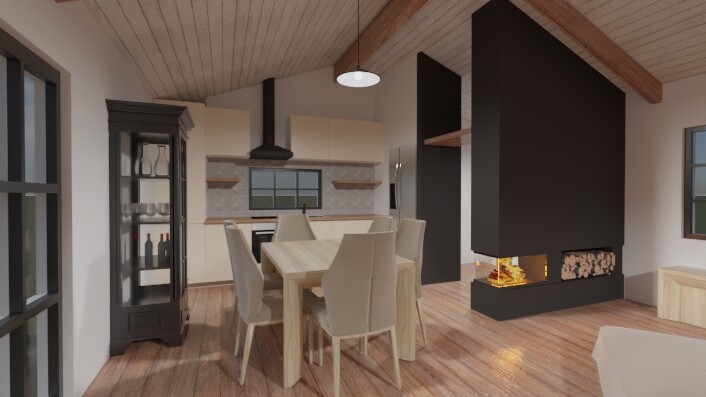
I am sketching a house where two barn structures meet at a 30-degree angle. Both bodies are open to the ridge, but only one has an upper floor/attic while the other is open between the levels. 7m ridge height.
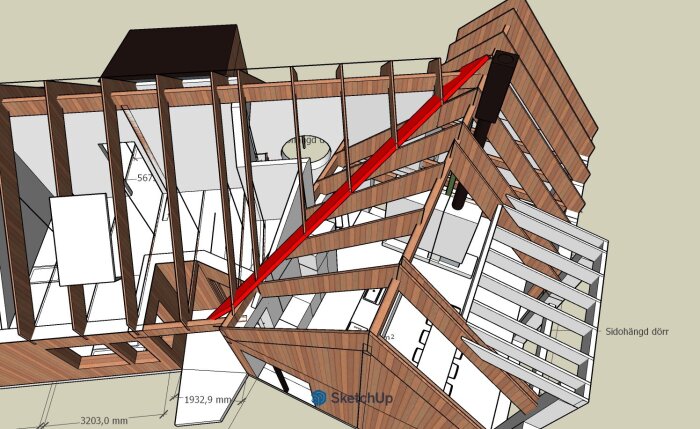
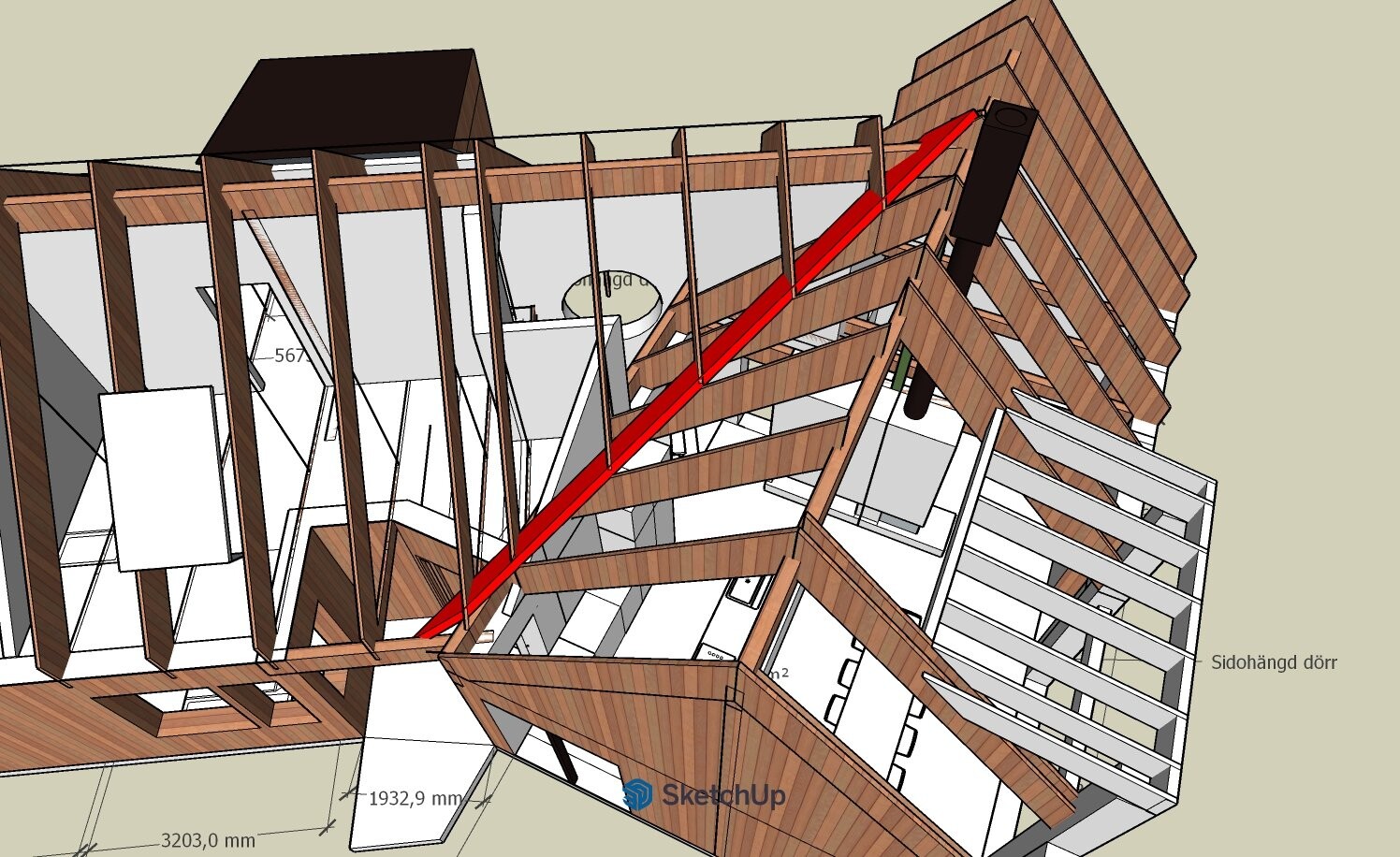
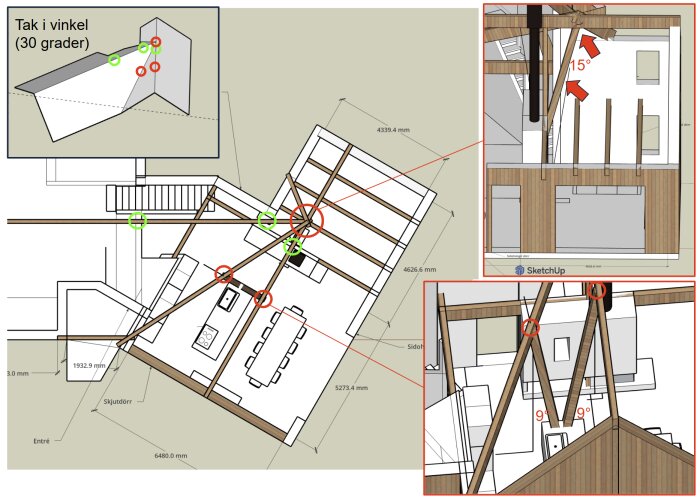
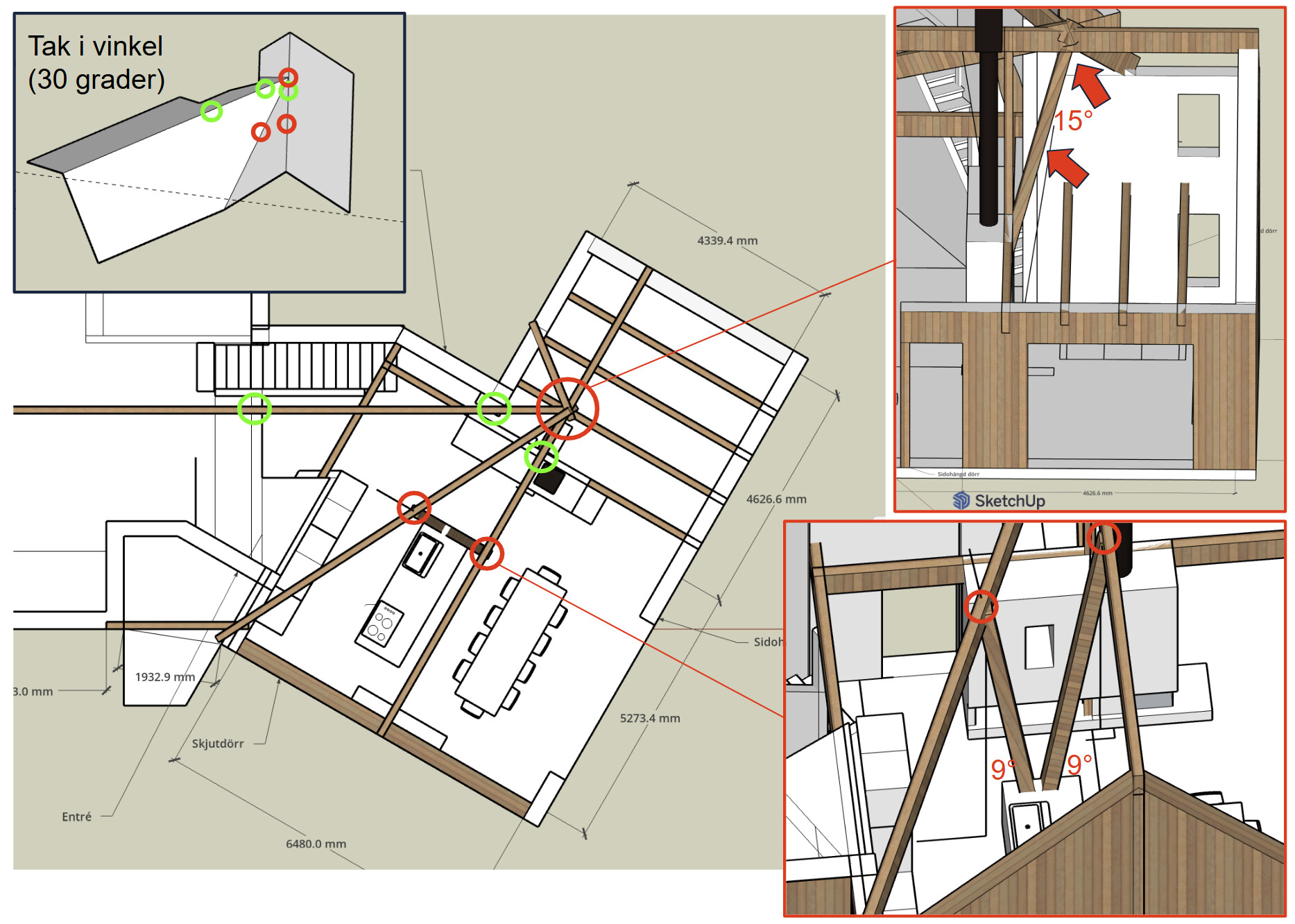
Given the angle between the house bodies, a different connection is formed where the roofs meet, and due to the floor plan (partly based on zoning plan constraints), the "junction" for the ridge beams ends up in a place where I don't want a vertical pillar.
So a question to all knowledgeable: is it unrealistic to think that the roof can be supported with the drawn pillars without them buckling? What challenges do you see? How would you have done it? [of course a structural engineer will look at this later]
A column carries vertical loads when it's vertical! The type of support you're planning to use is called a "lying column." Under load, it will move in the direction of the slope, so it must have a component to counterbalance this force. I don't understand why you'd want to complicate the structure with such solutions. Remember that rafters also transfer loads to the walls.
Thank you for the input, I would like to make it less complicated, without having to build a regular barn house without angles. My question is based on my belief that some kind of support is needed, and I have been thinking about how to do it without making it look ugly.
Should I interpret your answer as you don't believe the supports are needed, or did you have a suggestion on another way to relieve the load?
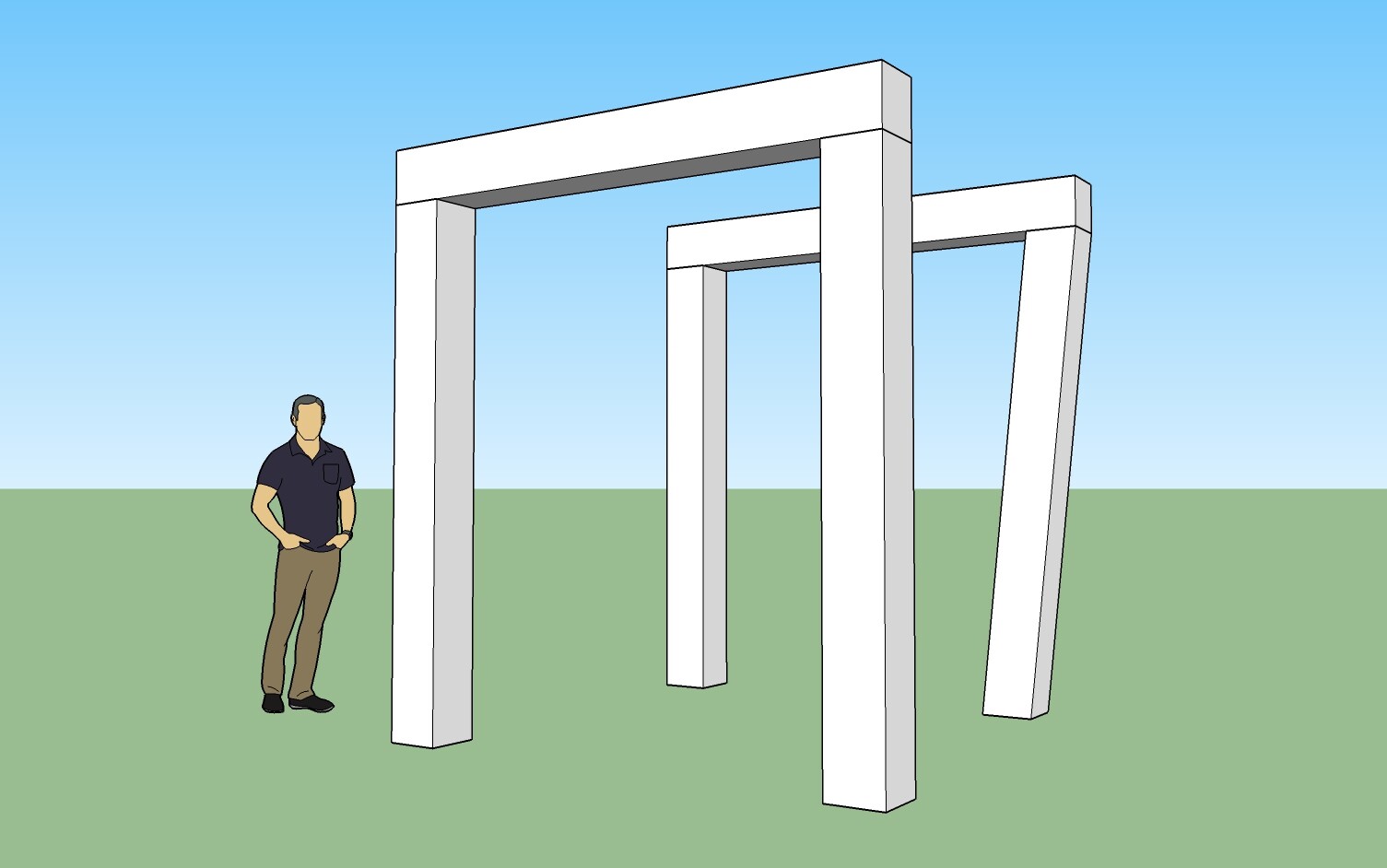
Leaning columns tend to buckle. An unsupported column must stand vertically.
Can't you break off the ridge before the houses meet so you get a column in one of the walls?
Exciting construction, slightly challenging with inclined pillars, attachment shear and buckling. With a vertical pillar, one must consider the bearing surface and buckling strength. Let an engineer take a look at this before you proceed.
Should I interpret your response as you don't think the supports are needed, or did you have another suggestion to relieve it?
So treat it as a negative. This solution is asking for disaster. Which of the following structures do you think is stable?
I remember your other post about this structure, where the roofs had a different layout. I see you accepted my suggestion. And I assume the lack of rafters above the dining table suggests you're sticking with the idea of a large dormer in this spot?
Well, forget about it, unless you've won the lottery. Besides, why do you need a dormer in an open-plan space? If you want more light, install skylights, but I don't recommend it. It's better to use the gable wall for this
PPosselosse said:
Can I place the columns just over 1m from the node or do they need to be directly underneath due to load/moment reasons?
Yes, you can. This is the best solution in this case. A column next to the chimney (green circle) that extends from level 0. Resting on the foundation, not on an interior wall.
Another issue is the support for the long valley rafter. A lot of snow can accumulate there, so significant forces will be exerted. I'm not sure what you're planning in this area? Are both attics open to open-plan spaces? If you use SU online, you can share the file, which will make it easier to understand, if you use a stationary one, you can publish it e.g. on Google Drive. If you don't want to send the link access to all, send it to me in PM.
\\edit
Looking at the longer term, it seems that after reducing the width of the open part to 8.5 m, the original concept will be easier, cheaper and will provide a view to the south side.
Of course, I understand that a leaning pillar is less stable, hence why I created the thread. I had hoped you would say it was "easy" to stabilize I'll go with vertical posts.
But I agree on the "long valley rafter" for the roof connection. I would prefer not to have a post in the middle of the kitchen (hence the question if I can have a leaning post), but perhaps that's not possible unless the beam is made of steel!?
As for the dormer... It's obviously completely unnecessary, but fun and adds something different. Thank you for bringing me back to reality! My goal is to add angles/other elements that make it not feel like a mass-produced barn. But if it adds too much complexity, it should of course be left out. Besides the cost of large windows, the construction of the dormer itself shouldn't be too expensive, right!? As long as the ridge beam can handle the extra weight, the construction itself isn't particularly difficult if you can plan it from the start, I think. The plan is to bring someone in to build the frame, but to do the rest myself.
Hi. I see you've overcomplicated things unnecessarily. That long, valley rafter isn't really necessary. The only thing I can recommend regarding SU is finding the SketchUp Make 2017 version online. This is the latest free version, available for online use but requires offline installation. It also allows you to install plugins that enhance the program and contribute to its popularity. You can still find it by googling it. Check PM
You have a lot of accuracy errors in your model. Meybe will put you on the right track.
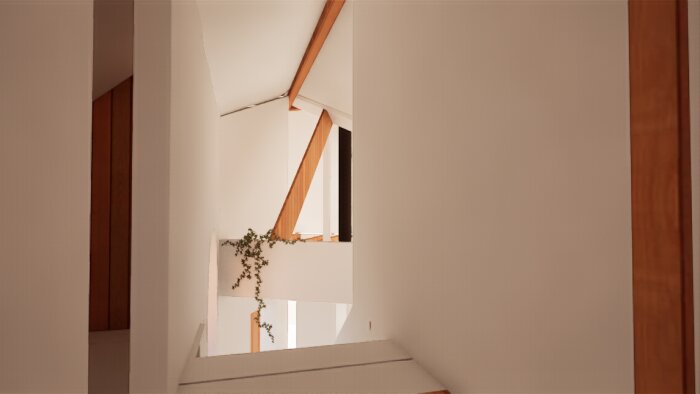
I think the upstairs hallway needs more light for an open-plan space. Maybe I'll add more later; I have to go to the store or they'll close. ;-) And that chimney in the middle of the rafters!!!
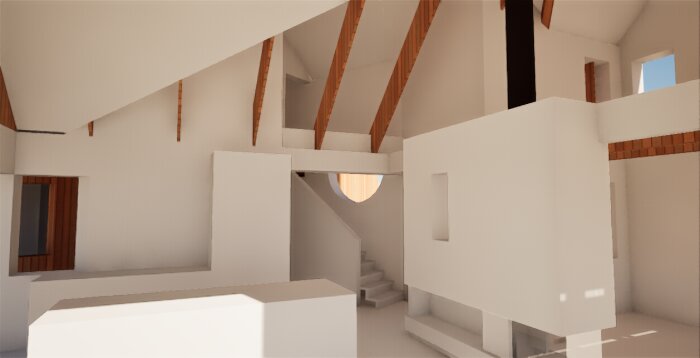
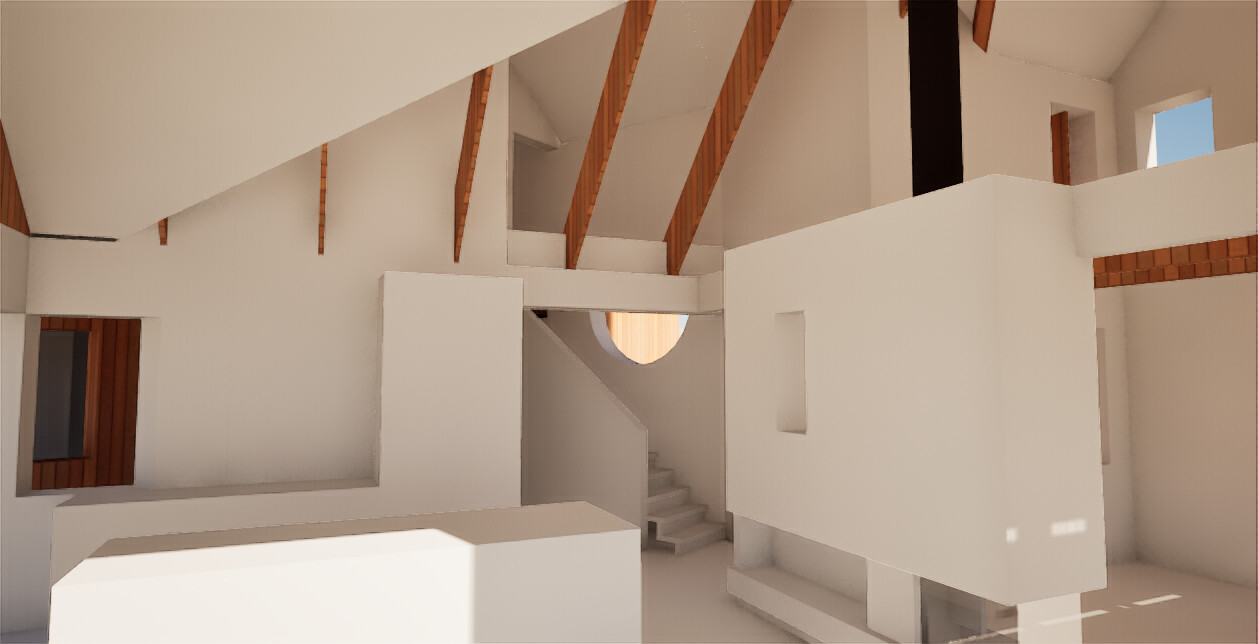
Oh, big thanks! I was considering trying to lower the rafters like you've done to relieve, but in my head, it would look strange. But the rendering actually turned out nice! It should stabilize quite a bit too and not just function as a beam replacement.
Is it possible to get that type of renderings in the free version or only in Pro?
Yes, the model needs to be made to get rid of all errors and overlaps. Seems like all the edits and revisions I've made have messed up some parts. It's on my to-do list, but I wanted to settle on a design that felt okay before jumping into the details.
Regarding the upper floor, I'm thinking of double skylights in the living area + one in the middle room. Should be enough, right?
Is it possible to get that type of rendering in the free version or only Pro?
No. The pro version also doesn't render. Only SU Studio has V-ray. I use V-ray and SU, but the older versions are permanent. In addition, I use other programs. As I wrote earlier, look for the Make 2017 version. It allows you to use plugins that make your work easier and faster, including for rendering and adding and setting materials.
You should consider a higher rafter density. C-C 60 allows you to use C24 45x245 rafters, saving money on glued laminated timber.
Good thought. My hope is to be able to use 220+145 c24 though, which also allows for good insulation. We'll see if it works for cc120 or not.
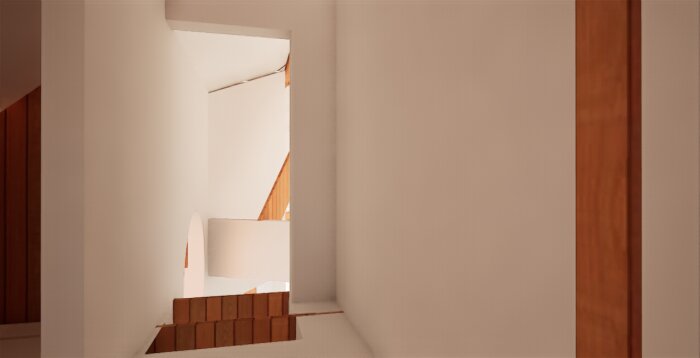
I realized, by the way, that your widened opening above the stairs makes it so you can see when someone goes in/out from the bathroom if you're sitting at the kitchen table. I don't like that, so unfortunately, the opening needed to be narrower again.


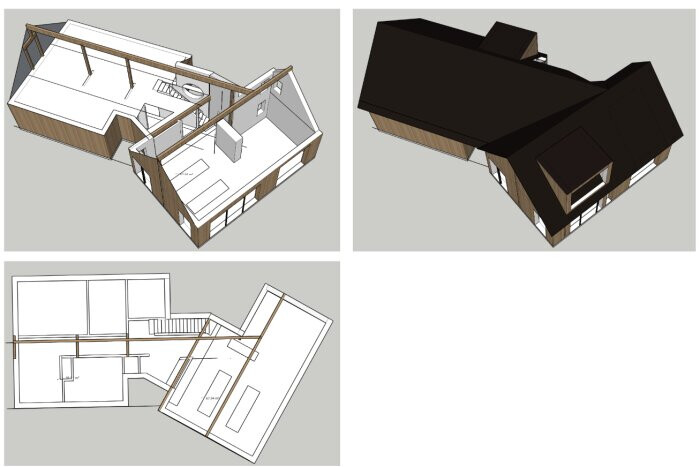
 I'll go with vertical posts.