He thinks I'm asking too many questions and refers to deflection and sway control, as well as their program that calculated this. Could he be right that I actually should have double studs?
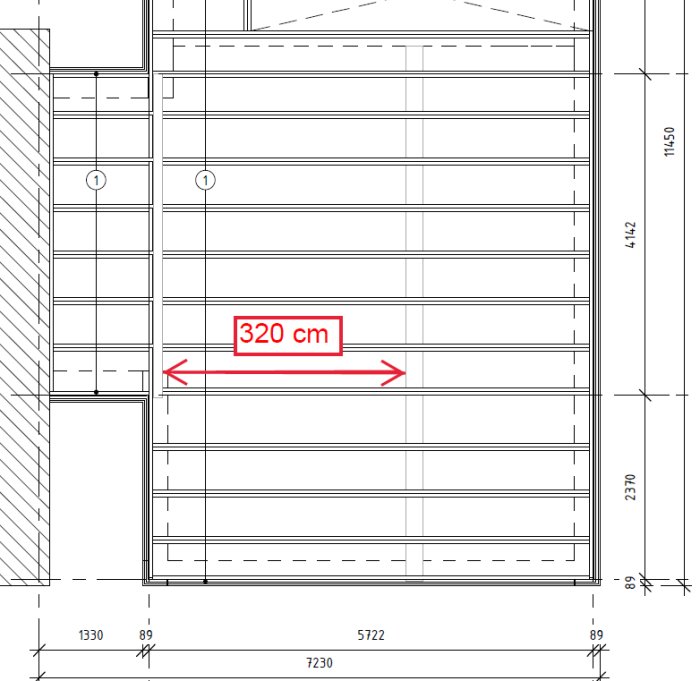
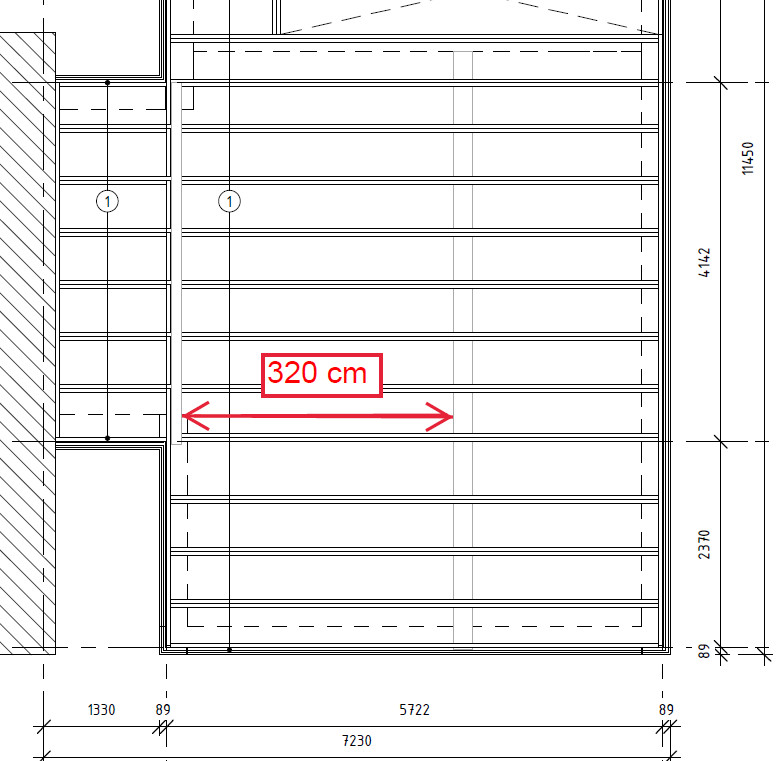
See the construction image. The total span is 5.8 meters but with a steel beam HEB-220, the longest divided span becomes a free length of 3.2 m. Is it the long steel beam that would require double studs since it's not a solid wall underneath?
It still costs an extra 20,000kr to have double. I myself had a plan to just go 45x220 C24 cc 600 with screw-laminated chipboard, while the constructor says 2x45x220.
I have a span of 8.4 meters, intermediate beams 45X315 and the bottom chord of the trusses 45X315 with center-to-center spacing of 1200 on the trusses, which are self-supporting without support underneath.
It sounds really strange that a single 45X220 cc 60 wouldn't be enough with such a short span of 3.2 meters,
There are only three bedrooms upstairs. The W-trusses are self-supporting so no weight from there either.
Even the exterior walls have double load-bearing beams under the wall plate everywhere. Not just at windows (1.2 m wide). I also think this is a bit over-dimensioned, but I was planning to ask about this in a separate thread so we can sort out the floor joists to start with.
I pointed this out again before the constructor completed all the actions, and he counted once more and said that 1st should still be enough and removed the doubles from the documents.
He argued that there would be less deflection with 2st, which I can of course understand. Even less with 2st cc 30 and so on, but what is reasonable...?
What is meant by the term "nyttograd" in this program in the link? For example, at 3.2 meters, it becomes 48% (4mm) and it is marked yellow. Not green... but at the same time, it is only the one at 88% that is rejected (12mm).
In the ultimate limit state (the construction is about to break), moments, shear force, and support pressure are checked. In the serviceability limit state (the construction is about to not meet functional requirements under normal use), deflection and vibration are checked. The serviceability limit state is likely the determining factor. For each check, one can calculate a utilization rate which is 1 (100%) when fully utilized. If it's over 1, it's not okay. If it's under 1, it's okay. Some designers are bold and stay close to 1. Others prefer some margin. You don't need to set higher requirements than the standard, but then it's somewhat individual how much margin one wants. The colors in the program are probably just to inform the reader about how serious it is. Calculation examples are available at traguiden.se.
Okay thanks, but I'm not sure if I fully understand it. The one that fails exceeds the deflection L/300, but at the same time it only shows 88% utilization, not over 100%. Should one then interpret it as the percentage being the breaking limit instead? And even if the color is in the same box, it's more related to the deflection.
Click here to reply
Vi vill skicka notiser för ämnen du bevakar och händelser som berör dig.