
2,631 views ·
11 replies
3k views
11 replies
Do I have insulation in the slab? (Image)
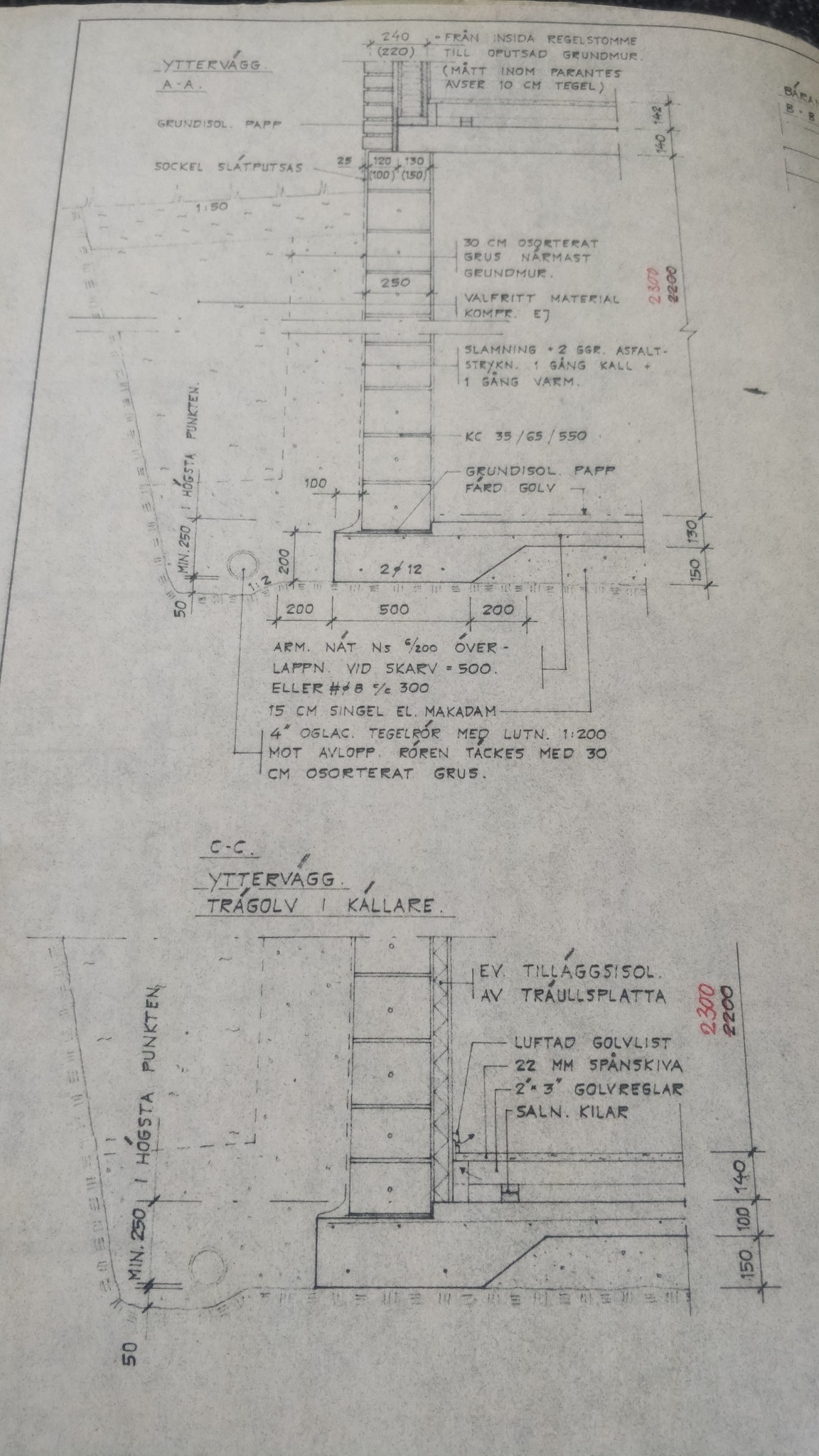
I found a cross-section of how they built my slab in the basement in 1970. As I see it, there is 70 mm insulation, which does not meet today's building codes, but if it is correct, then the slab is not completely uninsulated at least.
How do you interpret the image, is there insulation in the slab? Does it serve any function? I'm thinking about underfloor heating.
How do you interpret the image, is there insulation in the slab? Does it serve any function? I'm thinking about underfloor heating.

I interpret it as the slab being uninsulated, you have 70mm insulation above the slab. A construction which can be a risk construction today, as it can retain moisture that gets to the sole plate despite the plastic foil that lies there.

Sintered slab is probably an older term for tile, so the second concrete layer is a leveling compound to be able to lay tiles in the basement without the floors being so cold (insulation). In some cases with an older model of floor heating with steel pipes or prisol pipes embedded in the leveling.
Essentially the same technique used today with self-leveling compound to stabilize before tiles on non-rigid underlays like wooden intermediate floors.
Essentially the same technique used today with self-leveling compound to stabilize before tiles on non-rigid underlays like wooden intermediate floors.
It immediately became very complicated.C corre said:
Why is the house resting on timber? I mean, it's a stone house, I don't understand the purpose of having wood at the very bottom.
Last edited:
Now it's not a wall drawing. But what I see of the walls does not show a stone house. Then, of course, you can have plaster or stone facade even on wooden houses.
It is a stone house, with a brick-leaded basement. I wonder why they have put the drawing in the house binder if it does not belong to the house.D Daniel 109 said:
What is your question?
The latest picture shows a quite ordinary basement with raised flooring on a concrete slab. This is also a risk construction that needs to be assessed in its entirety with drainage and wall materials.
edit:
I read the original post again.
Are you considering installing underfloor heating on top of the existing floor?
If so, that’s not something I would recommend.
You might want to check out Granab/Nivell or Platon with 20mm XPS and hydronic tubing heating.
The latest picture shows a quite ordinary basement with raised flooring on a concrete slab. This is also a risk construction that needs to be assessed in its entirety with drainage and wall materials.
edit:
I read the original post again.
Are you considering installing underfloor heating on top of the existing floor?
If so, that’s not something I would recommend.
You might want to check out Granab/Nivell or Platon with 20mm XPS and hydronic tubing heating.
Yes exactly, I am in the process of planning a mechanically ventilated Platon system and considering floor heating. I won't be able to fit the recommended insulation, but I can fit 50mm XPS. However, the recommendation is around 30 cm.C corre said:What is your question?
The latest image shows a quite ordinary basement with a raised floor on a concrete slab. This is also a risk construction that needs to be assessed in its entirety with drainage and wall materials.
edit:
I read the TS first post again.
Is your thought to lay floor heating on top of the existing floor?
If so, it's not something I would recommend.
You can take a look at Granab/Nivell or Platon with 20mm XPS and waterborne hose heating
Best answer
300mm is the recommendation for a new slab when insulating under the concrete slab to meet today's quite tough energy requirements and moisture safety that modern constructions without floor ventilation require.
You can lay parquet on such a slab without Platon or similar.
In your case, it is ROT, so you take what you can.
40 or 50mm XPS is plenty of insulation in that case, so I wouldn't see any problem there.
You can lay parquet on such a slab without Platon or similar.
In your case, it is ROT, so you take what you can.
40 or 50mm XPS is plenty of insulation in that case, so I wouldn't see any problem there.
Click here to reply