
7,674 views ·
7 replies
8k views
7 replies
Dimension of floor joists for loft with extremely small margin
Hello
Planning to lower an existing loft. The issue is that we want a ceiling height of 1.9m on the loft and a ceiling height of 1.9m in the wardrobe below. Since the total ceiling height is 3.9m, there's essentially only 10cm left to build the actual frame. The dimensions of the lowered section will be 2.25x2.87. Can you have intermediate floor joists of 45x70 with 30c/c and screw-laminated chipboard above and below? Will it be shaky? Does anyone know if this might work?
Can steel studs be used instead to reduce the thickness, and if so, where can they be found?
Planning to lower an existing loft. The issue is that we want a ceiling height of 1.9m on the loft and a ceiling height of 1.9m in the wardrobe below. Since the total ceiling height is 3.9m, there's essentially only 10cm left to build the actual frame. The dimensions of the lowered section will be 2.25x2.87. Can you have intermediate floor joists of 45x70 with 30c/c and screw-laminated chipboard above and below? Will it be shaky? Does anyone know if this might work?
Can steel studs be used instead to reduce the thickness, and if so, where can they be found?

Without knowing, the construction will become stable. Place the studs along the shortest span. I assume the loft is intended to function as a bed and for about 2 people.
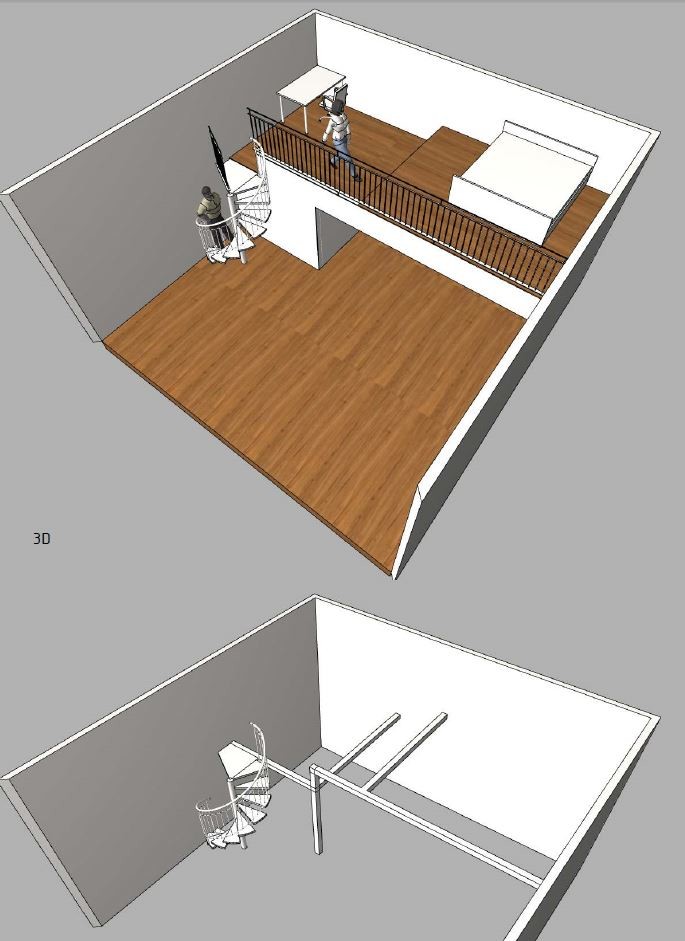
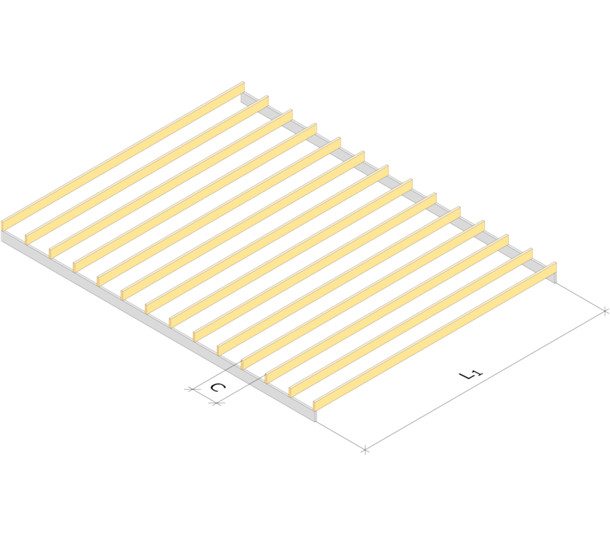
The lowered part will only sink down into the closet underneath. We want to maintain a ceiling height of at least 1.9m so that the square meter area of the apartment does not decrease when it is sold in the future.
The problem is that we only have 10cm to build the frame itself, including the floor. When I used a calculation site, it suggested using a 45x120 beam with 30cc. There should be a way to get around this.
I am thinking of using a 45x70 beam with 30cc and on top of that a 15mm chipboard.
But I don't want the ceiling to give way into the closet if someone happens to jump once.
Do you think it will be stable?
I added two images that roughly show my idea and an image of the loft with the lowering.
The actual loft image is from an earlier plan we had, so the suspension is no longer correct, it's just meant to give an idea of what the loft looks like.
Last edited:

Hard to say if it will be stable, but one alternative could be to build with steel beams, like I-beams or square beams. Maybe it's possible to replace some of the wooden beams with steel?
I think it's called "handelsstål" when you want to buy steel to build with.
I think it's called "handelsstål" when you want to buy steel to build with.
Hello and thanks for the response.
I read around a bit and found someone who had a similar issue, not exactly the same. They solved it by laying the 45x70 studs edge to edge over the entire surface, like a floor, and glued and screwed them all together like a giant glued laminated beam.
Maybe not the most aesthetically pleasing solution, but would such a construction work? The surface isn't that large, so it won't be particularly expensive. It's mostly the work that takes time.
I read around a bit and found someone who had a similar issue, not exactly the same. They solved it by laying the 45x70 studs edge to edge over the entire surface, like a floor, and glued and screwed them all together like a giant glued laminated beam.
Maybe not the most aesthetically pleasing solution, but would such a construction work? The surface isn't that large, so it won't be particularly expensive. It's mostly the work that takes time.
Run with cc 300 70 mm studs. Steel will not be needed. If it should sway. Offset in the closet. Is the staircase existing?
All force is transferred down to the pillar in the middle. Is it a beam structure? If yes, then I would be worried about that point, not the loft.
All force is transferred down to the pillar in the middle. Is it a beam structure? If yes, then I would be worried about that point, not the loft.
Last edited:
Hello and thanks again for the response, appreciated.
The picture of the entire loft is no longer current, mostly just to give you an idea of how it looks with us.
There shall be a joist across in the wardrobe with supports from the floor (all the walls you see in the picture are load-bearing). However, only the old part of the loft will be supported against it. Then we cut the part that will be lowered and build a new joist that supports the new lowered part, and on the other side, there is a load-bearing wall. Do you understand?
What is good to consider when it comes to the supporting joist that holds up the old part of the loft, the one that will not be lowered?
It will be perfect if it's possible to use a 70mm stud, then we'll have exactly 1.9m in ceiling height both in the loft and in the wardrobe.
The picture of the entire loft is no longer current, mostly just to give you an idea of how it looks with us.
There shall be a joist across in the wardrobe with supports from the floor (all the walls you see in the picture are load-bearing). However, only the old part of the loft will be supported against it. Then we cut the part that will be lowered and build a new joist that supports the new lowered part, and on the other side, there is a load-bearing wall. Do you understand?
What is good to consider when it comes to the supporting joist that holds up the old part of the loft, the one that will not be lowered?
It will be perfect if it's possible to use a 70mm stud, then we'll have exactly 1.9m in ceiling height both in the loft and in the wardrobe.
I think you should go down to c-c 150. I don't know if it will sway with c-c 300 but it doesn't fulfill Boverket's structural requirements. You could put a steel beam in the middle otherwise, but it feels like complicating things a bit for yourself then.
Click here to reply
Similar threads
-
Reinforcing undersized intermediate floor
Building Materials and Construction Technology -
Dimensionering av mellanbjälklaget, vad krävs för en spännvidd på 4,5 meter
Lösvirke & Timmerhus -
Sizing of the intermediate joist, what is required for a span of 4.5 meters
Building Materials and Construction Technology