
18,144 views ·
42 replies
18k views
42 replies
Dig a mini cellar 3x3x3m in/under existing house. (Slab on grade) ?
Hello, I hope I posted the forum thread in the right place.
I'm looking for thoughts and ideas on how to make this possible, namely creating a small mini-cellar of 3x3x3m in my existing house with a slab on grade.
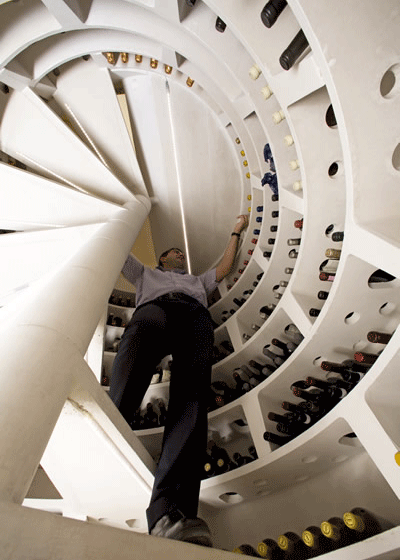
The reason for this is that I would like to have a beverage cellar, for example like these:
http://dornob.com/wonderful-wine-cellars-for-any-room-in-your-house/?ref=search
http://countrylife.media.ipcdigital.co.uk/3/000049566/4539/spiral-wine-cellar.gif
http://www.hometone.com/entry/open-floor-area-great-possibility-wine-cellar-kitchen-floor/
As shown in the pictures in the links above, I would like to have a hatch in the floor with a spiral staircase and beverages along the walls.
Now to the problem, my house doesn't have an existing cellar, just simply a slab on grade.
I can dig myself, I realize it will take a while as 64m3 needs to be dug up and removed.
The reason for considering this significant intervention is that I am going to redo the floors, so I will more or less have the concrete slab exposed.
I am a novice, so please excuse if it's a stupid idea, but as long as support is maintained during the process, walls and floors can be cast to achieve the necessary strength to prevent implosion at a later stage.
The hole I want to dig is more or less in the middle of the house, where there used to be a load-bearing wall, but it has been replaced with a ceiling beam and pillars far from my potential hole.
1. Dig a hole of 4 x 4 x 4m.
2. Lay stones at the bottom 0.5m.
3. Fill in gaps with smaller stones.
4. Insulation/ground board 0.3m.
5. Cast a slab with reinforcement 0.2m, size 3.3m x 3.3m.
6. Line the ground walls with e.g., isodrain and possibly a membrane.
7. Build walls with 0.3m Leca with inner dimensions 3 x 3m.
8. Brace the Leca walls with beams crisscross.
9. Fill the space between Leca and isodrain with concrete and reinforcement.
10. Cover floor and walls.
11. Done?
I KNOW I don't have everything correct in execution, but what I wonder with this thread is if it’s at all possible in a way that allows it to be done by oneself and without costing a fortune.
Questions:
1. How do I best support (the house?) so I can dig my 4 x 4m hole?
2. What do I do if I encounter rock/large stone, blast? Break? Drill?
3. Risks/odds?
4. Is it just to scrap the idea if I encounter water, a lot of water?
5. Thoughts and ideas?
And thank you in advance!
I'm looking for thoughts and ideas on how to make this possible, namely creating a small mini-cellar of 3x3x3m in my existing house with a slab on grade.
The reason for this is that I would like to have a beverage cellar, for example like these:
http://dornob.com/wonderful-wine-cellars-for-any-room-in-your-house/?ref=search
http://countrylife.media.ipcdigital.co.uk/3/000049566/4539/spiral-wine-cellar.gif
http://www.hometone.com/entry/open-floor-area-great-possibility-wine-cellar-kitchen-floor/
As shown in the pictures in the links above, I would like to have a hatch in the floor with a spiral staircase and beverages along the walls.
Now to the problem, my house doesn't have an existing cellar, just simply a slab on grade.
I can dig myself, I realize it will take a while as 64m3 needs to be dug up and removed.
The reason for considering this significant intervention is that I am going to redo the floors, so I will more or less have the concrete slab exposed.
I am a novice, so please excuse if it's a stupid idea, but as long as support is maintained during the process, walls and floors can be cast to achieve the necessary strength to prevent implosion at a later stage.
The hole I want to dig is more or less in the middle of the house, where there used to be a load-bearing wall, but it has been replaced with a ceiling beam and pillars far from my potential hole.
1. Dig a hole of 4 x 4 x 4m.
2. Lay stones at the bottom 0.5m.
3. Fill in gaps with smaller stones.
4. Insulation/ground board 0.3m.
5. Cast a slab with reinforcement 0.2m, size 3.3m x 3.3m.
6. Line the ground walls with e.g., isodrain and possibly a membrane.
7. Build walls with 0.3m Leca with inner dimensions 3 x 3m.
8. Brace the Leca walls with beams crisscross.
9. Fill the space between Leca and isodrain with concrete and reinforcement.
10. Cover floor and walls.
11. Done?
I KNOW I don't have everything correct in execution, but what I wonder with this thread is if it’s at all possible in a way that allows it to be done by oneself and without costing a fortune.
Questions:
1. How do I best support (the house?) so I can dig my 4 x 4m hole?
2. What do I do if I encounter rock/large stone, blast? Break? Drill?
3. Risks/odds?
4. Is it just to scrap the idea if I encounter water, a lot of water?
5. Thoughts and ideas?
And thank you in advance!
Last edited:

Very cool!
I don't think you need to dig by hand. There are electric diggers that can go through a regular door. Perhaps you can rent one of those plus a conveyor belt or a mini-loader so you don't have to carry the soil out in buckets.
I looked at a house with a basement where they had dug out a pool under the slab. If that's possible, then it should be possible to dig out a drink cellar, I think.
I don't think you need to dig by hand. There are electric diggers that can go through a regular door. Perhaps you can rent one of those plus a conveyor belt or a mini-loader so you don't have to carry the soil out in buckets.
I looked at a house with a basement where they had dug out a pool under the slab. If that's possible, then it should be possible to dig out a drink cellar, I think.

What are you waiting for??? 

You use large concrete rings that you lift into place.
You also need to check the groundwater level so you don't build a pool under the house.
Google 'vinkällare cementring' for some interesting results.
You also need to check the groundwater level so you don't build a pool under the house.
Google 'vinkällare cementring' for some interesting results.
Thanks for all the uplifting answers!
Concrete rings were an idea, but I would prefer to have the space square, to simplify the installation of ventilation and electricity, and concrete rings would likely be more expensive.
The approach to the construction itself can always be refined to ensure good load-bearing capacity, moisture control, and insulation.
My biggest problem is how to prevent something tragic from happening during the actual digging. I don't want to experience ground settling, or even worse, get crushed, hence I must somehow support and brace it so there is no pressure on the 4 x 4m area where I plan to dig my hole.
Then I wonder how I should proceed if I encounter rock/large stones or water, what does it cost to hire someone to blast, and can one build a basement below the groundwater level if that were to be the case.
If I can't get help here, I hope you can suggest someone to contact, a structural engineer? I will probably turn to one anyway, but I would need more insight before contacting someone who charges exorbitantly for discussing ideas.
Thank you in advance.
Concrete rings were an idea, but I would prefer to have the space square, to simplify the installation of ventilation and electricity, and concrete rings would likely be more expensive.
The approach to the construction itself can always be refined to ensure good load-bearing capacity, moisture control, and insulation.
My biggest problem is how to prevent something tragic from happening during the actual digging. I don't want to experience ground settling, or even worse, get crushed, hence I must somehow support and brace it so there is no pressure on the 4 x 4m area where I plan to dig my hole.
Then I wonder how I should proceed if I encounter rock/large stones or water, what does it cost to hire someone to blast, and can one build a basement below the groundwater level if that were to be the case.
If I can't get help here, I hope you can suggest someone to contact, a structural engineer? I will probably turn to one anyway, but I would need more insight before contacting someone who charges exorbitantly for discussing ideas.
Thank you in advance.
Not much of a response here, I have tried to find where I should turn instead but haven't found any sensible alternative.
Could some kind soul guide me to another forum or a good constructor/builder who can answer some questions, including the ones I've written above.
Could some kind soul guide me to another forum or a good constructor/builder who can answer some questions, including the ones I've written above.
Here you will find some information about assembly and prices:
http://www.spiralcellars.co.uk/what-is-a-spiral-cellar/
http://www.spiralcellars.co.uk/what-is-a-spiral-cellar/
Today, I did a bit of research.
The plan has changed a bit, feel free to share your perspective so we can fine-tune together!
The idea is to cut away a circle with a diameter of 360cm from the slab.
Place a concrete ring with a diameter of 350cm on the ground.
Excavate around and under the concrete ring to lower it.
When it's level with the concrete slab, I'll add another ring, down to a depth of 300cm.
Afterwards, I'll place larger stones at the bottom.
And polystyrene with a diameter of 320cm.
Then I'll add more concrete rings or walls with a diameter of 300cm with insulation on the outside.
Then I'll fill the remaining space between the rings with larger stones.
After that, I'll cast a slab at the bottom.
This way, I'll have a round insulated cellar with a diameter of 300cm.
Should a moisture barrier or something similar be included somewhere?
Anyone want to share their thoughts and fine-tune?
The plan has changed a bit, feel free to share your perspective so we can fine-tune together!
The idea is to cut away a circle with a diameter of 360cm from the slab.
Place a concrete ring with a diameter of 350cm on the ground.
Excavate around and under the concrete ring to lower it.
When it's level with the concrete slab, I'll add another ring, down to a depth of 300cm.
Afterwards, I'll place larger stones at the bottom.
And polystyrene with a diameter of 320cm.
Then I'll add more concrete rings or walls with a diameter of 300cm with insulation on the outside.
Then I'll fill the remaining space between the rings with larger stones.
After that, I'll cast a slab at the bottom.
This way, I'll have a round insulated cellar with a diameter of 300cm.
Should a moisture barrier or something similar be included somewhere?
Anyone want to share their thoughts and fine-tune?

Hobby carpenter
· skaraborg
· 365 posts
Shouldn't one be able to make a small hole first and drive down a driven well point to see if it works and how much water you get? If it can't be driven down, you might suspect bedrock or large stones.
Then maybe there's a neighbor or yourself who has drilled for geothermal heating or water and knows how far it was to the bedrock. Do the neighbors have basements?
Otherwise, it was a really cool idea.
Then maybe there's a neighbor or yourself who has drilled for geothermal heating or water and knows how far it was to the bedrock. Do the neighbors have basements?
Otherwise, it was a really cool idea.
How are you going to get cement rings with that diameter into the house? You need to have plenty of space and they are really heavy. Then there's the issue with the groundwater. Clearly an exciting project though.
We are 7 terraced houses in the row, none of us have a basement. However, we all have slightly different solutions under the garage floors, where I, for example, have a space with 1500mm in height and a sand-filled old oil tank.
Getting the concrete rings in will be a bit of a project but shouldn't be a problem as I am anyway going to install new glass sections facing the patio.
My biggest problem now is rock and water. Drilling one or several test holes is probably the best idea, my simple question is how I evaluate my test hole after drilling.
Test hole size? 300mm dia?
How much water is too much?
What is the name of the professional group who can do these drillings?
Then I wonder where I should turn to get the best possible price for concreting? I haven't found many companies that provide sizes over 2000mm in diameter.
Then I thought you might come up with ideas on how to most easily do the excavation.
Jackhammer, shovel, wheelbarrow, brute strength, willpower, and buckets with some kind of hoist system?
Music, homemade snus, and alcoholic beverages are a given.
Getting the concrete rings in will be a bit of a project but shouldn't be a problem as I am anyway going to install new glass sections facing the patio.
My biggest problem now is rock and water. Drilling one or several test holes is probably the best idea, my simple question is how I evaluate my test hole after drilling.
Test hole size? 300mm dia?
How much water is too much?
What is the name of the professional group who can do these drillings?
Then I wonder where I should turn to get the best possible price for concreting? I haven't found many companies that provide sizes over 2000mm in diameter.
Then I thought you might come up with ideas on how to most easily do the excavation.
Jackhammer, shovel, wheelbarrow, brute strength, willpower, and buckets with some kind of hoist system?
Music, homemade snus, and alcoholic beverages are a given.