
1,556 views ·
5 replies
2k views
5 replies
Diffusion-open extension on a vacation home
Now I've been trying to read up, but it feels like it requires a few extra years in the industry or some additional college credits.
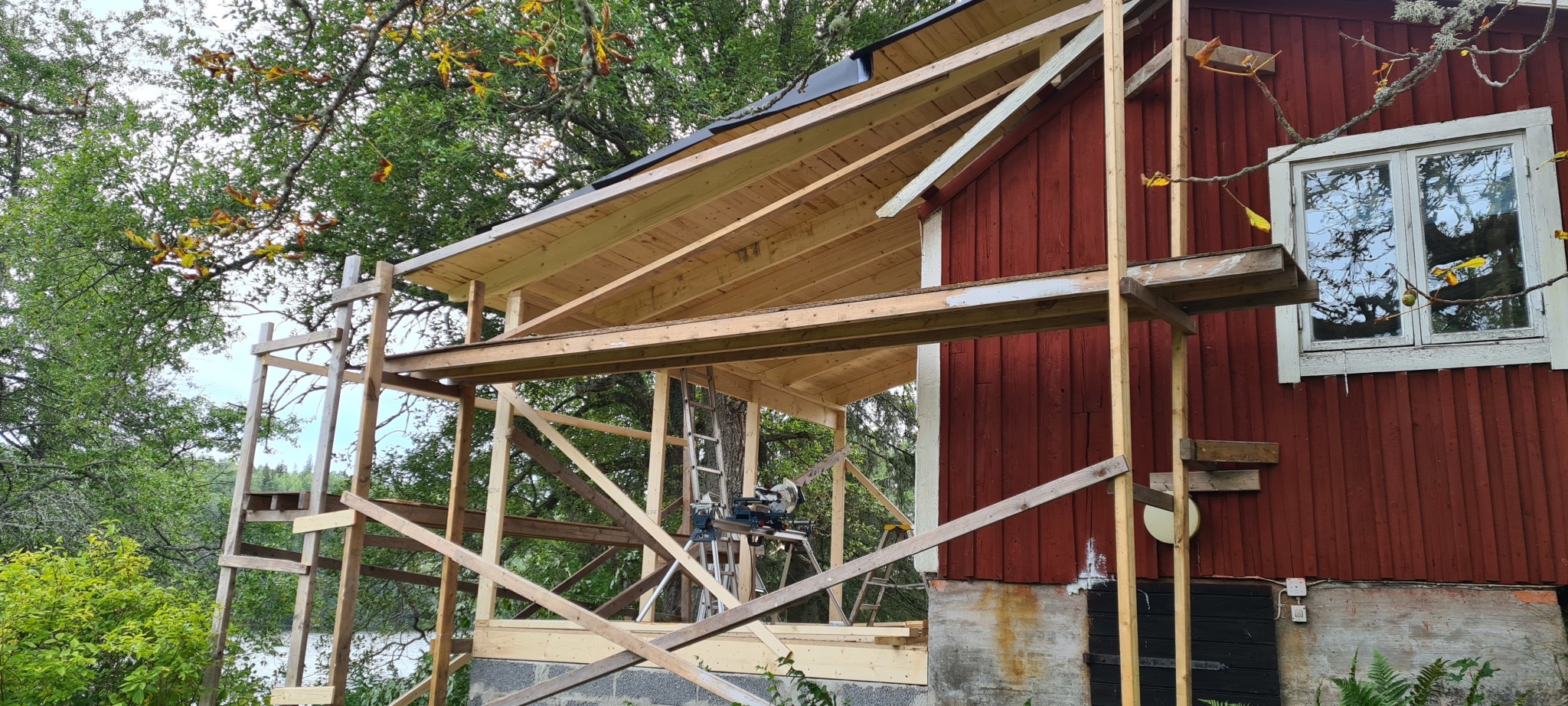
I'm in the process of expanding our cottage in the countryside by 15m² and have reached the point where we need to insulate.
The house is a bit of a mix with sawdust in some parts and rock wool/glass wool in others.
There is, although not in the picture, a wind barrier on the frame to withstand the rain better in the autumn, and I was planning to use a vapor barrier on the inside.
Now we come to the question, is it okay to use regular traditional and cheap rock wool?
It won't be heated, not even basic heating when we're not there, so how will moisture migration and the dew point be when we eventually get there and start heating?
I'm in the process of expanding our cottage in the countryside by 15m² and have reached the point where we need to insulate.
The house is a bit of a mix with sawdust in some parts and rock wool/glass wool in others.
There is, although not in the picture, a wind barrier on the frame to withstand the rain better in the autumn, and I was planning to use a vapor barrier on the inside.
Now we come to the question, is it okay to use regular traditional and cheap rock wool?
It won't be heated, not even basic heating when we're not there, so how will moisture migration and the dew point be when we eventually get there and start heating?
I know that cellulose and wood fiber insulation are excellent for this, but it's still 3 times the price. I also don't want to create the world's coziest hotel for the mice that thrive in fiberglass. I've heard that you shouldn't use plastic if you don't plan to heat it consistently.


Then the insulation is not very thick. This means that moisture can relatively easily migrate in and out. The time factor for how quickly moisture can be ventilated away/dry out from a structure is crucial for the risk of mold.
Mineral wool does not absorb water, so it is the framework/wooden studs and the inner and outer walls that do. If the construction is not moisture-proof, moisture can migrate both in and out of the wall. That is, if the wall becomes damp, it can dry out both inward and outward. This requires a certain amount of ventilation inside even when no one is there.
It also depends on how much moisture is generated indoors. It is directly proportional to the number of individuals inside, as well as cooking, showering, and washing, and then how well the ventilation works.
My opinion is that it should work fairly well with 15 cm of mineral wool, even if wood/plant-based hygroscopic insulation is considered better. Provided that the moisture load is not abnormally high.
Mineral wool does not absorb water, so it is the framework/wooden studs and the inner and outer walls that do. If the construction is not moisture-proof, moisture can migrate both in and out of the wall. That is, if the wall becomes damp, it can dry out both inward and outward. This requires a certain amount of ventilation inside even when no one is there.
It also depends on how much moisture is generated indoors. It is directly proportional to the number of individuals inside, as well as cooking, showering, and washing, and then how well the ventilation works.
My opinion is that it should work fairly well with 15 cm of mineral wool, even if wood/plant-based hygroscopic insulation is considered better. Provided that the moisture load is not abnormally high.
120 mm can be easily blown with cellulose. You get a compact insulation without gaps as a bonus. I previously had an attefall house with a vapor brake and cellulose. It stood cold for most of the winter without ever getting a hint of summer cabin smell.
Click here to reply