I am currently completely renovating the house, and when I got to the hallway extension (mono-pitched roof extending from the gable), I ended up tearing the whole thing down and have now poured a new concrete slab on the ground (bedrock under gravel and macadam).
I’m thinking of rebuilding it myself now, we’re talking about 2.4m out from the existing gable and 4 meters wide. Where can I find detailed descriptions of the details in the various stages?
I can probably manage everything without it, but likely in a more complicated way than necessary. When you google, you only find descriptions in general terms, but I'm more interested in how to frame the corners, attach the wall studs to some top plate, detailed images of how to attach the roof beams to the wall frame, etc.
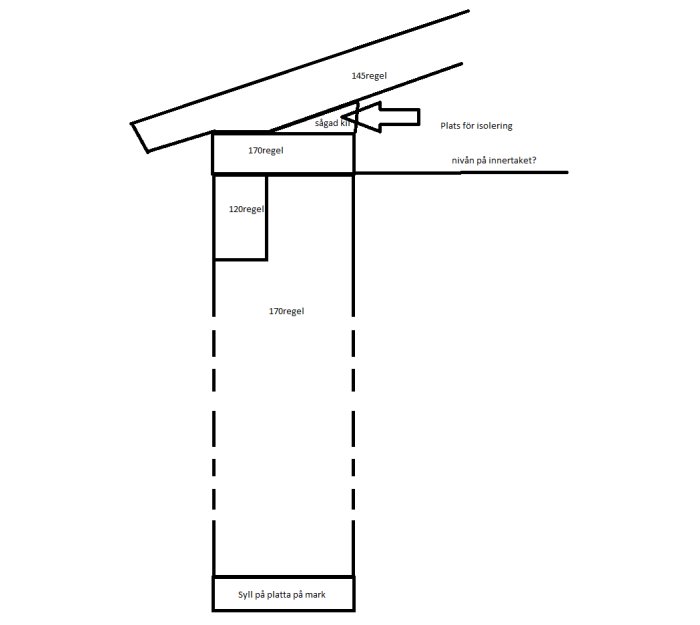
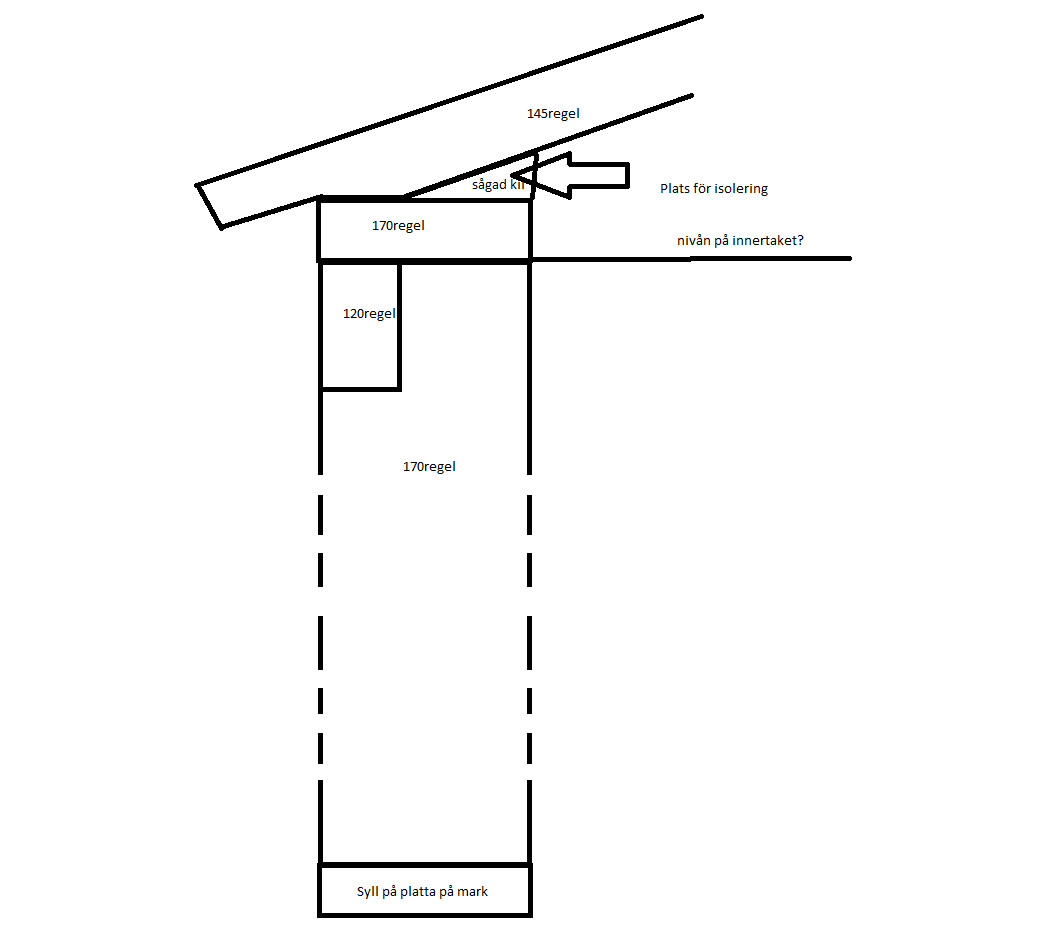
takes an example,.... The stud that goes from the sill is often cut in 45mm to insert a stud. Then a "cap" is placed above the wall stud and the notched stud, the figure shows what I mean. I want to understand the purpose of doing this as well as similar details on how to assemble the things, which fastenings can be used etc
I can guarantee that almost all your imaginable questions have already been discussed a lot in this forum. Search for each problem you're wondering about and you'll surely find your answers. That's what I've done and I've managed just fine
Regarding your latest question, search for hammarband. This has been discussed thoroughly!
Sure, every step can be found when searching. I've googled for about 1-2 hours on "hammarband" and it's hard to sift through amateur and professional comments... I would like a reliable source that describes how to build the construction. It must be one of the most common things, so maybe there's a book or something available.
For example, can it look like this? Set cc 60 on ceiling and wall studs?? It results in a lot of notching out of studs here and there.... but oh well...
This is the long wall, do the short walls need this type of top plate? Or is it enough with an over lintel there?
No wall plate is needed on the gables. No trusses or ridges resting on them.
Agree with MaZtoR, read up on byggbeskrivningar.se where there's a lot of useful information.
The rule is inserted to absorb the loads from the roof, preventing deflection on the top plate. Alternatively, double top plates can be used, but the insertion is recommended.
One inserts the rule to take up the loads from the roof, so there is no sagging on the wall plate. Alternatively, one can lay double wall plates, but the insertion is probably recommended.
Or plan where the trusses will land before starting to build and avoid this extra cost,
Absolutely right Danne83! It doesn't need to be done if you place the roof truss on the wall plate above the wall stud. Just explained what it was useful for.
I'm thinking that if you don't have the basic knowledge in frame construction and experience, maybe you should seek help from a carpenter who can assist you with the regulations in this construction so it doesn't go wrong
As I said, byggbeskrivningar.se is very valuable. Check out the videos they have on sheds, cabins, garages, and bicycle storage. No perfect mono-pitched examples though, except for carports and bicycle sheds, if I remember correctly.
They also offer calculation assistance for mono-pitched roofs and floor joists. I would easily place a horizontal rule under the wall plate so you have some freedom with door and window placement even after the construction is complete.
Then I don't know how you think about an entrance roof that can get a lot more snow from the rest of the house.