
3,112 views ·
15 replies
3k views
15 replies
Decorating cold attic from 1846
We live in a main building from 1846 and have beautiful (but not so easy to maintain) plank floors in most of the downstairs, while the upstairs, which was decorated in the 70s, has a mix of different floors.
We are now going to furnish the cold attic of about 40m2, which over the years has served as a storage. The floor here is also plank flooring, some planks are up to 35cm wide but unfortunately worm-eaten and poorly repaired after an old water damage. My partner is also demanding an easy-to-clean floor in our future bedroom, so it's not an option to try to fix the old floor.. (she's currently fixated on Herringbone parquet, but that might not be the final decision yet...)
I've always thought about tearing out the old floor and laying a new subfloor of chipboard, but I'm now starting to wonder if I should instead lay the chipboard directly over the old plank floor. However, we're a bit worried that the slightly musty old smell will seep through and be noticeable in the bedroom.
What does the collective expertise of this excellent forum say? (if I've posted this in the wrong subforum, a moderator can feel free to move it to the right part)
We are now going to furnish the cold attic of about 40m2, which over the years has served as a storage. The floor here is also plank flooring, some planks are up to 35cm wide but unfortunately worm-eaten and poorly repaired after an old water damage. My partner is also demanding an easy-to-clean floor in our future bedroom, so it's not an option to try to fix the old floor.. (she's currently fixated on Herringbone parquet, but that might not be the final decision yet...)
I've always thought about tearing out the old floor and laying a new subfloor of chipboard, but I'm now starting to wonder if I should instead lay the chipboard directly over the old plank floor. However, we're a bit worried that the slightly musty old smell will seep through and be noticeable in the bedroom.
What does the collective expertise of this excellent forum say?
(if I've posted this in the wrong subforum, a moderator can feel free to move it to the right part)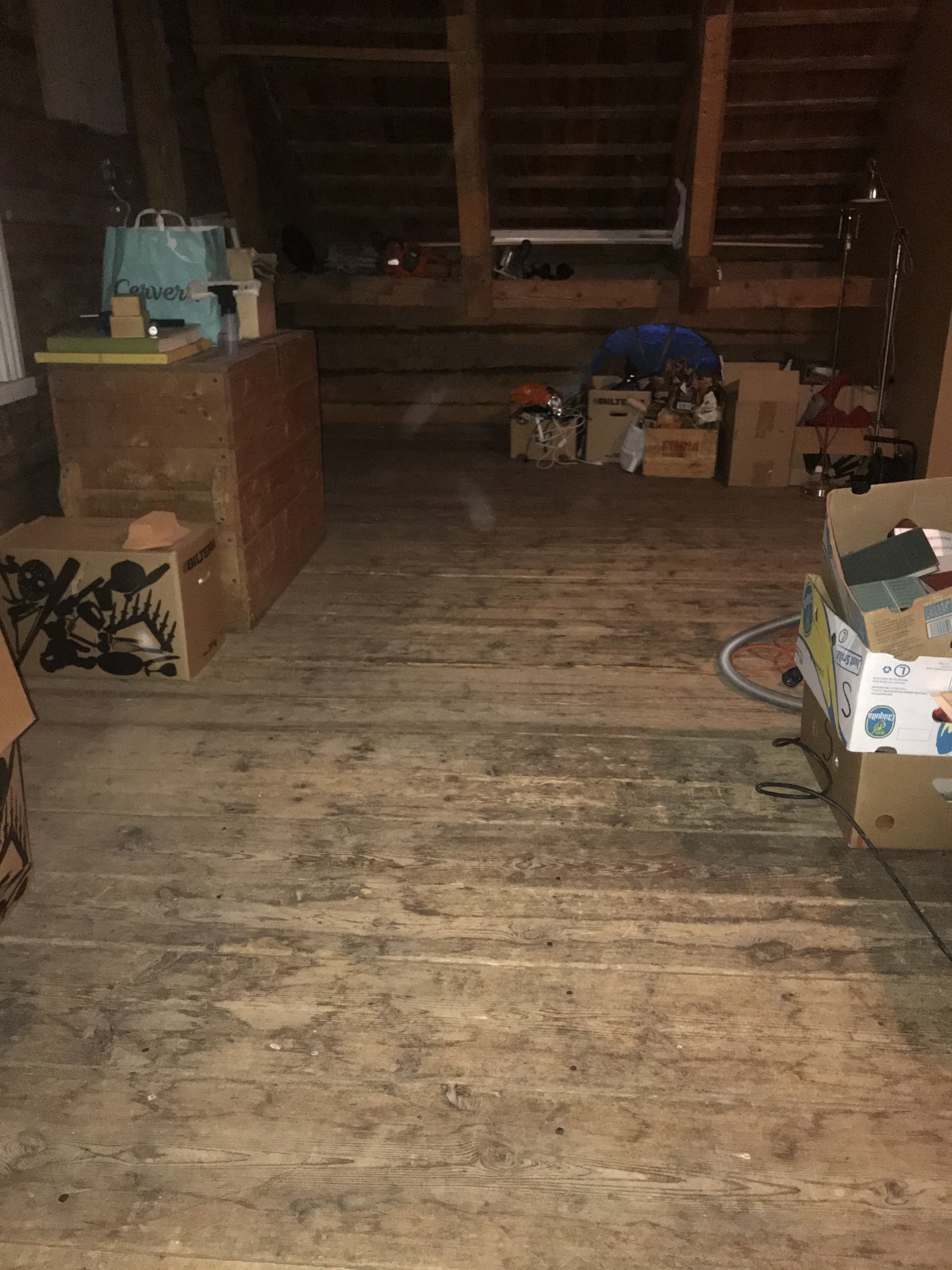

I think you'll have difficulty with the disc material. They weren't diligent with the spirit level back when the house was built. Another question: have you checked that the floor beams have suitable dimensions for the new usage? Attics are usually not designed for larger loads. Not even in 1846.
Thank you! I myself have been considering a 30mm wooden floor, and I think I can convince my partner that a sheet floor isn't suitable.
Tonight I have essentially decided to tear out the existing floor to ensure there aren't other damages in the joists that I need to take care of.
Regarding load-bearing capacity, the upper floor was furnished to 3/4 in the 70s, and now it's time to complete the last 1/4. I don't think any reinforcements were made when furnishing the earlier part, but I can certainly take the opportunity to measure the beam heights when I remove the old floor. The floor feels very stable, and we have probably lightened the joists by several tons considering all the trips we've made to the dump in recent years. To gain quicker access to the house upon takeover, we agreed that the previous owners could leave anything they didn't want to take with them...
Tonight I have essentially decided to tear out the existing floor to ensure there aren't other damages in the joists that I need to take care of.
Regarding load-bearing capacity, the upper floor was furnished to 3/4 in the 70s, and now it's time to complete the last 1/4. I don't think any reinforcements were made when furnishing the earlier part, but I can certainly take the opportunity to measure the beam heights when I remove the old floor. The floor feels very stable, and we have probably lightened the joists by several tons considering all the trips we've made to the dump in recent years. To gain quicker access to the house upon takeover, we agreed that the previous owners could leave anything they didn't want to take with them...
That sounds good. Check the beam dimensions and feel free to return with a report.
Absolutely! Thanks for the response!
I've been reading on this forum for many years and have come to understand that you, Justus, have solid construction knowledge.
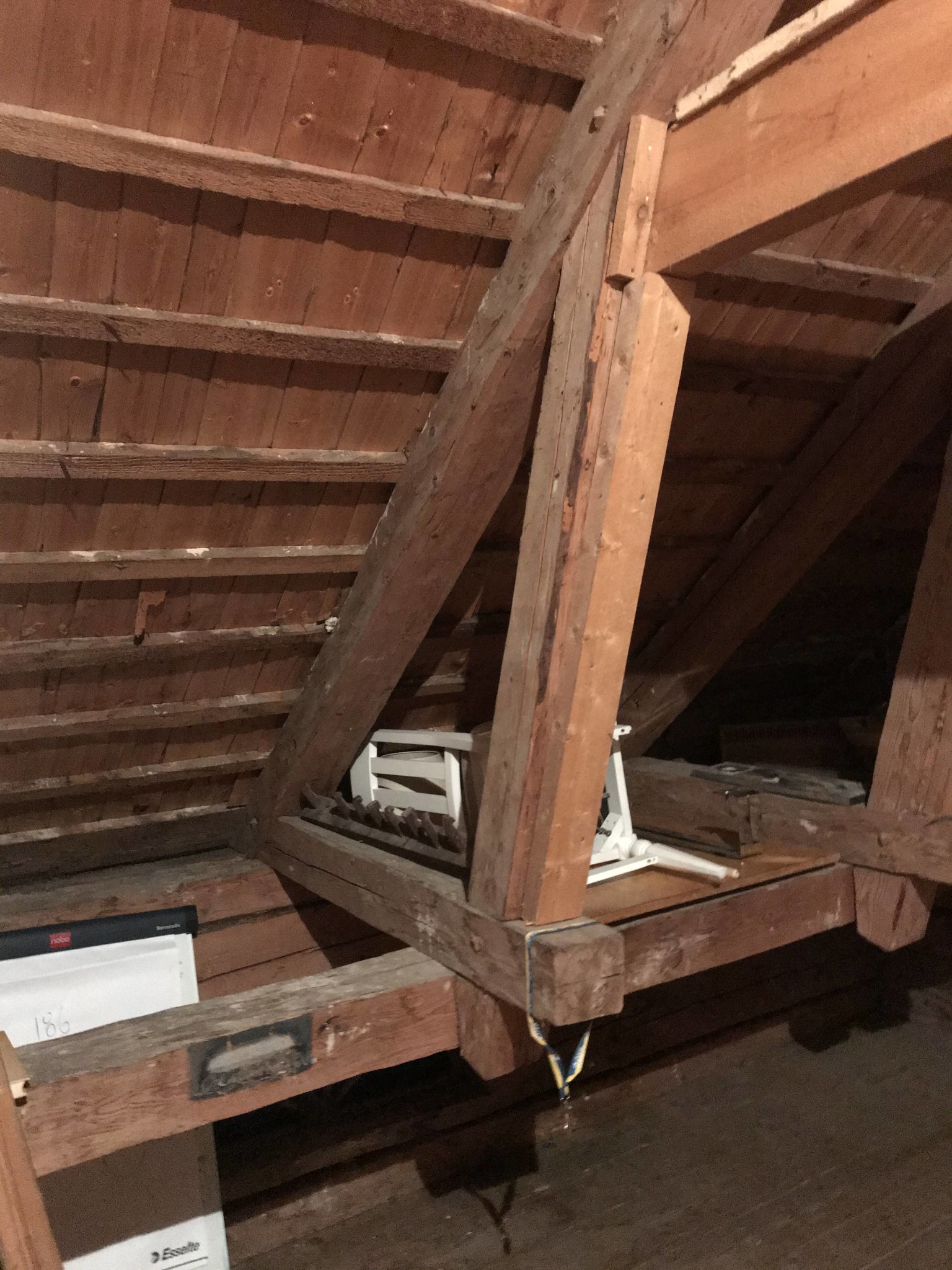
We would like to remove the support legs on the roof trusses, but we also realize that this can be a fairly extensive job...
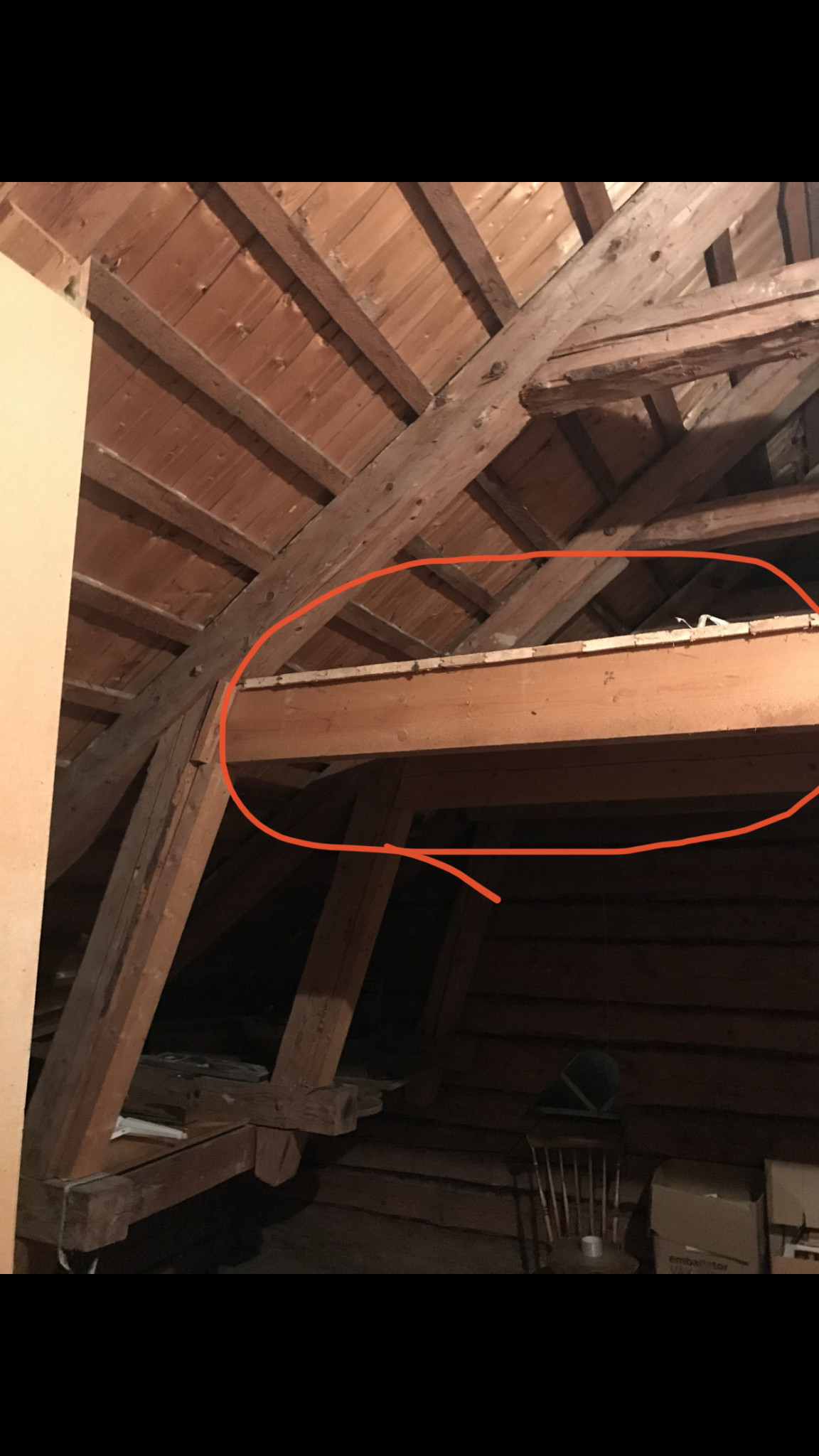
This has been done when furnishing the rest of the upper floor, and I see that they have placed a longitudinal beam under the collar tie, dimensions approximately 75x200mm. However, I can't see how the loads have been transferred from this beam...
Do you have any ideas on how this can be done?
It concerns 2 roof trusses whose support legs we would like to remove, including the longitudinal beam that the support legs rest on.
ps. The red circled ceiling joist is just an extra storage loft and has no load-bearing function.
I've been reading on this forum for many years and have come to understand that you, Justus, have solid construction knowledge.
We would like to remove the support legs on the roof trusses, but we also realize that this can be a fairly extensive job...
This has been done when furnishing the rest of the upper floor, and I see that they have placed a longitudinal beam under the collar tie, dimensions approximately 75x200mm. However, I can't see how the loads have been transferred from this beam...
Do you have any ideas on how this can be done?
It concerns 2 roof trusses whose support legs we would like to remove, including the longitudinal beam that the support legs rest on.
ps. The red circled ceiling joist is just an extra storage loft and has no load-bearing function.
Best answer
There are many reasons why you shouldn't do as you planned. The trusses are a variant of what is called the Swedish truss. The brace has several functions. Partly it reduces the span of the rafter, so that it can be made slimmer, partly it helps to direct down roof loads, and it also forms, together with the horizontal brace and the lower part of the rafter, a triangle that reinforces the eaves. This may be needed because you have horizontally timbered exterior walls. The longitudinal horizontal beam is necessary because the trusses and floor joists are not aligned with each other. It is then an example of a well-crafted carpenter's work.
Of course, it is possible to remove a single brace and replace it with a beam and some device that stiffens the eaves, perhaps a horizontal glued laminated beam. However, I think you should do as they always said in the army: embrace the situation.
Of course, it is possible to remove a single brace and replace it with a beam and some device that stiffens the eaves, perhaps a horizontal glued laminated beam. However, I think you should do as they always said in the army: embrace the situation.
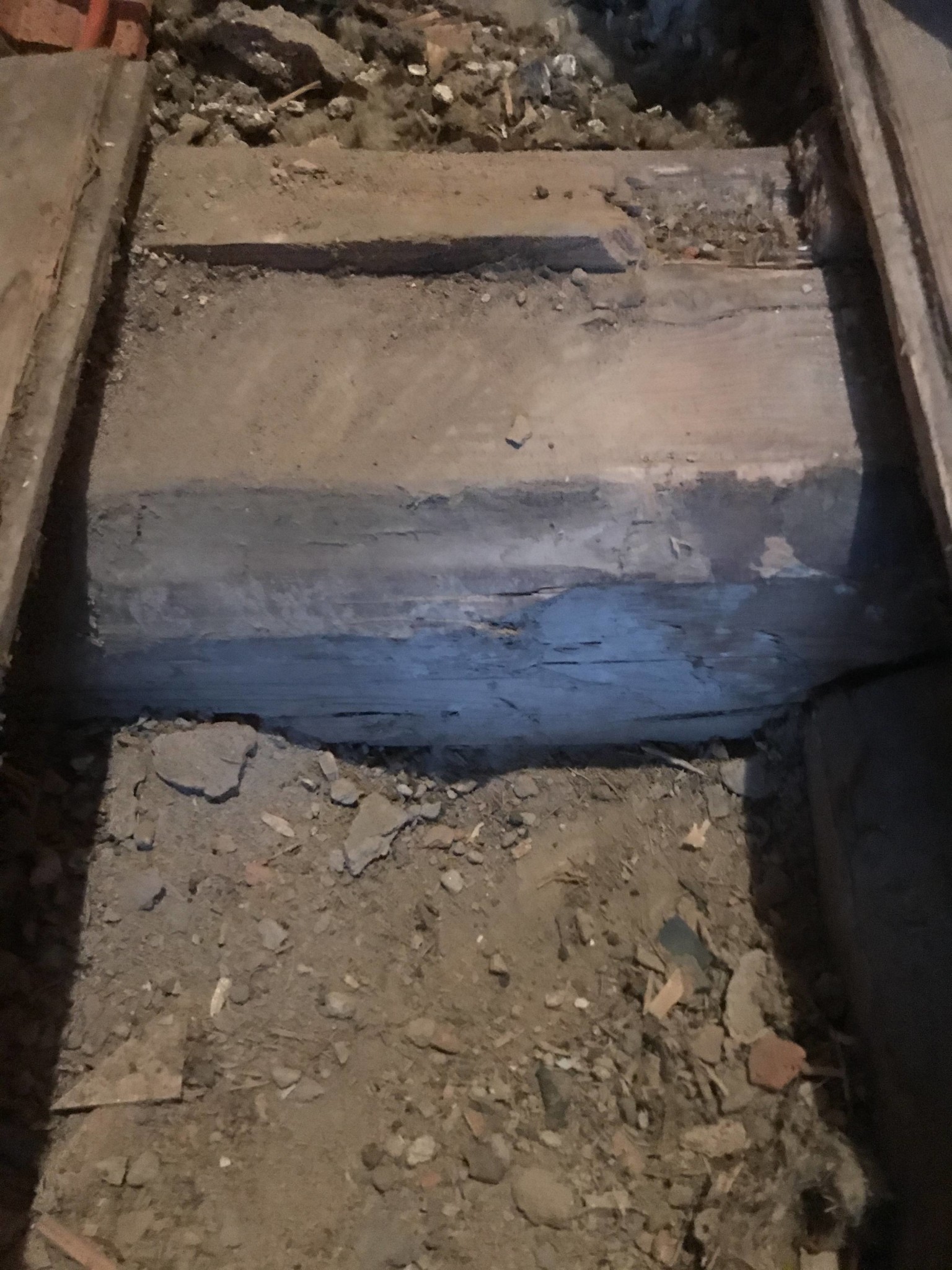
200x150 mm corresponds to 45x250 mm approximately. It becomes a bit shaky but I think one must accept that in such an old house. Especially if it is to be used as a bedroom. The beds are hardly standing in the middle of the floor. Slightly thicker floorboards, 30 mm thick or more, distribute the loads well.
Unfortunately, I have negative experiences with DalaFloda. They do not follow their own standard requirements regarding sorting concerning the presence of knots and try to push out inferior wood at too high a price. I have experienced having to discard an entire delivery. Baseco, Siljans, and Jabo are more reliable suppliers in different quality levels.
You are in luck, there is a loft apartment for sale at Kasernhöjden in Karlstad, so you can get inspirational images, many visible posts and beams there!
https://www.fastighetsbyran.com/sv/sverige/Objekt/?source=Hemnet&objektID=2226474#bilder
https://www.fastighetsbyran.com/sv/sverige/Objekt/?source=Hemnet&objektID=2226474#bilder
Thanks! I checked out a Baseco today that the local builder's merchant can deliver at a much better price than, for example, Bygghemma! 500kr/m2 vs. 749kr/m2 makes wonders in the renovation budget.J justusandersson said:Unfortunately, I've had negative experiences with DalaFloda. They don't adhere to their own standards regarding sorting, especially considering the presence of knots, and they try to sell lower quality wood at too high a price. I've had to reject an entire delivery. Baseco, Siljans, and Jabo are more reliable suppliers in different quality ranges.
Very cool! I'm barely brave enough to show it to my partner because she prefers smooth plaster ceilings while I prefer panel ceilings.Anna_H said: