Hello everyone,
I am a beginner with a moisture problem I would like to share in this knowledgeable forum.
We have been living in a villa built in 1972 for 3 years.
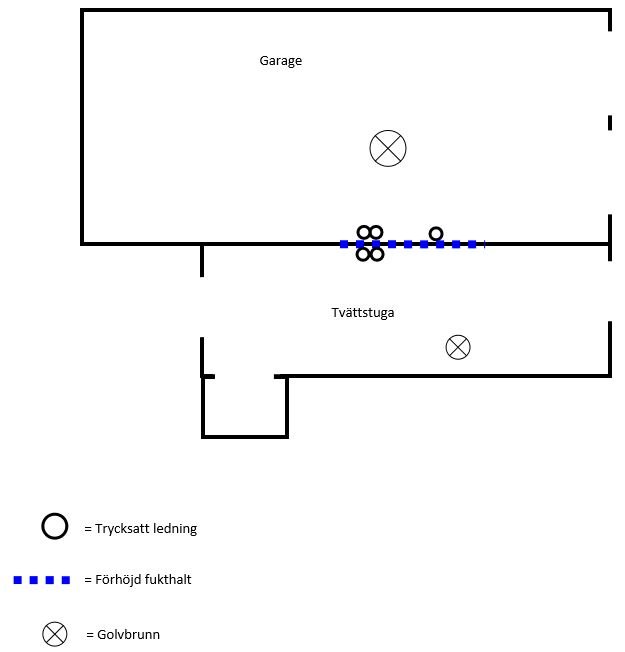
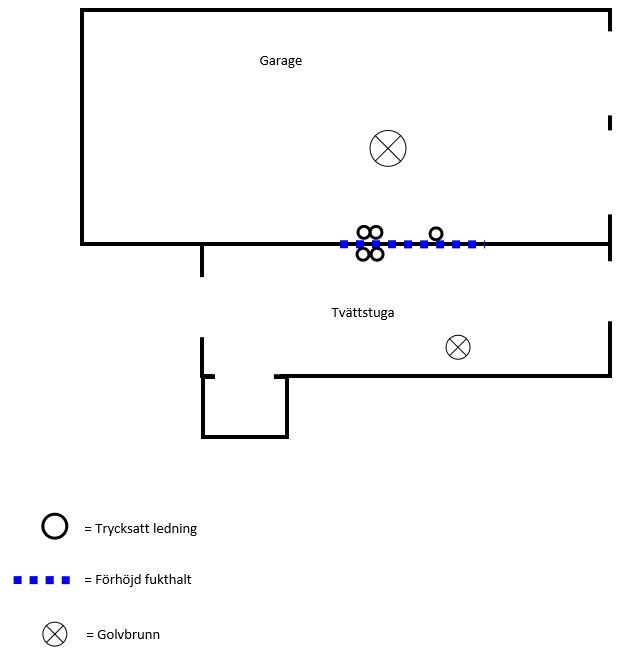
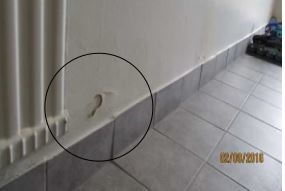
In our laundry room, we have moisture stains on a (gypsum) wall that borders our garage.
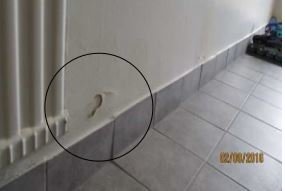
The moisture stains are at the floor and seem to appear where the wall studs are, not along the entire wall, but about 60 cm apart and about 35 cm up the wall.
No elevated moisture on the garage side.
We do a lot of laundry, 6 people in the family, and have a dehumidifier in the laundry room.
There is a water-based radiator in both the laundry room and garage at the wall in question. There is also a cold water tap on the garage side.
During the house inspection three years ago, we were pointed out that there was moisture in this wall.
One theory then was that the plastic mat on the laundry room's concrete floor (on ground) pushed ground moisture into the wall.
We removed the plastic mat during our renovation and laid tiles without a waterproofing layer and repainted the walls.
However, the moisture stains seem to return, and we even noticed a smell this summer. However, after several weeks without using the laundry room.
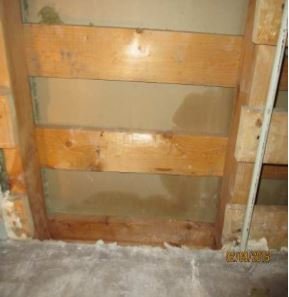
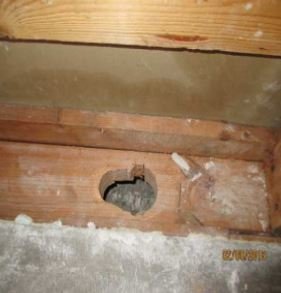
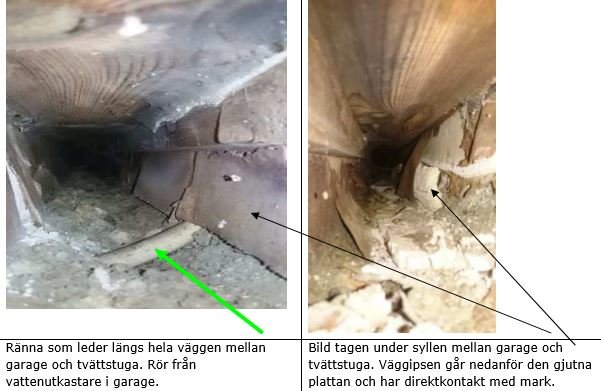
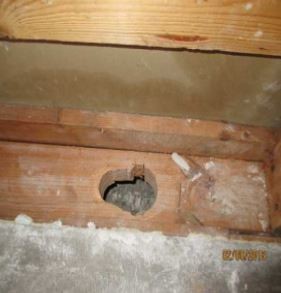
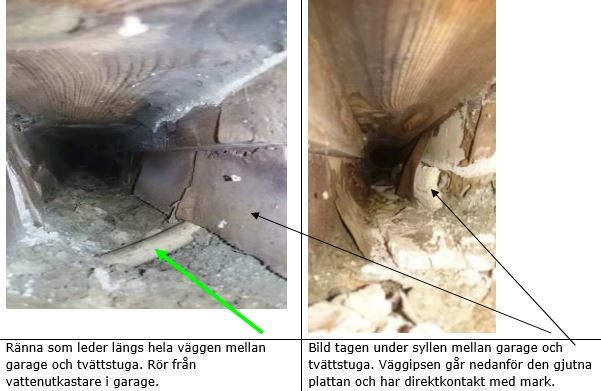
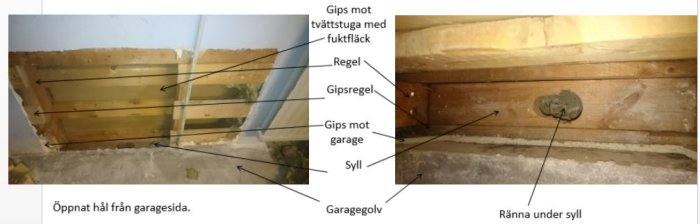
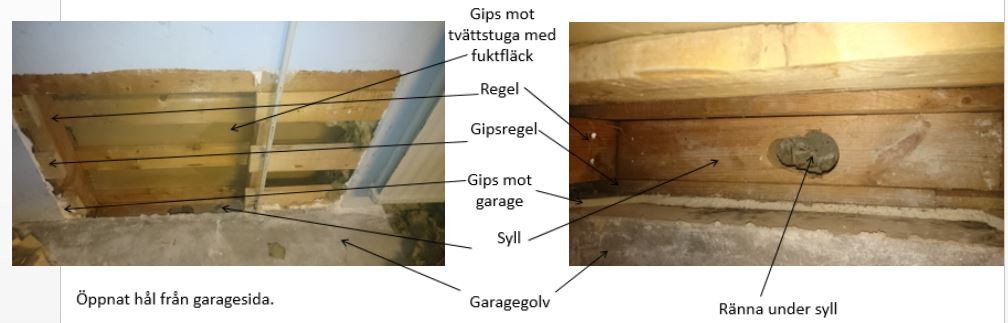
I removed a piece of gypsum on the garage side and sawed a hole down into the beam running along the floor. The garage's concrete slab and the laundry room's floor don't seem to be connected, at least not at floor level. There is a channel, about 15*15 cm, between the slabs under the beam.
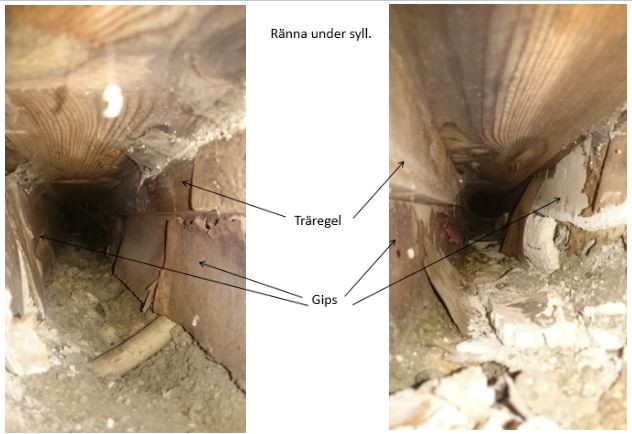
By holding my phone down into the hole in the floor beam, I could take a picture along the space.
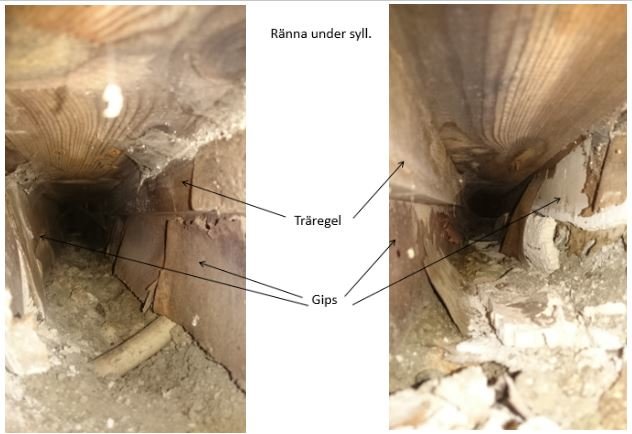
The pictures show that the gypsum boards go all the way down into the space.
I contacted my insurance company, who in turn called in a moisture company. The moisture company wrote in its report that ground moisture might have traveled up the gypsum boards.
No elevated moisture in the sill.
I am recommended to expose more of the wall and replace with inorganic materials (steel studs, etc.).
Unfortunately, this is as much help as I get from the insurance company.
My intention is probably to remove the entire wall and rebuild it with inorganic materials.
However, it would be nice to know where the moisture is coming from, as it will remain even if I rebuild the wall.
1) Has anyone seen a similar moisture problem?
2) Could it be condensation, meaning that the studs function as a thermal bridge between the garage (and/or the channel below) and the warm air in the laundry room?
3) Should I fill the channel with insulation, material, or ventilate it better?
Grateful for help.
Please correct me if I've posted in the wrong forum category.
It's clearly a construction error. You don't place drywall directly against the ground. Since moisture was noted in the inspection report, forget any thoughts of it being a hidden fault. The insurance company also won't cover external moisture, so the problem is yours.
The question then is, what can be done about it? The drywall should be removed from the ground. The question is whether it can be done without removing the soleplate.
I would probably consider starting by making two ventilation holes down into the space between the slabs and placing an exhaust fan (like a standard PC fan) at one hole to draw warm indoor air through the space to keep it dry. Similar to a raised floor. If it works, you might get rid of enough moisture for the drywall to dry completely and keep the space dry. If it works, you can avoid tearing down the wall.
The smell you noticed could have come from the floor drain if the laundry room has been unused for a long time.
Thank you for the response.
Ventilation of the gutter might be the right solution.
However, it feels like I want to correct the faulty construction and redo it.
Since the moisture spots seem to appear where the studs are, I wonder if the moisture is worsened by the studs acting as a thermal bridge and causing condensation.
Will it then get worse if I replace wooden studs with metal studs?
The idea of the smell from an empty floor drain is good, but the smell was different. Additionally, the drain was filled because it was suspected that the smell came from there, but the smell did not disappear.
I will take a closer look at the images on a larger screen. Drawing down warm indoor air can work but can also backfire, very much so. Warm indoor air carries quite a few grams of water (in vapor form). Blowing it into a cool space can cause condensation and then it can get really wet. Even a small computer fan moves many cubic meters of air per day, so per week and month, the volumes become immense. It's possible to calculate what happens when you blow warm, normally humid indoor air into cold spaces. When I saw how it could turn out, I was taken aback.
I am a keen amateur, but family and friends have had environments where we needed to manage moisture, so I have both read a lot and done plenty of experiments.
Most small moisture dilemmas have their own issues, so be a little cautious about "buying/accepting patented solutions." My experience is that you have to try to make as good a solution as possible and then follow up with either measurements or at least supervision.
I will look at the images over the weekend and give you my reflections. At the same time, I am one of those bores who asks questions, but it is to provide the best reflections/ideas for alternative solutions. When it comes to wall construction, you should probably distinguish between it and how you handle the space underneath, even though they naturally should
There are a couple of questions before I look at the images on a larger screen
1) What kind of wall is between the garage and laundry room? Is it an exterior wall against a garage with simpler construction, or is the garage built with real house exterior walls?
2) This is somewhat dependent on question 1, but what temperature do you usually have in the laundry room and garage, and what temperatures do you want to maintain in the future?
3) Am I seeing correctly in the images that the wooden sill lies directly against the concrete slab without any form of intermediate material like tar paper?
4) Another image question. Does the wood extend into the space below, or is it just gypsum?
Very grateful for the help. Questions are absolutely okay.
I will try to answer below:
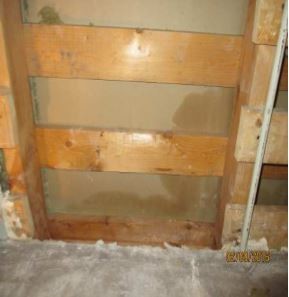
1) Between the laundry room and the garage, there's an interior wall. Gypsum, wood studs, insulation.
I took a picture that I hope shows this.
The garage is a large double garage with outer walls made of Mexitegel.
2) In the laundry room, it is often warm (and also humid). In the garage, it is cooler.
Today the temperatures were:
Garage 16 degrees.
Trench under wall 18 degrees.
Laundry room 22 degrees (with dehumidifier running).
3) The sill doesn't seem to be directly against the concrete slab. The gypsum is between the sill and the concrete.
I hope it's visible in the picture above.
4) Outside the sill are studs holding the gypsum. These studs continue down into the trench. See picture.
Hmm, as a layman, my thoughts are 70s, slab on grade. If I'm wrong on the timeline, someone will surely correct this. Slab on grade built in the 70s was probably uninsulated on gravel. Not a very successful experimental construction. Gravel is capillary breaking, meaning water runs straight through, but there is often water/moisture in the ground that can come from below or from the side. Anyway, where there is water, the humidity is high, and water tends to "climb" upwards. I think they call it diffusing upwards, meaning the gravel gets wet on the surface and strives towards the concrete slab, which is a bit warmer. The concrete slab absorbs this water, which then moves upwards. Today, insulated slab on grade is built; the insulation should both insulate and prevent water from the ground from reaching the slab.
In the 70s, wooden studs were also cast into slabs, and for a period, even pressure-treated to prevent rotting. Treated wood that gets wet begins to smell through a chemical process and doesn't stop smelling even when it dries.
I made this description for you to check that it's not just gypsum in direct contact with the concrete slab. It doesn't look like pressure-treated wood, but as I said, I'm not an expert.
However, I find it difficult to see if the studs are directly on the slab or if there is any moisture protection in between. It might be a good idea to check this before making a decision about a remedy.
I simply see two tracks.
One alternative is to ventilate the space so that it becomes so dry that the gypsum doesn't get any moisture. It might work with indoor air, but the temperatures you mention probably change over the year, and then you can blow dry during certain periods and "blow" in moisture that condenses during other periods. It is possible to measure this, and you can get a dehumidifier that blows in dry air regardless of other factors. At the same time, you might want different temperatures in the laundry room and the garage, and then it might be good with some insulation in the wall. Regardless, you can get it dry, but it doesn't fix the error.
The second alternative, which you mention yourself, is to redo the wall. When it comes to removing all the organic material in the channel and filling it in, I would like to suggest that it might consciously be divided. The division can be an "expansion joint" to allow a large slab to be in two parts so that small movements don't cause settlement damage. However, there is certainly suitable material that doesn't cast the slabs together but fills the space without causing problems.
Rebuilding the wall becomes more or less extensive depending on if there are load-bearing elements and if, for example, studs are cast into the slab. In the pictures, I don't see any other way to remove the gypsum without removing the sill??
If you choose to redo the wall, I would insulate because I have a lower temperature in the garage than inside. How much insulation is another question. A laundry room becomes both warm and very humid at times when you hang laundry and run the dryer. The phenomenon, I think, can be called higher vapor pressure, meaning different climates strive for equalization, and then moisture and heat look for the cooler garage. It might lead to increased moisture in the wall. I guess this can be handled with an open construction similar to the current one but with completely inorganic materials. Gyproc has a waterproof board that I chose for the laundry room. It might be an unnecessary extra cost for you even though I made that choice.
Wood has better properties when it comes to insulation compared to steel. At the same time, steel studs aren't solid. If you make an insulated wall and don't plan to have very large temperature differences between the garage and the laundry room, it might be good to think about how the wall towards the laundry room should be made. In my laundry room, I chose painted wetroom wallpaper because I don't want moisture from inside to move out into the external wall. That is, a vapor barrier that is also easy to clean and repaint if needed. At the same time, a garage can occasionally be a real moisture bomb if you drive a snowy and icy car in.
If you want to see the laundry room as more indoors than the garage, you might want to consult someone about vapor barriers in the inner wall in combination with insulation to get it right. There are, for example, simple vapor barriers that are diffusion-open, which in simpler terms means they are leak-proof if you pour water on it but to a certain extent open to water in vapor form=humidity. Wall construction is something many know better than me. At the same time, a laundry room can become so warm and humid that you hardly want any moisture in a wall that is 7-8 degrees colder on the other side. It can go wrong.
My reasoning leads to a few observations:
1) Are the studs or any wood in contact with the concrete or cast into the concrete?
2) I interpreted your writing as wanting to redo the wall, and the question is whether it is load-bearing?
3) How do you want to use the garage going forward. I ask because the existing wall might have worked perfectly if the gypsum wasn't down in the channel and all the wood in contact with the slab was dry. That is, a new wall should function as a garage wall too and not just from the laundry room side. As I said, I have sealed walls in the laundry room, but every building is different. It has to work within the overall structure of the house. I can't give advice there, but see my contributions as suggestions.
4) If you redo the wall with insulation and perhaps some form of vapor barrier or alternatively tight vapor barrier, consult the right competence to choose the right materials.
5) If you change the wall, you change the conditions for the garage's climate. Check the heating and ventilation to make sure it works.
I feel this post mostly became a matter of reasoning, so I hope you don't fall asleep. Thank you for making it this far. I've received "super-certain" advice from "experts" during renovations and realized every old house has different conditions and is used differently, so my knowledge isn't enough to give black-and-white advice.
Click here to reply
Vi vill skicka notiser för ämnen du bevakar och händelser som berör dig.




 At the same time, a laundry room can become so warm and humid that you hardly want any moisture in a wall that is 7-8 degrees colder on the other side. It can go wrong.