
Hello,
I'm not sure if this question is in the right category, but I'll give it a try.
We own an old Skånelänga (circa 1860) and due to elevated moisture levels in a wall, we removed the chipboard that was moisture-damaged. Almost all the underlying plaster came off, leaving a sparsely bricked wall where the intermediate layer consists of something we believe is clay. The problem is that the clay or claystone is very porous and damp. The question is, can new plaster be applied on this surface once it has dried? Or do we need to scrape away all the loose material? Or is the wall completely ruined?
The part of the plaster that didn't come off (see image) is painted black and I also wonder if anyone knows what that might be and why it was done?
Thanks in advance!
I'm not sure if this question is in the right category, but I'll give it a try.
We own an old Skånelänga (circa 1860) and due to elevated moisture levels in a wall, we removed the chipboard that was moisture-damaged. Almost all the underlying plaster came off, leaving a sparsely bricked wall where the intermediate layer consists of something we believe is clay. The problem is that the clay or claystone is very porous and damp. The question is, can new plaster be applied on this surface once it has dried? Or do we need to scrape away all the loose material? Or is the wall completely ruined?
The part of the plaster that didn't come off (see image) is painted black and I also wonder if anyone knows what that might be and why it was done?
Thanks in advance!
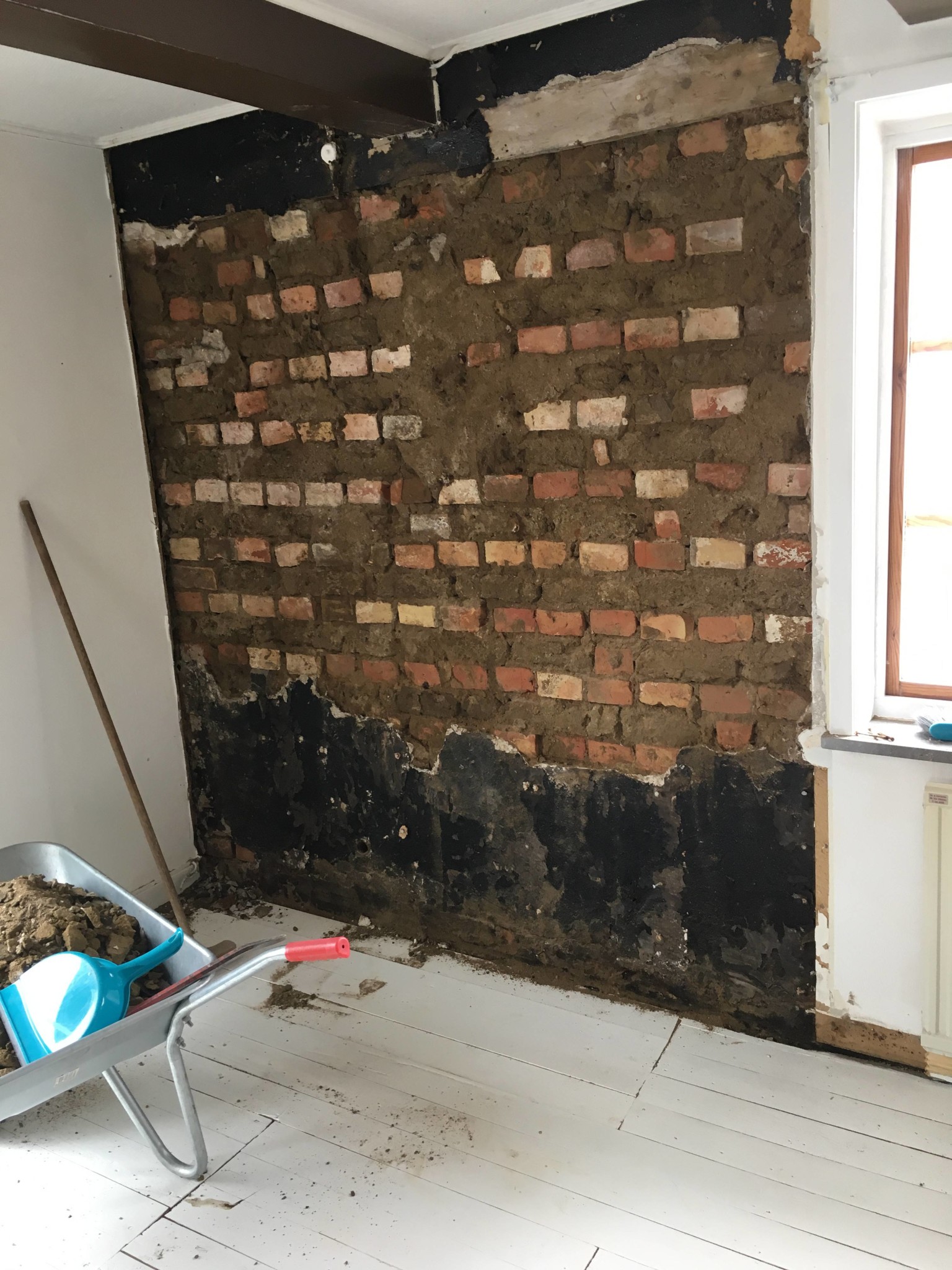

The plaster is likely clay, and since it is water-soluble, it's not surprising that it's deteriorating in a damp wall. It also seems that the mortar is clay, although this can be hard to discern from the picture. Normally lime mortar was used, which can also be scraped out, but clay is much more sensitive to moisture. In principle, you can always scrape out all the (clay) mortar, so it can look worse than it is.
Do you see any difference between the (clay) plaster and the mortar?
Do you know why the wall is damp? The cause of the moisture should be addressed first; walls should not remain constantly damp. Is it treetex or another type of board? It seems like the board was placed directly against the plaster, hence the moisture damage?
What you should do also depends on how the wall is constructed and its thickness. It is a load-bearing wall, so you need to be a bit extra careful about the condition.
It is best to get someone knowledgeable about old houses to visit the site, as it's always best to see firsthand what it looks like in order to decide on appropriate measures.
Do you see any difference between the (clay) plaster and the mortar?
Do you know why the wall is damp? The cause of the moisture should be addressed first; walls should not remain constantly damp. Is it treetex or another type of board? It seems like the board was placed directly against the plaster, hence the moisture damage?
What you should do also depends on how the wall is constructed and its thickness. It is a load-bearing wall, so you need to be a bit extra careful about the condition.
It is best to get someone knowledgeable about old houses to visit the site, as it's always best to see firsthand what it looks like in order to decide on appropriate measures.
Thanks for the response. The moisture is due to poor drainage on the outside. This will be addressed in the spring. The mullbänk foundation will also be excavated.
The wall is constructed of brick with the short side against the inner and outer walls, with plaster on the outside and inside. Treetex board has been placed on the plaster of the inner wall, and wallpaper has been applied on top.
We will probably need to hire someone on site to help us with the assessment of how to proceed with the wall. For now, it has at least been exposed and will hopefully dry out a bit.
The wall is constructed of brick with the short side against the inner and outer walls, with plaster on the outside and inside. Treetex board has been placed on the plaster of the inner wall, and wallpaper has been applied on top.
We will probably need to hire someone on site to help us with the assessment of how to proceed with the wall. For now, it has at least been exposed and will hopefully dry out a bit.
Hello, I'm back to ask about our clay brick wall.
So, the wall in the Skåne house from 1860 is built with alternating layers of fired brick and clay brick. We removed wall material, and the brick wall underneath was porous and damp. Now, the wall has been left for about four weeks, and the clay brick feels slightly harder on the surface, but is still damp.
We have also removed the treetex board on the adjacent wall, and most of the plaster fell off there too, with the rest being very easy to scrape off.
This summer, the plan is to plaster the walls with clay plaster.
My question is whether it's possible to plaster with clay plaster on a clay brick wall that is this damp?
Grateful for answers. Perhaps someone has similar experiences, how did you proceed in such cases?
So, the wall in the Skåne house from 1860 is built with alternating layers of fired brick and clay brick. We removed wall material, and the brick wall underneath was porous and damp. Now, the wall has been left for about four weeks, and the clay brick feels slightly harder on the surface, but is still damp.
We have also removed the treetex board on the adjacent wall, and most of the plaster fell off there too, with the rest being very easy to scrape off.
This summer, the plan is to plaster the walls with clay plaster.
My question is whether it's possible to plaster with clay plaster on a clay brick wall that is this damp?
Grateful for answers. Perhaps someone has similar experiences, how did you proceed in such cases?
M
Marcussjogren
Member
· Västra Götaland
· 3 083 posts
Marcussjogren
Member
- Västra Götaland
- 3,083 posts
Clay is a material that can retain incredible amounts of water.
Drying out a tiled stove with a 3-4mm thick layer takes at least a week (at which point even the joints behind are dry).
I imagine such a wall takes about half a year or so to dry out so that the clay is thoroughly hard. However, I wonder if the wall hasn't settled quite a bit? It looks like the clay bricks have collapsed quite a lot.
Drying out a tiled stove with a 3-4mm thick layer takes at least a week (at which point even the joints behind are dry).
I imagine such a wall takes about half a year or so to dry out so that the clay is thoroughly hard. However, I wonder if the wall hasn't settled quite a bit? It looks like the clay bricks have collapsed quite a lot.
Thanks for the reply! So we should wait longer than we thought. I'm also wondering if we need to scrape off all that is porous before we apply clay plaster on top?M Marcussjogren said:
And what do you do in places where there are clean cavities? Can you fill in with clay plaster or with some other mortar?
M
Marcussjogren
Member
· Västra Götaland
· 3 083 posts
Marcussjogren
Member
- Västra Götaland
- 3,083 posts
Yes, it is at least appropriate to take some form of brush and go over the wall. Brush it normally as when you brush the floor indoors, not too hard, not too softSaband said:
Thanks for the response! So we should wait longer than we planned. I'm also wondering if we need to scrape away everything that's porous before plastering with clay plaster on top?
And how do you handle areas that have direct cavities? Can they be filled with clay plaster or with some other compound?
that is, do not damage what is solid.Holes should be repaired with the equivalent clay mortar that is in the wall today. It's not so easy to travel back 130 years and ask, but the main thing is to try to see if it's reinforced with something like straw.
Otherwise, I would mix 1:3 (clay:sand) to create a mortar that can just be formed into a solid ball for repairs and pressed in quite hard. No hitting, just pressing with the hand.
The plaster should be a bit wetter, like... clay porridge?
It should be quite easy to spread on the wall without crumbling and falling off.Note that I'm not an expert in the field, but I write from what I've read and done myself at home.
Thanks for the answer! Now the project feels a little more hopeful.M Marcussjogren said:Well, it is at least appropriate to take some kind of brush and go over the wall. Brush normally as when you brush the floor indoors, not too hard, not too soft
Holes repaired with a corresponding clay mortar that exists in the wall today. It's not so easy to go 130 years back in time and ask, but the most important thing is to try to see if it's reinforced with, for example, straw.
Otherwise, I would have mixed 1:3 (clay:sand) to a mortar that can just be formed into a solid ball for the repairs and pressed in quite hard. No impact, just pressure with the hand.
The plaster should be a bit wetter, like... clay porridge?
Note that I am not an expert in the area, but write from what I have read and done myself at home.
Click here to reply