
3,073 views ·
31 replies
3k views
31 replies
Cut Lecabalk
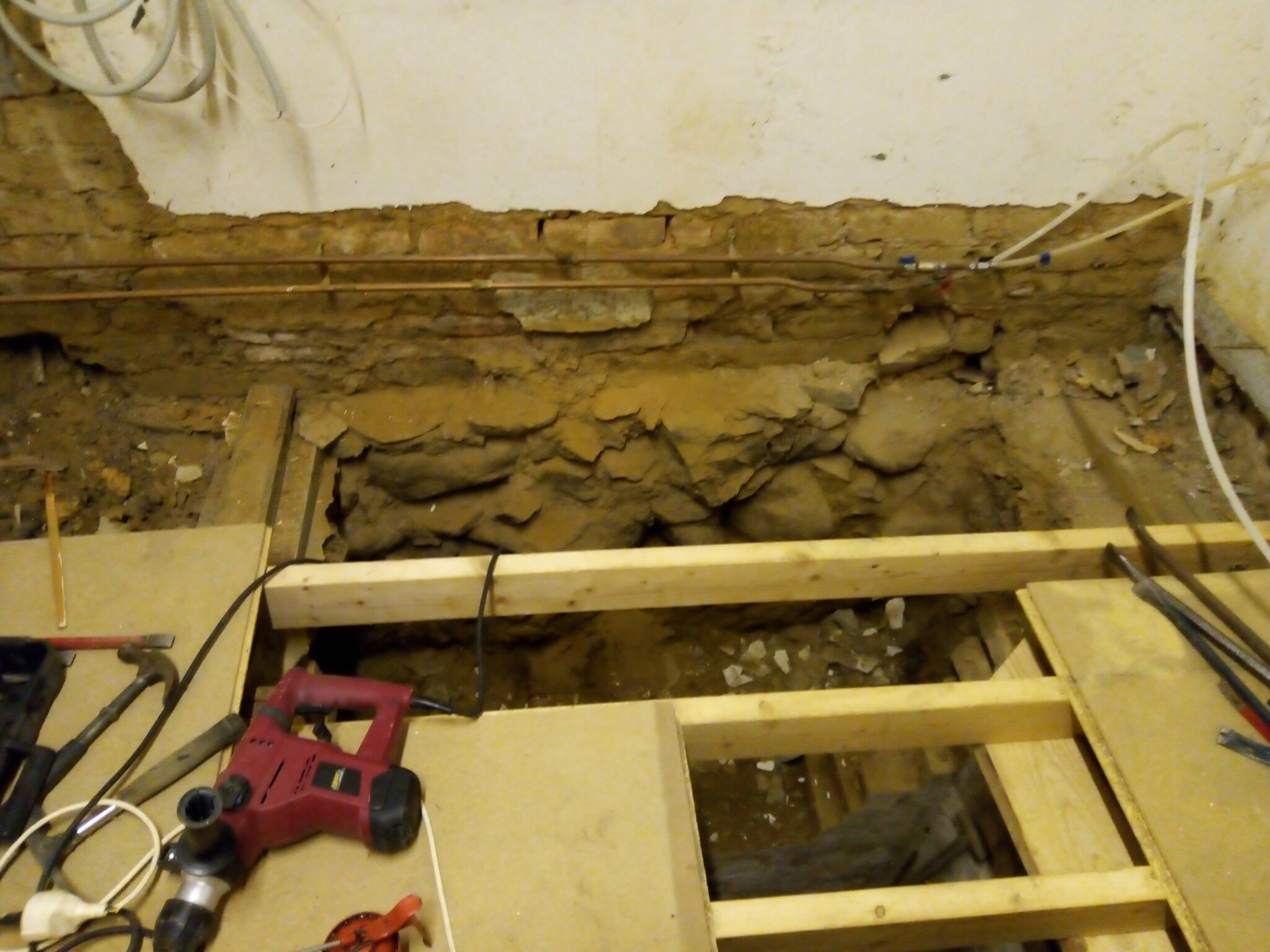
The masonry wall goes up one floor, and on top of that, there is a wooden beam that the attic floor rested on. The wall rests on a row of stones that is about 70cm high and rests on the ground or a little bit below the ground.mexitegel said:
Nothing strange about cutting a lintel, but it is reinforced, so the easiest way is a hefty concrete cutter. Otherwise, you have to carve with various cutting discs on the angle grinder.
But, in all friendliness: Do you have control over the wall's load-bearing capacity and construction? What does the lowest course of bricks rest on? Just to make sure you don't undermine the wall. Normally, you prop up before demolishing a load-bearing wall.
Without answering your actual question; When I was in a similar situation (and I'm too stingy to consult a structural engineer or whoever does those calculations), I went to the local scrapyard. They had some railway tracks lying around, and it didn’t cost much to get them to cut 2 meters for me.
I propped everything up, removed two courses of brick, and secured the "iron beam" in the best way before meshing over and plastering. I believe that beam will outlast the house and has ten times the strength of a lecabalk. I think.
Then, of course, other factors like deflection during a fire come into play, so if you want to do it right, someone should calculate it, of course.
I propped everything up, removed two courses of brick, and secured the "iron beam" in the best way before meshing over and plastering. I believe that beam will outlast the house and has ten times the strength of a lecabalk. I think.
Then, of course, other factors like deflection during a fire come into play, so if you want to do it right, someone should calculate it, of course.
I have good contact with a retired engineer who will probably have the final say on the matter.Maveric77 said:
Without answering your actual question; When I was in a similar situation (and I'm too cheap to consult an engineer or whoever calculates such things), I drove to the local scrapyard. They had some railway tracks lying around, and it didn't cost much to get them to cut 2 meters for me.
Propped everything up, removed two layers of bricks, and secured the "iron beam" in the best possible way before meshing over and plastering. I believe the beam will outlive the house and has ten times the strength of a lecabalk. I think.
Then other factors come into play, like bending in case of fire and so on, so if you want to do it right, someone should definitely calculate it.
Do the same but with a steel beam instead, H, I, U, or even 2 L can work well.maxmsm said:
Leca probably works, but it seems very cumbersome. Especially if you don't have the right length.
What the right length is can probably only be answered by a designer, the opening under the wall will be a maximum of 150cm so in my thought I should have at least 50cm beam on each side of the opening.AXS said:
By stones do you mean natural stone and not bricks, and are you not digging under this level? However, I do get a bit nervous that the wall is opened so much when there is a gable wall above. Talk to your engineer, but I agree that a steel beam is probably more suitable and easier.maxmsm said:
Yes, there's a row of natural stone in various sizes under the wall, it's a typical interior wall (not a gable) that, when the house was built, was between the former apartments in the house, so the masonry wall is single brick and about 2.5m high.
I was at a local builder's merchant I frequently buy from, who has great expertise, and I discussed this a bit. A few days later, I received an email where they had asked their supplier, who is also the manufacturer of lecabalkar, and they did not want to perform a structural calculation on such a beam...
Now I know which manufacturer to boycott for the rest of the renovation...
Now I know which manufacturer to boycott for the rest of the renovation...
Feels very much like going over the river instead of water with this beam. It's an old house and a difficult wall to calculate. You won't get sensible values as the input values are impossible to calculate.
The reasonable thing is to replace the masonry wall with a suitable beam that fits. Make sure to secure it well and then reinforce around it.
The reasonable thing is to replace the masonry wall with a suitable beam that fits. Make sure to secure it well and then reinforce around it.
Do you mean to tear down the wall?It feels very much like overcomplicating things with this beam. It's an old house and a difficult wall to calculate. You won't get sensible values since the input values are impossible to calculate.
The reasonable thing is to replace the brick wall with a suitable beam that fits. Make sure to secure it well and then reinforce around it.
Nothing is gone, I need to get through between the basement spaces under the wall and don't want a brick wall on my head.....
The plan now is to remove 3 courses at the bottom of the wall and replace with a lecabalk of 2.4m over an opening of about 1.5m as support during the work, so I thought to remove a stone about 80cm from the end and another about 160cm from the end in the 4th layer and insert studs there to support the wall before I remove the 3 courses below.
Picture attached of a test on loosening a stone.

I’ll jump to the original question. It seems doubtful to cut a lecabalk. The first hit on Google is prestressed, and then it should reasonably not be cut, if it is to maintain its function. The bearing length should be 250mm per side, and then you can expect that the reinforcement fastening is somewhere within that length from both ends. Cut 0mm at the end - ok! Cut 250mm at the end - not ok. The boundary lies somewhere in between 
https://nystromscement.se/produkter/lecablock/lecabalkar/lecabalkar/
https://nystromscement.se/produkter/lecablock/lecabalkar/lecabalkar/
I think a Lecabalk is "Mickey Mouse" in your case, use an H-beam or similar. (iron)
You also have to ensure that the load can be supported by the walls the H-beam rests on.
Lecabalk is all well and good, but it can handle 3 MPa from the factory, and shouldn't be cut to maintain these MPa.
Trust me, you'll shed many tears if your house starts to "move," so better safe than sorry.
Regards, jawen
You also have to ensure that the load can be supported by the walls the H-beam rests on.
Lecabalk is all well and good, but it can handle 3 MPa from the factory, and shouldn't be cut to maintain these MPa.
Trust me, you'll shed many tears if your house starts to "move," so better safe than sorry.
Regards, jawen