Hello, we are about to undertake building a new kitchen in our house from 1880. The existing walls, ceiling, and floors are crooked, which we really like and don't want to align by putting up unnecessary panels. However, the three walls where the U-kitchen will be built need to be somewhat straight, but most importantly the angles need to be right. Currently, there are a few layers of wallpaper and then hardboard nailed to the log walls. The hardboard is quite warped, so installing a kitchen on the existing walls is not an option. I hope to avoid aligning the walls as I think the angles are almost right, at least sufficiently so. I'm considering what would be best to cover the logs with; I've thought about hardboard or OSB. If the walls need to be aligned, I'm considering using furring strips, adjusting with frame screws, and then installing paneling + beadboard. I would gladly appreciate any feedback on this.
Best regards,
Petrus
Personally, I think slanted walls are a bigger problem in a kitchen than crooked corners. The latter can usually be solved with filler pieces. You can also make things easier by only using factory-made base cabinets and combining them with wall-mounted shelves. Suitable wall material depends on how the walls will be used and finished, as well as how much they need to be adjusted. K-plywood is a much better material if you need to attach many things and the screws do not reach the timber. Tile requires gypsum. Beadboard looks very nice in an old-fashioned kitchen. It can be installed both on studs and on panels, depending on how strong you want the construction to be.
Personally, I think that slanted walls are a bigger problem in a kitchen than crooked corners. The latter can usually be solved with filler pieces. You can also make it easier for yourself by only using factory-made base cabinets and combining them with wall-mounted shelves. Suitable wall material depends on how the walls are going to be used and treated, as well as how much they need to be adjusted. K-plywood is a much better material if you need to attach many things and the screws do not reach into the timber. Tiles require gypsum. Beadboard looks very nice in an old-fashioned kitchen. It can be mounted both on studs and on a board, depending on how strong you want the construction to be.
Jjustusandersson said:
Personally, I think that slanted walls are a bigger problem in a kitchen than crooked corners. The latter can usually be solved with filler pieces. You can also make it easier for yourself by only using factory-made base cabinets and combining them with wall-mounted shelves. Suitable wall material depends on how the walls are going to be used and treated, as well as how much they need to be adjusted. K-plywood is a much better material if you need to attach many things and the screws do not reach into the timber. Tiles require gypsum. Beadboard looks very nice in an old-fashioned kitchen. It can be mounted both on studs and on a board, depending on how strong you want the construction to be.
Jjustusandersson said:
Personally, I think that slanted walls are a bigger problem in a kitchen than crooked corners. The latter can usually be solved with filler pieces. You can also make it easier for yourself by only using factory-made base cabinets and combining them with wall-mounted shelves. Suitable wall material depends on how the walls are going to be used and treated, as well as how much they need to be adjusted. K-plywood is a much better material if you need to attach many things and the screws do not reach into the timber. Tiles require gypsum. Beadboard looks very nice in an old-fashioned kitchen. It can be mounted both on studs and on a board, depending on how strong you want the construction to be.
Jjustusandersson said:
Personally, I think that slanted walls are a bigger problem in a kitchen than crooked corners. The latter can usually be solved with filler pieces. You can also make it easier for yourself by only using factory-made base cabinets and combining them with wall-mounted shelves. Suitable wall material depends on how the walls are going to be used and treated, as well as how much they need to be adjusted. K-plywood is a much better material if you need to attach many things and the screws do not reach into the timber. Tiles require gypsum. Beadboard looks very nice in an old-fashioned kitchen. It can be mounted both on studs and on a board, depending on how strong you want the construction to be.
Jjustusandersson said:
Personally, I think that slanted walls are a bigger problem in a kitchen than crooked corners. The latter can usually be solved with filler pieces. You can also make it easier for yourself by only using factory-made base cabinets and combining them with wall-mounted shelves. Suitable wall material depends on how the walls are going to be used and treated, as well as how much they need to be adjusted. K-plywood is a much better material if you need to attach many things and the screws do not reach into the timber. Tiles require gypsum. Beadboard looks very nice in an old-fashioned kitchen. It can be mounted both on studs and on a board, depending on how strong you want the construction to be.[/QUOTE
Hi, I haven't removed the masonite yet but from what I can measure with the laser, the walls look straight, and then the angles should be reasonably right as well. We'll see how it turns out when I've removed the buckled masonite. K-plywood seems sensible behind the frames. We are not going to tile but will use beadboard between the countertop and wall cabinets so no gypsum, thank goodness. However, I am a bit unsure of what to do with the parts of the walls that will not have cabinets. I would like these to be completely straight, which would be the result with plywood. Hence my thought with masonite which becomes more "wavy". I have a few months to think about it, so no rush.
No concrete answers, but maybe a little help anyway.
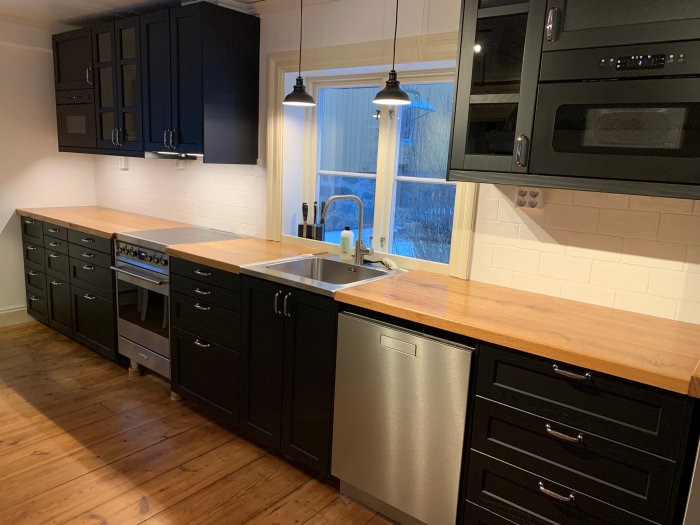
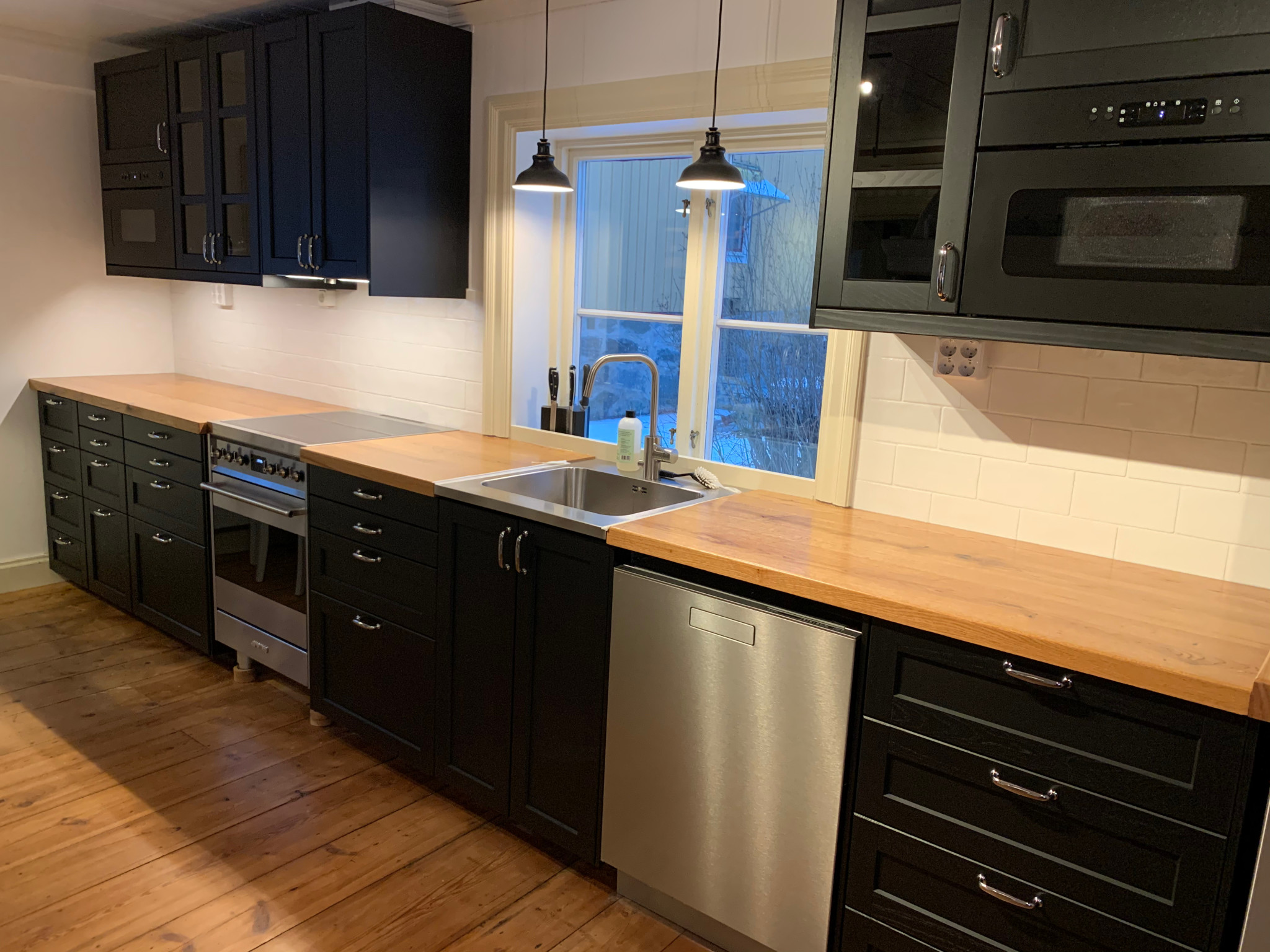
I am almost done with our kitchen renovation in a much older house than yours. Timber frame with walls, floors, and ceilings that are completely without right angles and also pleasantly wavy in all possible directions. The ceiling height varies by more than 5 cm between the corners.
Instead of making the whole room "right" and both losing some volume and having issues with windows, old moldings, and casings, I chose to install a straight kitchen with a little distance from the walls. Ikea's system with rails worked smoothly. I first attached the rails where the wall protruded the most and then filled in the valleys with masonite. Some cabinets then got slightly larger spacer blocks at the bottom to come out a bit more from the wall, but once everything is straight, they are screwed together and covered with sides and moldings. Adjusting cover panels, some creativity with tile backing and custom-made countertops that follow the house's angles. Of course, you can see that the house is still crooked if you look closely, but it's nothing that bothers, and the old house has retained its charm.
And sure, the stove's slippers will be replaced with longer legs, as soon as they arrive.
Click here to reply
Vi vill skicka notiser för ämnen du bevakar och händelser som berör dig.