
Have searched in the forum but can't find any current thread that answers my question. We are going to replace the ceiling in our living room, about 28 sqm, currently, there are only cross beams with large gaps, so it needs additional framing, and gypsum ceiling tiles need to be installed. We will spackle and paint ourselves.
How many hours does the framing and installation of gypsum boards take? That is, what should the cost be? We were considering making the same change in the kitchen at 16 sqm, but that can wait if it turns out to be as incredibly expensive as it seems... we probably don't have much knowledge about the construction industry :-/
Hope someone has good insight and can help!
How many hours does the framing and installation of gypsum boards take? That is, what should the cost be? We were considering making the same change in the kitchen at 16 sqm, but that can wait if it turns out to be as incredibly expensive as it seems... we probably don't have much knowledge about the construction industry :-/
Hope someone has good insight and can help!
I don't know what it costs, but I think they should manage it in a day.
What I actually wanted to convey was to think again about plasterboards, and doing the jointing and painting yourself because it requires experience to make it smooth and nice.
"Real" ceilings might be more expensive to buy, but easier to install, don't require costly jointing and painting, and don't crack.
It's not fun when they crack later. *looks grimly at my ceilings*
What I actually wanted to convey was to think again about plasterboards, and doing the jointing and painting yourself because it requires experience to make it smooth and nice.
"Real" ceilings might be more expensive to buy, but easier to install, don't require costly jointing and painting, and don't crack.
It's not fun when they crack later. *looks grimly at my ceilings*
Hello!
Yes, I understand, but I would prefer a smooth ceiling; otherwise, I am considering a panel similar to "rough" used on the wall. But thank you, then I suspect it might be a bit overestimated. They have calculated 56 hours for the 28 sqm and 36 for the possible 16 sqm in the kitchen.
Yes, I understand, but I would prefer a smooth ceiling; otherwise, I am considering a panel similar to "rough" used on the wall. But thank you, then I suspect it might be a bit overestimated. They have calculated 56 hours for the 28 sqm and 36 for the possible 16 sqm in the kitchen.
Yes, I understand that plastering can be tricky, but it was the hardware store that said it would be easier if you bought real ceiling plasterboard with a slight bevel around the entire board; that way, there will only be a very small amount of plastering. But I have also considered that it might crack, so maybe I'll check with more professionals.
The ceiling gypsum they are referring to is the kind where you only plaster the screw heads. This results in a grid pattern of the sheets when finished. I have such ceiling gypsum sheets in my garage.J Jezzie said:I understand that plastering can be tricky, but the hardware store mentioned that it would be convenient to buy proper ceiling gypsum with a slight bevel around the whole sheet, as that would require only a small amount of plastering. However, I have also considered that it might lead to cracks, so it might be wise to consult more professionals.
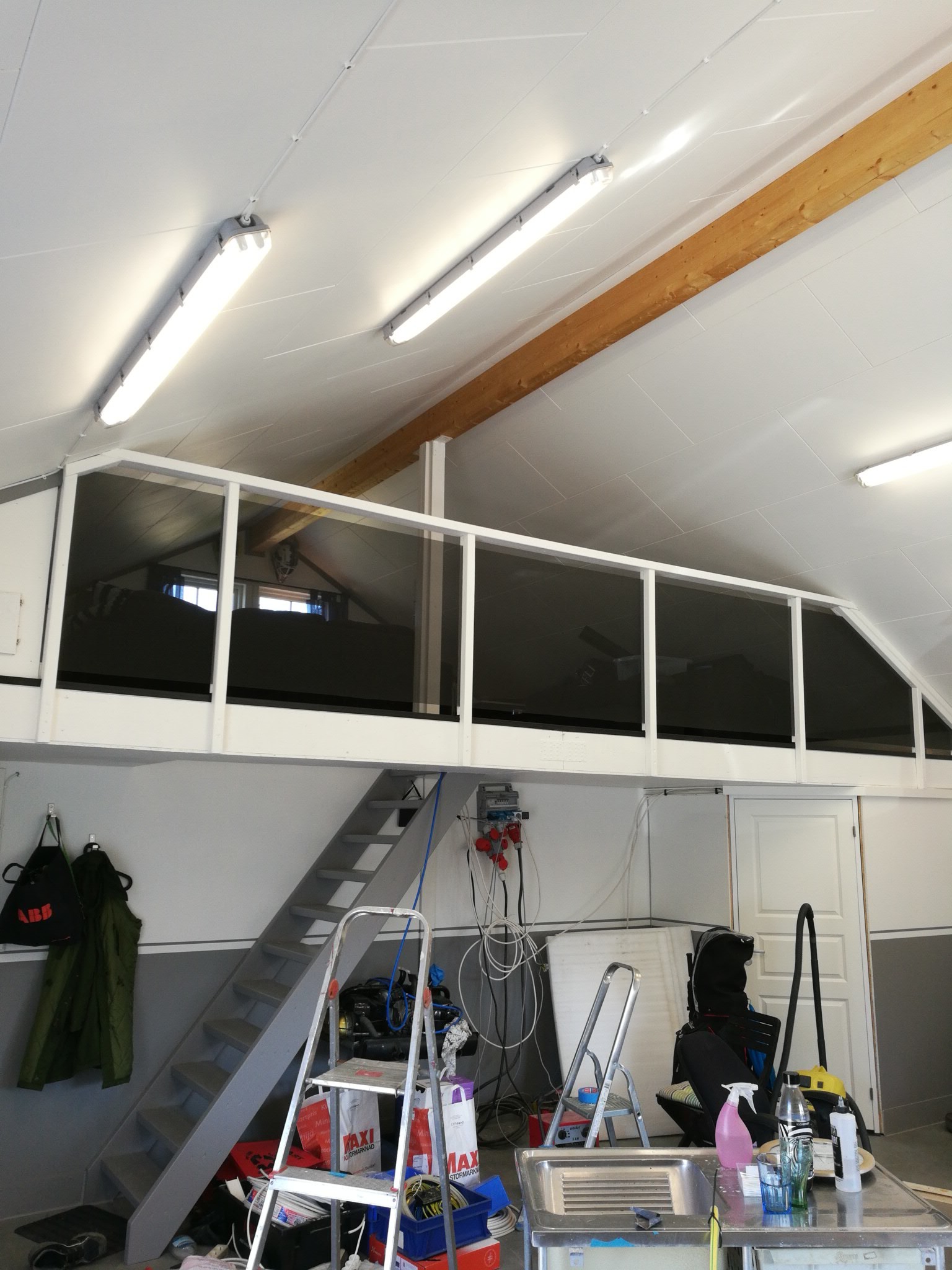
Yes, exactly those ones, but he suggested that you could fill the small gap between the boards in a simpler/better way than filling regular plasterboards that have the wide indentation for tape/strips. But as I said, I've only heard this from one person, so it might not be such a good idea after all.
I don't think it's a good idea, it will definitely crack if you don't have a strip.
Go for large panels and install them yourself, subcontract the plastering if you're not confident or don't have the energy to make it look good yourself.
Go for large panels and install them yourself, subcontract the plastering if you're not confident or don't have the energy to make it look good yourself.

As mentioned, do the entire job yourself, or at least the installation of the boards.
You attach furring strips to the ceiling, which are boards of 28x70mm (assuming a maximum of 120cm between the joists). Place them 30cm apart. You can also place them 40cm apart, but then you must place furring strips around the room's edges as well. It becomes too long of a span for a plasterboard edge with 40cm.
Rent a drywall lift, costs about 200 for a weekend. It's a stand with a jack that presses the board against the ceiling. It's very easy to lift the boards with a lift. You work with the board at a comfortable height, hoist it up into place, and screw it in. I recall that the screws should be 30cm apart around the edges, and 60cm apart "in the middle" of the boards (check with someone who knows).
Installing the boards is a piece of cake compared to plastering.
IF you plaster yourself, buy or rent a drywall sander. It's a sanding machine with a long handle, connected to a vacuum cleaner. It becomes almost dust-free. And you can easily sand 20 sqm in an hour.
My experience as an inexperienced ceiling plasterer at home is that as a beginner, you should expect to plaster in 3 rounds (plaster for the tape, plaster over, a filling plaster for what you missed). Then sand, and then touch-up plaster and sand another 2 - 3 times. The pros plaster in two rounds (or even once) and then sand, done.
You attach furring strips to the ceiling, which are boards of 28x70mm (assuming a maximum of 120cm between the joists). Place them 30cm apart. You can also place them 40cm apart, but then you must place furring strips around the room's edges as well. It becomes too long of a span for a plasterboard edge with 40cm.
Rent a drywall lift, costs about 200 for a weekend. It's a stand with a jack that presses the board against the ceiling. It's very easy to lift the boards with a lift. You work with the board at a comfortable height, hoist it up into place, and screw it in. I recall that the screws should be 30cm apart around the edges, and 60cm apart "in the middle" of the boards (check with someone who knows).
Installing the boards is a piece of cake compared to plastering.
IF you plaster yourself, buy or rent a drywall sander. It's a sanding machine with a long handle, connected to a vacuum cleaner. It becomes almost dust-free. And you can easily sand 20 sqm in an hour.
My experience as an inexperienced ceiling plasterer at home is that as a beginner, you should expect to plaster in 3 rounds (plaster for the tape, plaster over, a filling plaster for what you missed). Then sand, and then touch-up plaster and sand another 2 - 3 times. The pros plaster in two rounds (or even once) and then sand, done.
Okay, we probably need to seriously consider this and look around a bit. But about 50000:- to get it framed and gypsum installed, we don't feel we can prioritize :-/
H hempularen said:As I said, do the whole job yourself, or at least the mounting of the boards.
You install furring strips in the ceiling, these are boards of 28x70mm (assuming a maximum of 120cm between beams). Place them cc 30. You can place them cc40 too, but then furring strips need to be installed around the edges of the room as well. It's too long a span for a gypsum edge with 40cm.
Rent a drywall lift, costs about 200 for a weekend. It's a stand with a jack that presses the board against the ceiling. It's very easy to lift the boards with a lift. You work with the board at a comfortable height, lift it into place, and screw it in. I remember that screws should be cc30 around the edges, and cc60 "in the middle" of the boards (check with someone who knows).
Installing the boards is a piece of cake compared to plastering.
IF you plaster yourself, buy or rent a giraffe sander. It's a long-handled sander, connected to a vacuum cleaner. It becomes almost dust-free. And you can easily sand 20 sqm in an hour.
My experience as an inexperienced ceiling plasterer at home is that, as a beginner, you should expect to plaster in 3 rounds (plaster for the tape, plaster over, a filler plastering for what you missed). Then sand, and then repair plaster and sand an additional 2 - 3 times. Professionals plaster in two rounds (or even once), then sand, and done.
H hempularen said:As I said, do the whole job yourself, or at least the mounting of the boards.
You install furring strips in the ceiling, these are boards of 28x70mm (assuming a maximum of 120cm between beams). Place them cc 30. You can place them cc40 too, but then furring strips need to be installed around the edges of the room as well. It's too long a span for a gypsum edge with 40cm.
Rent a drywall lift, costs about 200 for a weekend. It's a stand with a jack that presses the board against the ceiling. It's very easy to lift the boards with a lift. You work with the board at a comfortable height, lift it into place, and screw it in. I remember that screws should be cc30 around the edges, and cc60 "in the middle" of the boards (check with someone who knows).
Installing the boards is a piece of cake compared to plastering.
IF you plaster yourself, buy or rent a giraffe sander. It's a long-handled sander, connected to a vacuum cleaner. It becomes almost dust-free. And you can easily sand 20 sqm in an hour.
My experience as an inexperienced ceiling plasterer at home is that, as a beginner, you should expect to plaster in 3 rounds (plaster for the tape, plaster over, a filler plastering for what you missed). Then sand, and then repair plaster and sand an additional 2 - 3 times. Professionals plaster in two rounds (or even once), then sand, and done.
If you do it yourself, it's about 2,000 in material for sheets, spars, and screws.
Click here to reply