I am building a garage and have received different opinions on where to place the vapor barrier in my exterior wall. The garage will be heated in winter.
I have my own idea of where I think is right (i.e., if there is a right and a wrong).
What does the collective expertise here say?
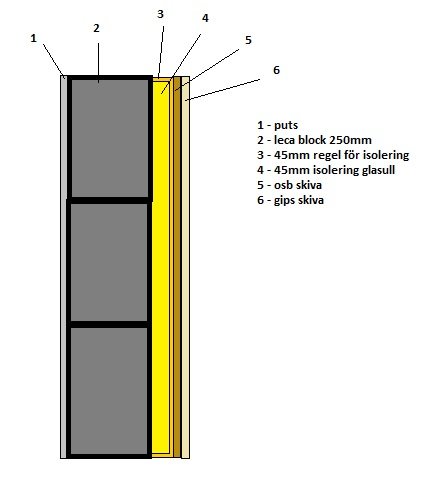
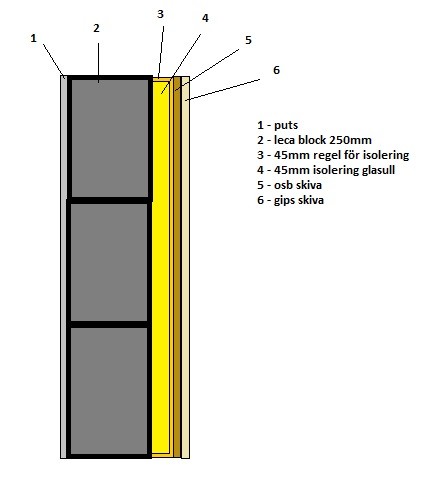
According to the image below:
Between which layers should the plastic film be?
You need to start by being clear about the purpose of the plastic. In the past, the primary function of the plastic was to prevent humidity from migrating out and condensing against the colder parts slightly further out in the structure, thus creating conditions for microbial growth, namely mold. Today, with a different type of ventilation, there is often a vacuum in houses, and the plastic also serves a sealing function to prevent cold air from being drawn in, thereby increasing energy consumption in the form of more heating.
I am not particularly knowledgeable about lecablock, but I would not have had a wooden frame lying against the construction you have drawn; driving rain that hits your plaster risks penetrating and causing mold growth on your wooden frame.
I would have had an air gap between the wooden construction and the lecan, and then had the plastic behind the insulation but not pressed against the lecan.
Why should you even insulate and use wood if you are building a garage with Leca? Instead, use Weber's products to make the plaster windproof, moisture-secured, and plaster both the outside and inside for a problem-free garage.
I would have skipped the plastic entirely.
If you place it closest to the leca it "protects" the stone, if you put it before the OSB it will be perforated by all the screws you will drive through the plasterboard + all the shelves in a garage, so the plastic won't do much good.
However, I disagree that having wood on the inside would be bad, though I wouldn't put up the studs right away but would wait a few months for the moisture to leave the leca and mortar.
OSB + plasterboard makes it sufficiently tight to prevent drawing out air that condenses, which is the most common problem.
If we are wrong, it's not worse than tearing down the wooden studs and reporting back.
Why should you even insulate and use wood if you are building a garage with Leca. Instead, use Weber's stuff to make the plaster windproof, moisture-proof and plaster both the outside and inside, and you'll have a problem-free garage.
The two different suggestions I received from visitors at the construction site are to place the plastic between the beam and the leca in one proposal, and between the OSB board and the insulation according to the other proposal.
Since the garage will be heated in the winter, I will likely wash the car there occasionally in wintertime (however, the garage will not function as a proper car wash), and then it will be really humid in the room.
If one then chooses not to place plastic in the wall, will the insulation not absorb a lot of moisture? Similarly, if you place the vapor barrier between the leca and the insulation, then the moisture will remain and condense in the insulation, or am I wrong? If instead, you place the plastic between the OSB board and the insulation, the moisture never reaches the insulation, which spontaneously feels more natural to me, although perhaps unnecessary to do, or completely wrong... or even harmful?? I readily admit I don't know about these things.
Moisture from outside, even if it's driving rain on the facade, feels spontaneously quite distant. It would first have to soak through the plaster and then seep through 250mm thick leca. The leca is not completely dense, but it would probably have to rain heavily for the moisture to travel through, I imagine.
Feel free to add more opinions!
Thanks in advance to all of you who are more knowledgeable than me in this area!
In a way, I would like to place the diffusion-tight plastic between the LECA and the wooden frame construction, to protect the wood from becoming damp from the LECA moisture. (e.g. after driving rain).
But then we have the rule of thumb that the diffusion-tight layer must not be placed further in than 1/3 into the wall construction from the inside. This is to prevent moisture from reaching so far out that it starts to condense (during the winter months).
And since lambda LECA = about 0.2 and lambda MU = about 0.037, it means that the plastic would then be placed (temperature-wise) roughly in the middle of the construction or even slightly further out towards the outside.
And that's not good.
So for that reason, the plastic should sit behind the OSB.
But maybe you should insulate with foam and use metal studs... maybe...
Or, best of all, you use iso-LECA. Then you can skip the inner insulation layer altogether if you wish.
Offtopic: is extra insulation needed on leca walls? Shouldn't it insulate well anyway?
Well, Leca has quite a poor lambda value. So, 25cm LECA is roughly equivalent to 5 cm mineral wool. They are quite thin walls. -40s standard, kind of. =)
Mikael_L
Or, even better, you can use iso-leca. Then you can skip the inner insulation layer entirely if you wish.
Thanks for your reply!
The walls already exist so I'm in the "additional insulation" situation currently.
I'm somewhat against foam plastic as it is extremely flammable and thus a bit less suitable than glass wool to have in a garage/workshop if there are alternatives.
In fact, mineral wool doesn't mold either, so mineral wool + metal studs should also work. And then plastic between studs and OSB. If you do so, make sure you get metal studs with lots of holes and little metal. Otherwise, they form a very strong thermal bridge. There is usually some info about the product.
Or maybe skip plastic entirely, add some mechanical exhaust ventilation, like a small PAX fan, and painted walls with acrylic sealant in all corners and any gaps, and it shouldn't diffuse much water vapor into the walls.
It’s not at all certain that it's a problem to place wooden studs directly against the LECA wall, but there is a slight risk, isn't there?
After receiving responses from several sources that the plastic should be between the OSB and the insulation, and thereby not between leca and the wooden stud, that's the way it had to be. The work has started and continues as I make my way around the garage. The fact is that reputable serious construction companies, as well as various carpenters and general "know-it-alls" that I asked during late summer and fall, provide both alternatives depending a bit on where you go with your question. That is, different construction companies give different answers, for example. This means that if you order the job, you'll get the plastic in different places depending on which company you hire. Who is right in this matter??? Or if we turn the issue around - Can one make a mistake?? When I started unraveling this, I didn't think it would be so complicated to get an answer to this question, or that I would be writing in this thread nearly half a year later... But I find this question interesting and still wonder what is considered "most correct" if there is an answer to that at all...... What's the deal, folks?
Click here to reply
Vi vill skicka notiser för ämnen du bevakar och händelser som berör dig.