
1,273 views ·
14 replies
1k views
14 replies
Correct a floor with "slope" when laying laminate flooring
Garden fixer
· Stockholm
· 173 posts
Hello,
I am going to install laminate flooring. Currently, there is a vinyl floor in the room.
Near one wall, about a meter from the wall inward, the floor slopes about 8mm in a meter.
Is there any simple and good method to correct this before laying the laminate floor? I'm thinking that leveling compound on a vinyl floor might not be very good.
I'm posting two pictures to show how much it slopes (ignore the spirit level visible in the picture. The other “correct” line level is vertical in the second picture.
I am going to install laminate flooring. Currently, there is a vinyl floor in the room.
Near one wall, about a meter from the wall inward, the floor slopes about 8mm in a meter.
Is there any simple and good method to correct this before laying the laminate floor? I'm thinking that leveling compound on a vinyl floor might not be very good.
I'm posting two pictures to show how much it slopes (ignore the spirit level visible in the picture. The other “correct” line level is vertical in the second picture.
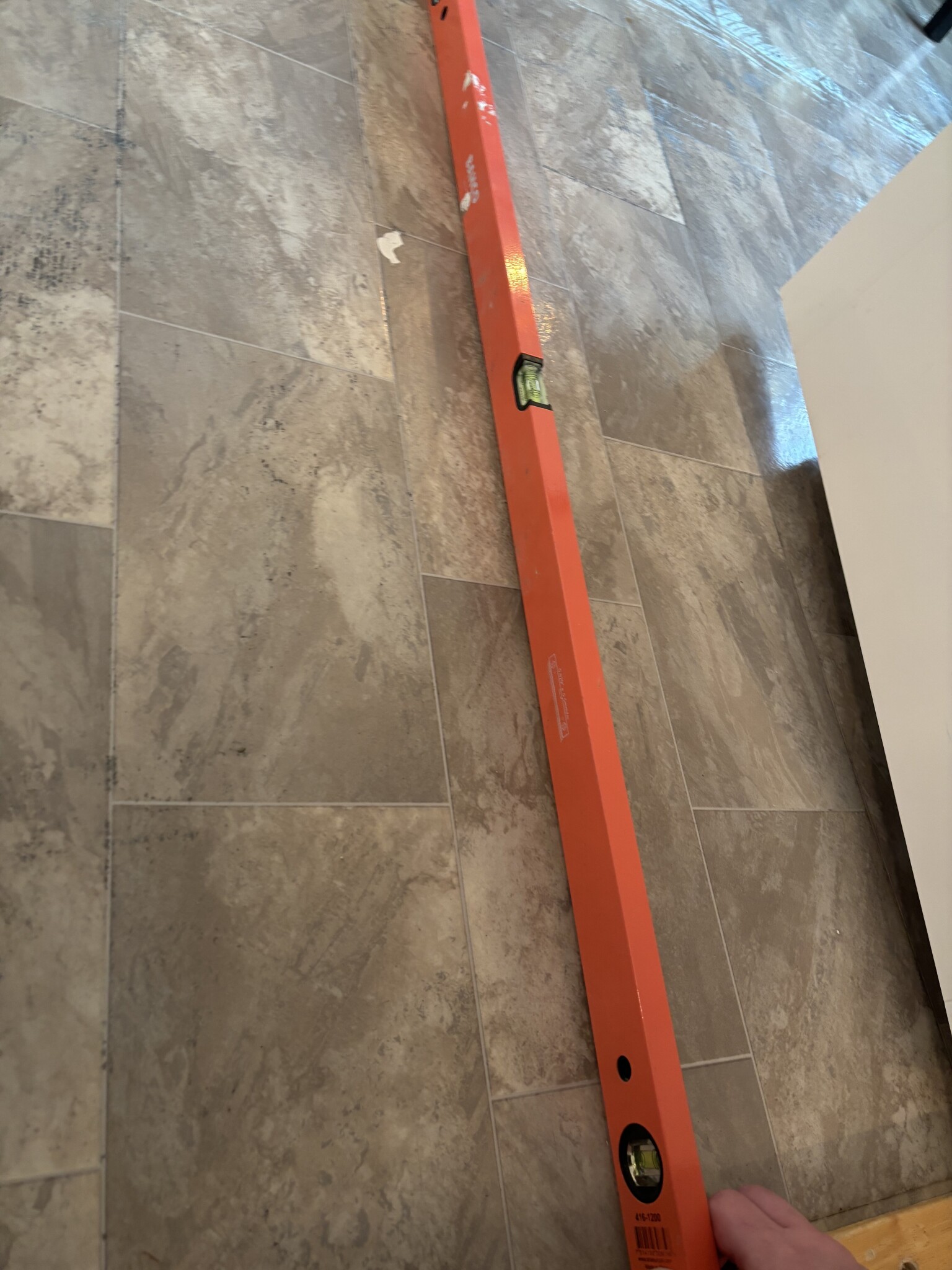
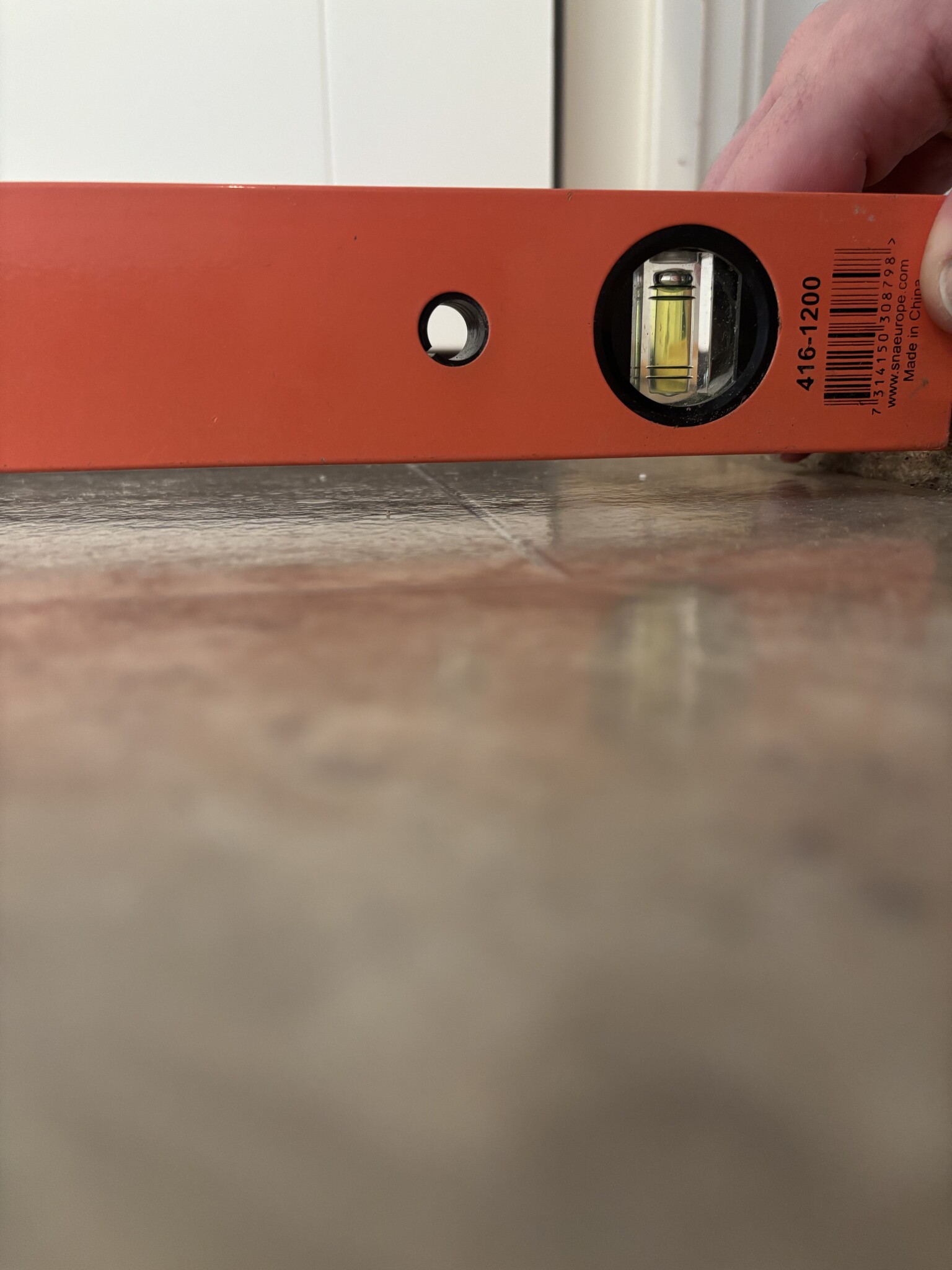
The question is why there are cases at all.
the fact that it slopes doesn't matter. You'll just have problems with doors, etc. if you start leveling the floor in a corner of the house. The problem arises if you have hollows and peaks when laying the floor. The tolerances are written on the flooring packages. Usually, it's +-5mm/m. You fill up such "hollows" with self-leveling compound.G Gräsmattenörden said:Hello,
Going to lay laminate flooring. Today there's a vinyl floor in the room.
Near one wall, about a meter from the wall and inward, the floor slopes about 8mm over a meter.
Is there a simple and effective method to correct this before laying the laminate floor?
I think self-leveling compound on a vinyl floor can't be very good.
I'm posting two pictures of how much it slopes (ignore the spirit level visible in the picture. The other "correct" level is vertical in the second picture.
Garden fixer
· Stockholm
· 173 posts
ricebridge said:
Fill with what on vinyl flooring?N Nickesågen said:that it slopes does not matter. You'll only have problems with doors, etc., if you start leveling the floor in one corner of the house. The problem comes if you have pools and peaks when laying the floor. The tolerances are on the flooring packages. Usually it's +-5mm/m. Such "pools" you level with filler.
The thing is, the doors are in the "original position" because the floor is too low at the door compared to the door.
The wall has not settled. The house was built in 1991, so it's not that old.
It might have been uneven since the construction. We've only lived in the house for two years.
It's very sloped. Use liquid screed. I would take up the floor and see what the slope is due to. We had a room where the beam was broken in the middle and nailed together with the help of a piece of timber. We had to reframe and also use liquid screed on a section as the floor was uneven and slanted in all directions.G Gräsmattenörden said:Hello,
I'm going to lay laminate flooring. Today there's a plastic mat in the room.
On one side, about a meter from the wall, the floor slopes about 8mm over one meter.
Is there a simple and good method to correct this before laying the laminate floor? I thought that liquid screed on a plastic mat might not be very good.
I'm uploading two pictures to show how much it slopes (ignore the level visible in the picture. The other "correct" level is in a plumb line in the other picture.
It's better to talk to the supplier and read the installation instructions to see what tolerance levels the floor manufacturer has. These are probably stricter than what AMA recommends. 8 mm tilt per meter is a lot of tilt, too much tilt, it needs to be corrected before laying a click floor if you want it to be good. Small dips can be remedied appropriately.N Nickesågen said:that it slopes doesn't matter. You'll only have problems with doors, etc., if you start leveling the floor in a corner of the house. The problem occurs if you have puddles and peaks while laying the floor. The tolerances are stated on the floor packages. Usually, it's +-5mm/m. You should level out such "puddles."
You have to tear up the flooring if you want the new floor to look nice.G Gräsmattenörden said:What to fill with on plastic flooring?
The thing is that the doors are in the “original position” because the floor is too low at the door in relation to the door.
So the wall hasn't settled. The house was built in 1991, so not that old.
It may have been crooked since construction. We have only lived in the house for two years.
Garden fixer
· Stockholm
· 173 posts
I want to address this for personal reasons as it bothers me today. So either leveling compound or building up with something is what I want to do no matter what.H HEM2121 said:It is better to talk to the supplier and read the installation instructions to see what tolerance levels the floor manufacturer has. Probably these are narrower than what AMA recommends. 8 mm slope per meter is a lot, too much, it needs to be addressed before laying a click floor if you want it to be good. Small dips can be addressed in a suitable way.


You'll need to pull up the carpet and see what's wrong first. If you're going to use self-leveling compound, you must prime first; maybe you'll need a thin reinforcing mesh in some places? It depends on how the floor tilts, does it tilt all in one direction or in different directions? If it tilts in one direction, it might be easiest to shim up a joist that is completely level; you need to be precise so that all the joists are level. Remember, 1 mm is a lot, so you have to be extremely precise. It's good if the new joists are allowed to sit indoors for 1-2 weeks before you install them. Laminated beams are good but expensive. If it tilts in all directions, then self-leveling compound and reinforcing if needed.G Gräsmattenörden said:

Tear off the plastic carpet, prime and use flow screed; the screed will stay in place even if it cracks. I have screeded directly on primed wood in several rooms where there were dips, works fine after 20 years (engineered parquet).
My house tilted 8 cm in one corner, so we had to level it with joists, but otherwise, flow screed. An old house where the foundation was built over a stump, construction fault from 1907. Otherwise, rock underneath, but the stump caused the whole house to twist as it rotted....
My house tilted 8 cm in one corner, so we had to level it with joists, but otherwise, flow screed. An old house where the foundation was built over a stump, construction fault from 1907. Otherwise, rock underneath, but the stump caused the whole house to twist as it rotted....
Garden fixer
· Stockholm
· 173 posts
the floor in the room is completely level throughout the room until 1 meter from this wall. There, the floor begins to slope with a consistent slope towards the wall. The width of the room is 4.5 meters, and the entire width consists of the same slope. On the other side of the wall is another room. There, the floor is completely level. If the house had settled, the slope should continue on this side of the wall.
The slope has no significance whatsoever. It is dips and peaks that are problematic. Do not involve AMA in an old house. Start leveling one room and you’ll have to continue throughout the whole house to avoid thresholds in inconvenient places.H HEM2121 said:It is better to talk to the supplier and read the installation instructions regarding what tolerance levels the floor manufacturer has. These are probably stricter than what AMA recommends. 8 mm slope per meter is a lot of slope, too much slope, it must be corrected before laying a click floor if you want it to be good. Small dips can be addressed in a suitable way.
I disagree with you there, you should follow the manufacturer's installation instructions. AMA applies in old houses too when you are renovating. If the manufacturer has higher requirements than AMA, then the manufacturer's installation instructions apply. I think I'm pretty well-versed on AMA. 😉😀N Nickesågen said:
Click here to reply