We live in an extended terraced house where the space between the houses has been built together, so the houses are now technically row houses. The houses were built in 1979 and the extension was done in 1986. We have sound problems between the houses, especially noise propagating very much between the structures. It doesn't help that our bedroom is wall-to-wall with the neighbor's living room. Mainly, there are two disturbing sounds:
1. When the children run between the kitchen and living room at the neighbor's.
2. Bass line when the neighbor plays music, even if it's not particularly loud music.
I have now torn down "our" wall on the ground floor up to the neighbor's old outer facade to take a closer look at how the houses are joined.
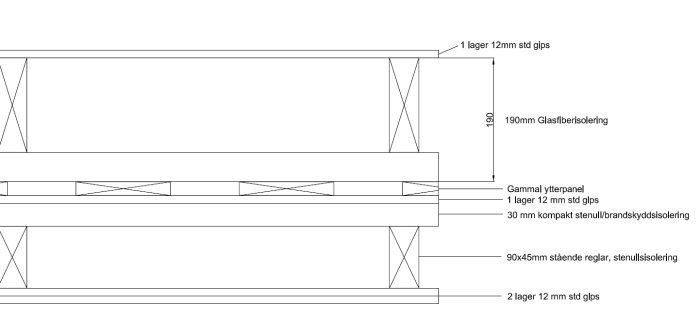
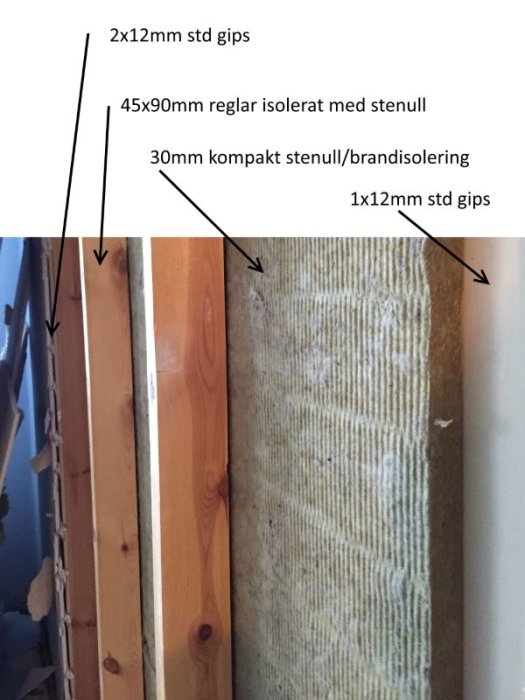
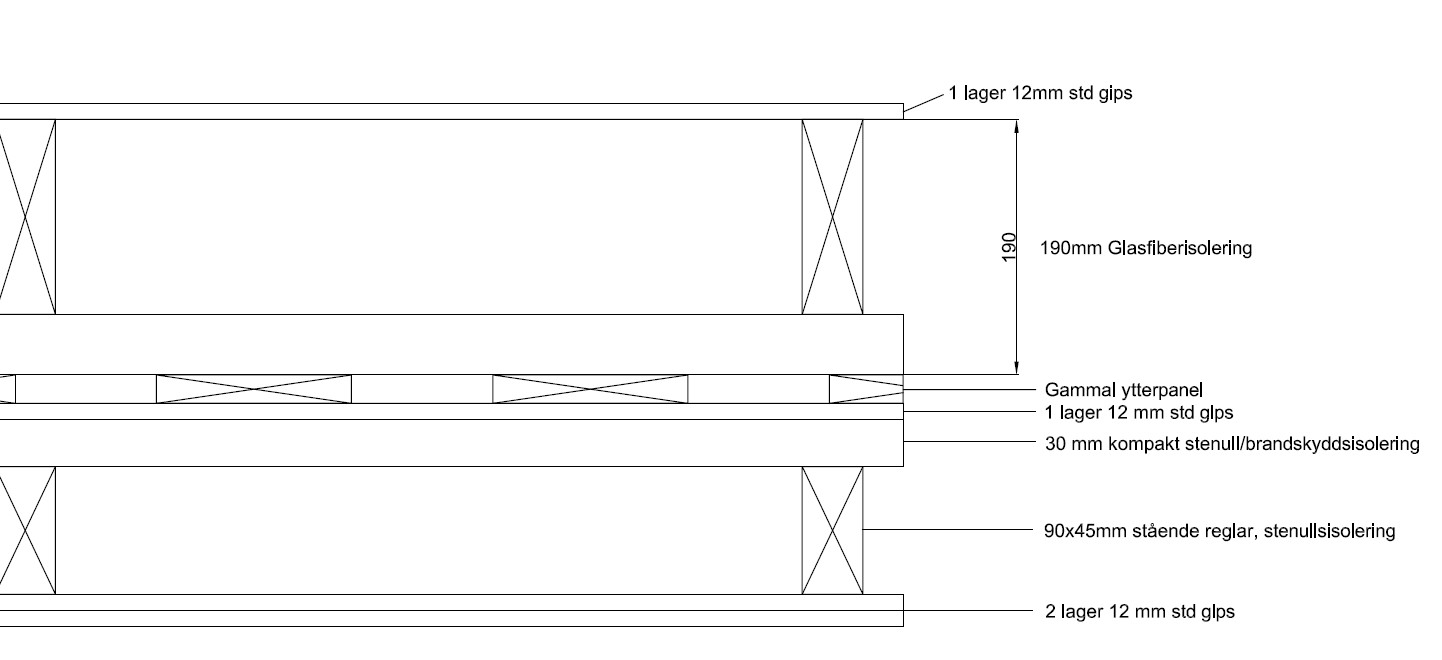
From our side, it looks as follows:
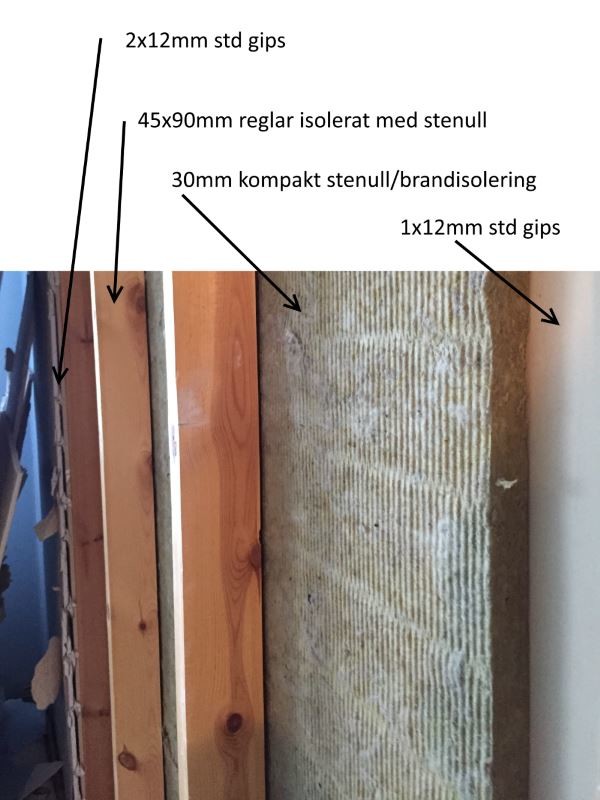
1. Double plasterboard
2. 95mm standing studs, insulated with stone wool
3. 30mm stone wool slab dense for fire insulation
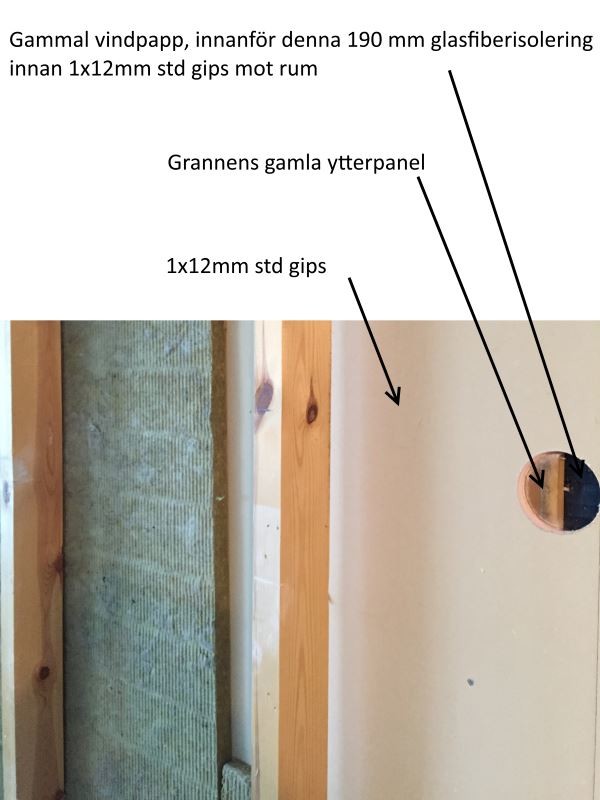
4. 12mm standard plasterboard
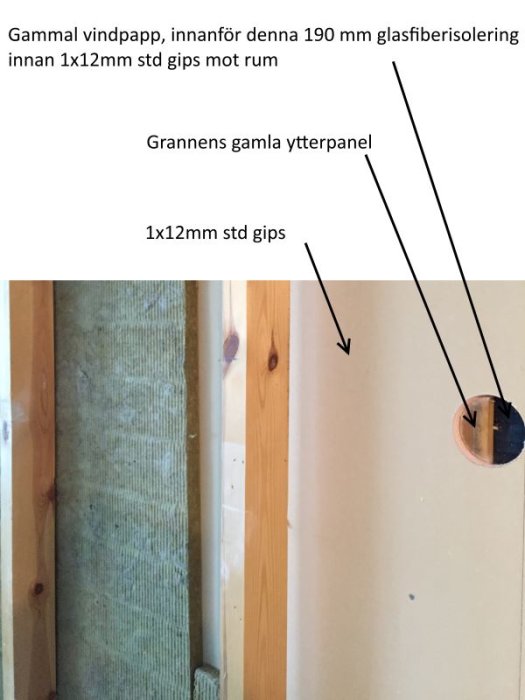
5. neighbor's old facade panel (inner lockboards, outer layer removed)
6. neighbor's wind barrier
7. neighbor's old outer wall approx. 190mm insulated with glass wool
8. 12mm single plasterboard towards neighbor's room.
Unfortunately, in reverse order above against the sketch I made:
Photos:
I mainly react to two things:
1. How little plaster there is in the "fire protection" between the houses. It consists only of a 12mm gypsum board and 30mm stone wool, naturally with a few gaps between the boards here and there. :eek:
2. Lack of an air gap. Shouldn't there be an air gap between the houses? Especially to prevent noise from propagating.
Am I right in my objections here?
Now to what I plan to do to improve the situation.
My idea is to move our 45x95 studs 95mm towards our house. This way, I create space to put more plasterboards (fire plaster?) between the houses and create an air gap.
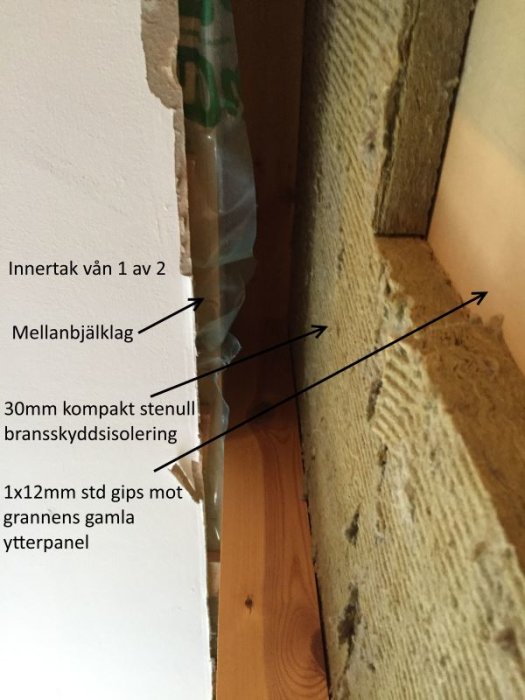
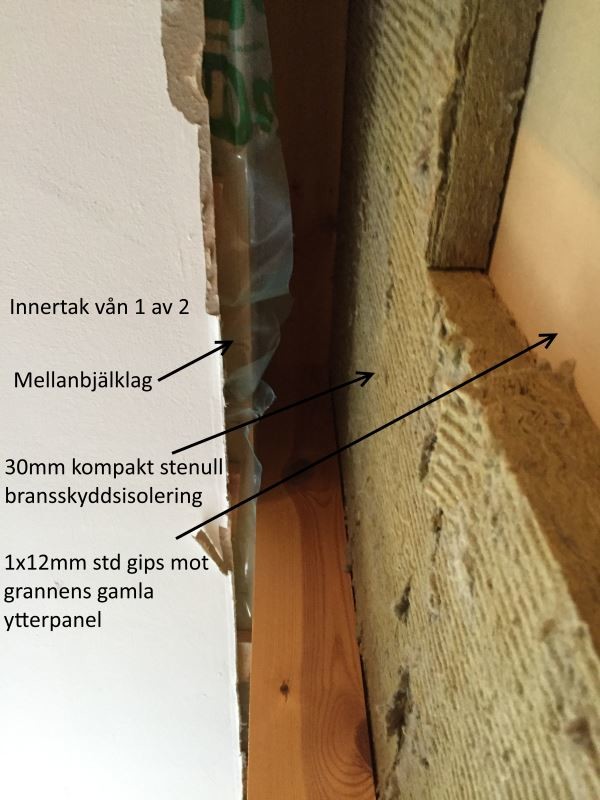
The downside to this is that the studs, which now run "outside" the middle floor, will be moved in under and over each middle floor and leave this "open" into the air gap between the houses.
See picture of the middle floor taken from below:
Does anyone here have experience with a similar situation and can give some tips on what I should consider?
You have two types of noise disturbances that require partially different strategies. The neighbor's children's running is a structure-borne sound transmitted because the houses' outer walls are adjacent to each other. The solution is to break this connection. Possibly in the way you suggested; however, I can't assess all the consequences based on your images. The bass sound gets in because it's harder to dampen low-frequency sounds. Generally, you should have as heavy a construction as possible, which can be difficult in a wooden building. Ground boards with a volume weight of about 150 kg/m3 are significantly better than regular mineral wool. Another option is to make a membrane absorber, i.e., a plywood board that absorbs sound energy. However, it might be tricky to implement in this situation. 30 mm fireproof insulation, if it doesn't contain wooden studs, has better thermal insulation properties than a traditional brick firewall (which does have some other advantages). One option is to supplement this insulation with a ground board placed directly against the fire insulation without any through studs. As thick as you can fit.
If I interpret your answer correctly, it's not wrong to add a layer or two of fire-resistant gypsum against the existing single-layer gypsum inside the wall. (It does undeniably make the construction heavier.) Then, I'll put back the existing 30mm fire protection insulation (which is, of course, without studs) and add as thick a board as I can fit outside the fire protection insulation. Then there will be a 2-3 centimeter air gap before we rebuild our inner wall anew. The new construction will be above/below the floor structure and built according to recommendations to achieve as high soundproofing as possible.
The question is how to attach the fire protection insulation and the board to the gypsum boards? Currently, it is wedged behind our wall's 45x95 studs, which hold it in place. But with an air gap behind, you'll almost have to screw it up. Screws, however, as we know, conduct heat. Any experiences/suggestions?
It is never wrong with drywall, heavy and good. However, paper-coated drywall should not be placed where the paper can absorb moisture. When installing insulation without squeezing it between studs, you can do it in different ways. You can glue it, attach it with nails through plastic washers, use plastic nails with barbs, etc. The appropriate method is somewhat product-related, so I would check with the supplier. Both Paroc and Rockwool also have ambitious websites.
Click here to reply
Vi vill skicka notiser för ämnen du bevakar och händelser som berör dig.