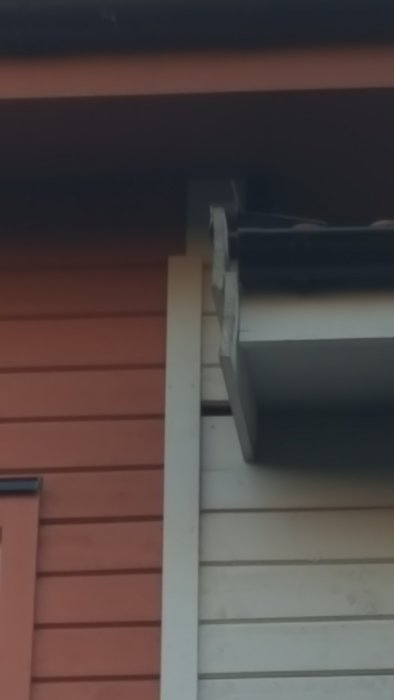
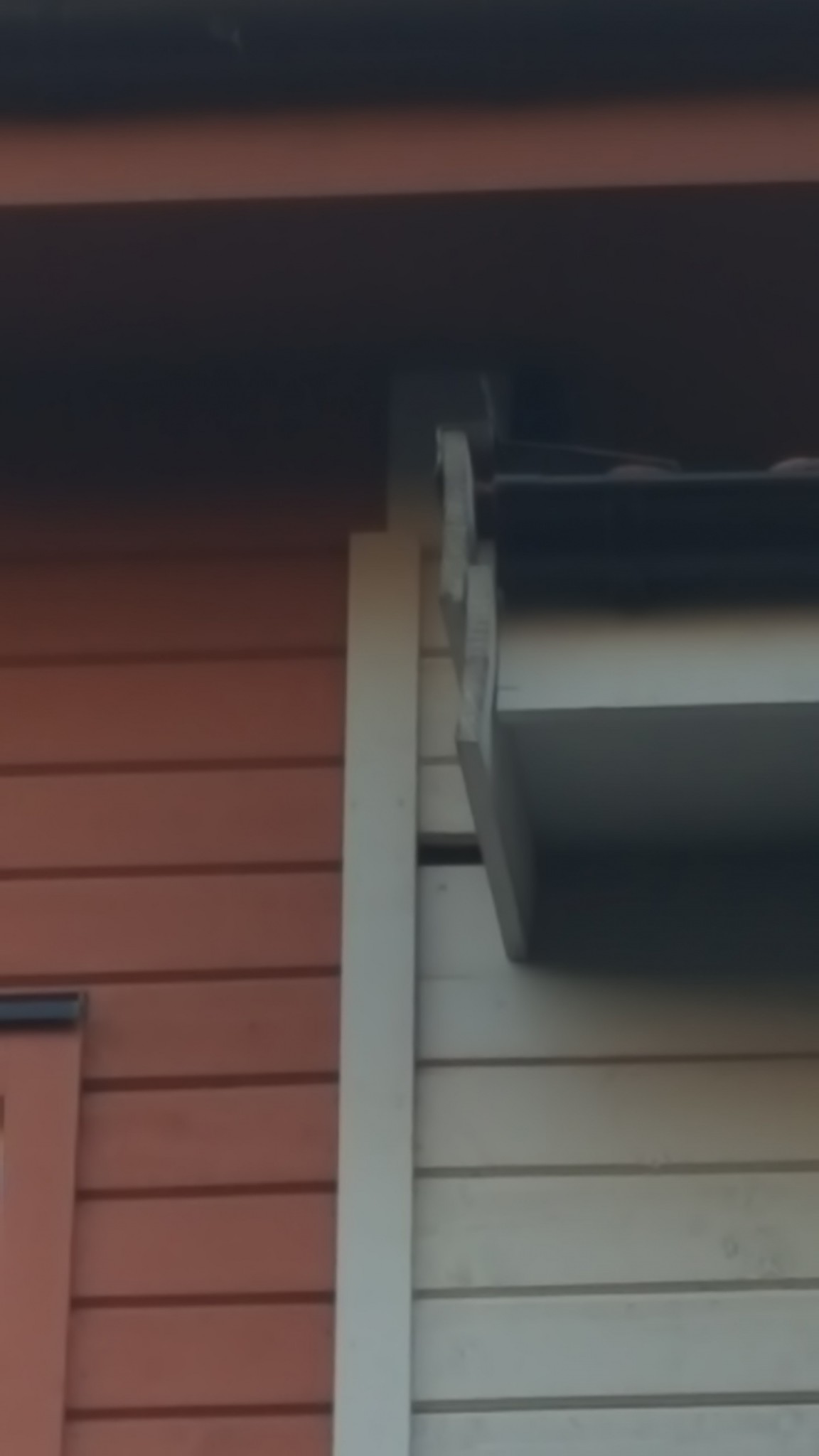
We live in a townhouse that was built in 2008. Today we discovered a construction defect high up on our house wall. About half a meter below the neighbor's roof, there is a hole/gap straight into the wall because the plank there is much narrower than all the other planks. We have never noticed this before because it is so high up and all the way on the side, towards the neighbor's house wall. But we are very worried now and feel that this needs to be fixed because there could be moisture damage inside the house wall if rainwater gets into this gap. Since it is a construction defect, the construction defect insurance should apply, right? It should be valid for 10 years after the house was built (in 2008).
We have tried to take a picture of the gap, although it is not easy to see since it is so high up, but I am attaching the picture. It's hard to guess, but we think the gap is about 10 x 4 cm in size.
It generally looks like a construction defect with the roof at the house wall. As you can see in the picture, the roof ends before our house wall does, i.e., our roof does not cover the entire house wall. The red roof that is visible above our roof in the picture is the neighbor's roof. If the roof ended where our house wall meets the neighbor's wall, there wouldn't be small planks on the other side of the roof, and this problem with the gap/hole would never have arisen.
Do you think there is any danger with water, that large amounts of water could have gotten in so there is now moisture damage inside the wall? Do you think the construction defect insurance applies in this case?
Any water that finds its way behind the facade boards should not be able to cause any moisture damage if the wall is correctly constructed.
I'm having a bit of difficulty from the picture and your description understanding how the houses are positioned relative to each other. Isn't it simply that your house ends before your facade boards?
I would cover up the hole. Guaranteed more work to try to handle it legally with a construction company.
Any water that finds its way behind the facade boards should not be able to cause any moisture damage if the wall is properly constructed.
I have a bit of difficulty from the picture and your description to understand how the houses are positioned in relation to each other. Isn't it simply that your house ends before your facade boards?
I would cover the hole. Definitely more work to try to deal with it legally with a construction company.
Ok, so large amounts of water can't rain into the hole then? No, I think our house ends where the neighbor's house begins. There isn't a large gap inside the boards between our and the neighbor's house. But the neighbor's house is higher up than ours because the street we live on slopes, so that's why the neighbor's roof is higher than our roof.
This is a typical thing you just handle as a homeowner, starting to involve construction insurance and stuff like that is for when something is really wrong.
The problem is that it's about 9 meters up, so we have no way to fix it ourselves. If the house hadn't been so tall, we could have nailed a small plank ourselves. But I guess we'll have to hire some carpentry firm then...
But I have heard that it is the construction company that is listed on the actual building insurance and that the deductible applies to them, not the homeowner. So if they fix the problem, we shouldn't pay a penny, but the construction company can in turn use the building insurance, and then the deductible will be deducted from their compensation. Does anyone know if this is correct?
1. No, the construction defect insurance is the developer's insurance. And it's almost never the construction company that is the developer, usually, the developer is the first user/owner.
But I don’t know how it is in your case.
2. The construction defect insurance can have a deductible of half a price base amount (common), i.e., around 20,000:-
3. If it costs more than the deductible to bring in a company that addresses it with a skylift or scaffolding, then it might be worth looking into whether BFF can compensate for this.
But considering the amount of time and hassle you'd likely have to invest in it, I would say that the measure should probably cost at least 30' before even considering using BFF.
4. BFF is a completely worthless insurance that should never have been legislated in its current form. A sheer profit for the companies, two out of three of which are owned by construction companies themselves. So it's a bit ironic that construction companies themselves make money from the legislator's decision that insurance must exist for protection - against faults made by the companies who then benefit from the insurance claim profit.
It's not far-fetched to suspect that maybe the construction companies themselves have lobbied for this.
But I don't really understand.. The building defect insurance is in this case Einar Mattssons. So then it is Einar Mattsson who has to pay the deductible, right? When I spoke to a claims adjuster at TryggHansa, she said that I shouldn't pay any deductible at all because the insurance is not in my name but in the builder's, and they must fix the defect since it's built incorrectly.
I fought tooth and nail to avoid this completely unnecessary and worthless insurance when we built. It actually worked, probably because of a sensible municipality and a sensible case officer. I know many who have fought a lot but still been forced to pay for this ridiculous insurance.
But I think we builders can see a little light on the horizon.
Homeowners with moldy single-stage sealed stucco facades have so far been harshly rejected by the BFF companies when trying to get compensation for the construction defects they have suffered.
But I believe a ruling has now been passed requiring them to compensate for this. It might be appealed to higher courts for a few more years, etc. But perhaps the BFF companies will eventually have to pay out money, and if it's about single-stage sealed stucco facades, it could be a lot of money.
I believe that everyone with such facades should immediately file a damage report against their construction defect insurance so that it has been done in time and can then use the BFF if the Supreme Court eventually rules in favor of the homeowners.
OK, so you bought an already finished house that someone else has lived in?
Yes, then you are not the ones with the insurance, and thus no agreement with FB.
It is only the original builder who has BFF and an agreement with FB who can handle the insurance issue.
Then you can pursue this as a "hidden defect," and all owners must pursue it backward until it reaches the first owner who can handle it as an insurance matter.
But that there is a gap, completely visible in the facade, is likely quite futile to pursue as a "hidden defect."
This should have been examined (and found) during the purchase of the house.
Yes, it sounds like an incredibly complicated and crazy insurance. But when you were exempted from the insurance, were you a private person or acting as a developer? Or is one called a developer if you build a house as a private person? Einar Mattsson built the entire row of townhouses where we live, so it's that firm that is the developer, right? So they must fix the fault at no cost to us? (regardless of whether they choose to use the insurance or not) Because we have a right of complaint for 10 years and they made a mistake in the construction.
Ladder or rent a skylift, and it's done in half an hour! If the house is nine meters high, you should be able to reach that height yourself. Partly to be able to paint it, but also to clean gutters and check for any roof damage. Otherwise, it will be very expensive to maintain if craftsmen have to come every time something needs to be done up there.
Vi vill skicka notiser för ämnen du bevakar och händelser som berör dig.