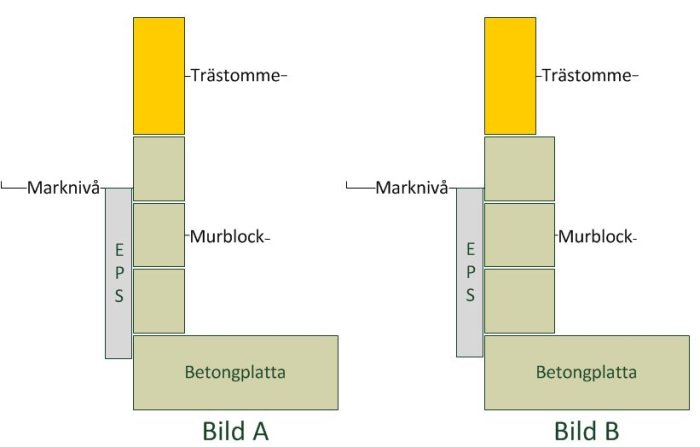
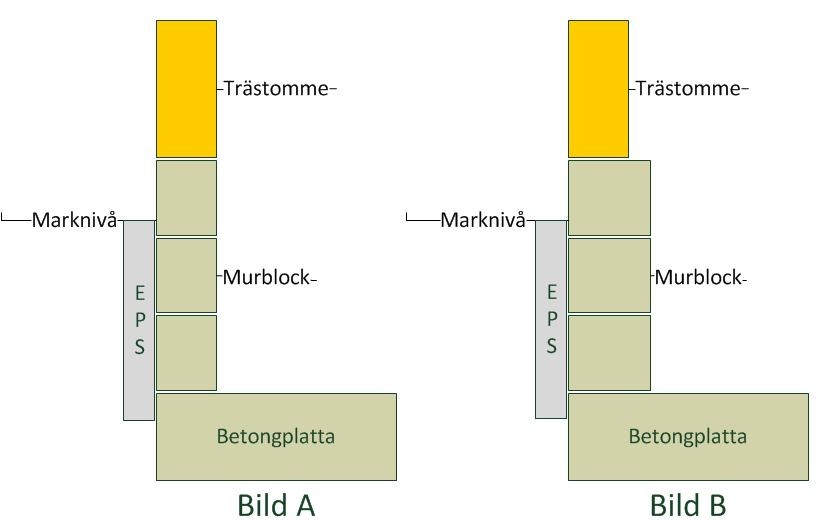
I am in the process of designing a future Attefall house and have come to the conclusion that I will want to dig it down 0.5 meters in order to achieve a sufficient ceiling height in the loft (the Attefall limitation of 4.0m from the average ground level to the ridge). The plan is to excavate and cast the slab so that its top side is 0.5 meters below ground level. Then build up 70-80 cm and then transition to a wood frame of 145+45.
Now to my dilemma. The Attefall regulations limit me to a building area (above ground) of a maximum of 25 sqm. Since it’s all a compromise between insulation and living space, I don’t want to exceed wall thickness 145+45 + panel and drywall. But how do I ensure the masonry basement part is adequately insulated for the house to be considered an auxiliary dwelling?
My initial thought was to build with regular 190mm wide leca and add insulation to it externally below ground. But since I don't want the wooden facade to start at ground level, I get 10-20cm of uninsulated wall before the wood frame begins.
I am attaching a sketch to show how I have thought (Image A). What I definitely want to avoid is having the inner wall not align (Image B). Is the only solution to step up to a wall thickness of 250mm and then use insulated masonry blocks? Or can I simply use uninsulated leca blocks in a course? Grateful for all the help and wise thoughts I can get.
Your problem is typical of Swedish construction today, more a matter of law than architecture. Fortunately, there are solutions to most issues. It can be assumed that leca stone has half the U-value compared to mineral wool of the same thickness. Naturally, the leca stone should be flush on the inside with the rest of the wall construction. On the outside, it should not protrude beyond the wall surface as the building area is then calculated from the outer edge of the leca stone. Whether a layer of leca stone has a lower U-value than the rest of the wall construction is completely irrelevant. The masonry blocks beneath ground level are insulated on the outside. When calculating the building’s insulation capability, there are two alternative methods according to BBR (Boverket's Building Regulations) for houses under 100 sqm. In one case, the building's overall U-value must be below 0.33. In the other, the U-value for each building part (roof, walls, etc.) must be below a certain specified value. There are alternatives depending on the heating method and climate zone. In all cases, the U-value for each energetically equivalent part is calculated individually and then integrated for an overall value. In your case, I could imagine that optimizing the interior area involves compensating for deficiencies in the wall construction with more insulation in the roof and under the slab.
Great, just what I was looking for. After a bit of rough calculation, I should end up below the value 0.33 on average for the entire shell. Now it's just to continue with the construction drawings... Thank you so much for the help!
Great, exactly what I was looking for. After some rough calculations, I should end up with a value below 0.33 on average for the whole shell. Then it's just a matter of continuing with the construction drawings... Thanks a lot for the help!
How's it going with building the attefallshus with a basement? I'm also thinking about building with a basement.
How did the construction of the Attefall house with a basement go? I myself am considering building with a basement.
Unfortunately, the laziness took over and it ended up being a slab on the ground instead. However, it turned out very successful nonetheless. You can read about it in the construction thread "Attefall house from thought to reality."
Click here to reply
Vi vill skicka notiser för ämnen du bevakar och händelser som berör dig.