I am going to build a boiler room in one corner of the house (log house with crawl space). It will be about 3.5*3.5 meters and should accommodate a heat pump with an accompanying tank, a simple shower, toilet, and washing machine.
My original plan is to pour a concrete slab for that room, but now I've started to think more and more about a timber joist floor instead.
A concrete slab has some advantages. Mainly, the load-bearing capacity and less risk of vibrations spreading. The disadvantages are that it's relatively expensive and it's a bit more complicated to reroute pipes in the future if you decide to change something.
If you build a timber joist floor, you can make it independent of the rest of the floor if you're worried about vibrations, and the load-bearing capacity can be addressed with proper sizing.
Additionally, it's quite easy to carry in a bunch of planks compared to moving a cubic meter of gravel with a wheelbarrow...
I'm doing most of the work myself, but I'm outsourcing the pouring since I don't want to mix one and a half cubic meters in a regular cement mixer...
So, what really speaks for (or against) a concrete slab?
"log house with crawl space"
There you have the answer, go with the same solution
There is NOTHING that justifies a concrete slab in your case.
Moreover, 3.5X3.5 meters is nothing, it will be just as stable as a concrete slab.
Keep it simple!
It will most likely be wooden joists. The next question is how to dimension it... Is 45x170 C24 cc300 sufficient? The floor will then be screwed and glued floor chipboard with a few centimeters of self-leveling compound on top.
There is a difference of 10:- per meter. That means several lunches for the difference...
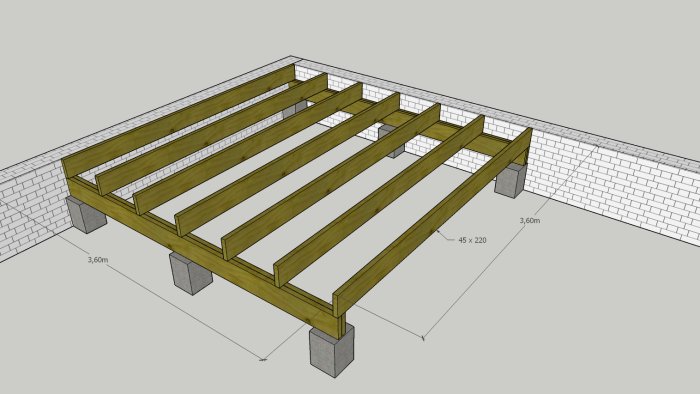
According to the wood guide, 45x220 CC600 works for a floor joist. Here, there will be quite a high point load exactly where the heat pump and tank will be placed, but it might be enough to use CC600 and add an extra floor beam right where the heavy items will be.
You need up to 45x220 plus glued chipboard for acceptable deflection values with a 3.5-meter span. However, c/c 600mm is sufficient. If any furniture parts, such as an accumulator tank, represent a larger point load, the dimensioning should also be checked with regard to that. The placement of the point load is then of great importance.
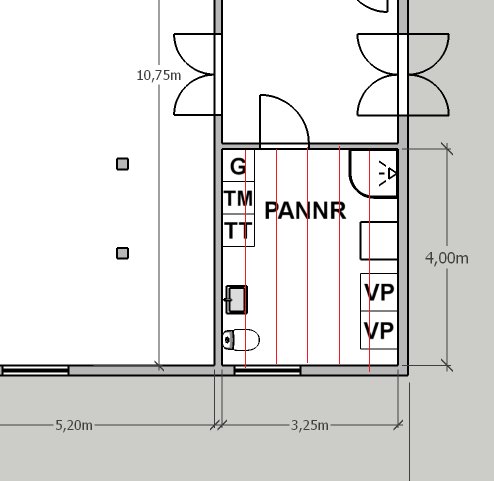
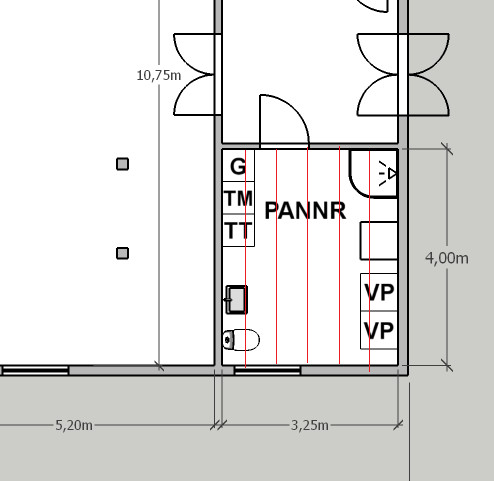
The boiler room will be in this corner. The direction of the floor beams according to the red lines. The greatest load will be at the bottom right corner/right wall:
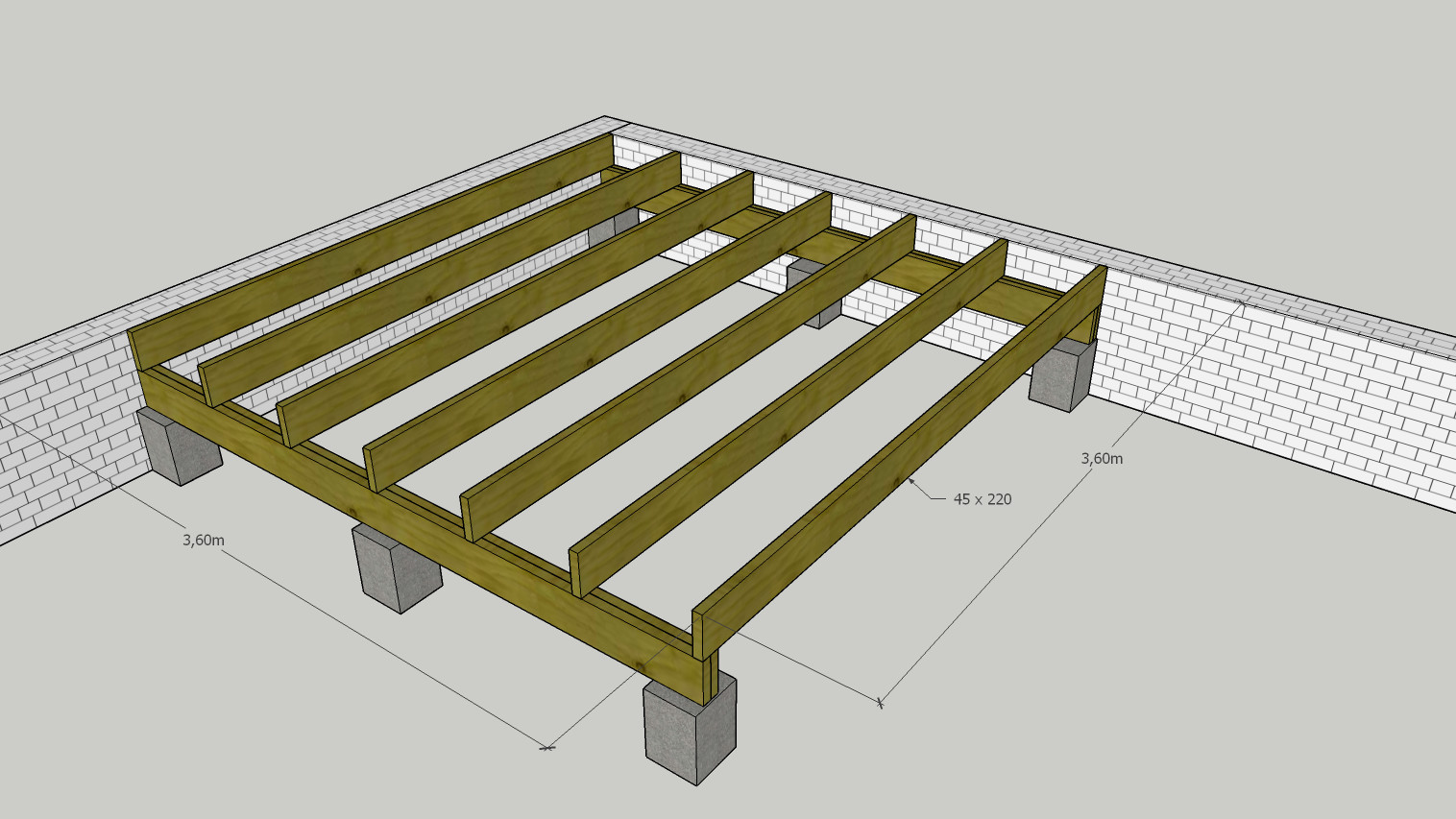
A slightly schematic image of how I have planned the floor joists. What dimension is required for the support beams if you want to skip the plinth in the middle?
If you want a beam without a middle support, it must be glulam. At least 90x270, preferably 90x315. It can be replaced with a lower and wider one if the height is an issue, e.g. 215x225. Point loads are easier to accept when they are near the support of a beam. It is primarily VP number 2 from the bottom that is questionable if it weighs a lot. In that case, it's probably easiest to replace the innermost beam with something stiffer in glulam. How much do they weigh?
Then it'll have to be a middle support... I don't know exactly how much the heat pumps weigh (if there will be two separate units), but you can probably count on a couple of hundred kilos. Then there is a tank as well of 500 liters, but maybe that could be placed in the corner instead.
You should be able to add an extra floor beam between the two closest to the wall to improve the load-bearing capacity on that side?
You also have a floor joist that is next to the wall. If you place the tank in the corner and then arrange the heat pumps in order of weight and ensure that these loads are supported by two floor joists, it will be fine. Since the sizing is based on the deflection criterion, you have a good margin.
If you want a load-bearing beam without a center support, it has to be glulam. At least 90x270, preferably 90x315. It can be replaced with lower and wider if height is an issue, e.g., 215x225. Point loads are easier to accommodate when they are near a beam's support. It is mainly VP no. 2 counted upwards that is questionable if it is heavy. In that case, it is probably easiest to replace the innermost beam with something stiffer in glulam. What do they weigh?
Can this replace glulam if I just want two supports under one of the beams?
At least C24 based on density and straightness...