
29,297 views ·
31 replies
29k views
31 replies
Compressive strength of Isodrän or foam plastic under foundation wall
Can you explain a bit more? I'm not quite following what you mean.KnockOnWood said:
I was hoping for that too, but the seller at Beijers was not keen to help me at all. Actually a bit rudeKnockOnWood said:

No idea. The guy at Beijer didn't dare/want to help me and referred me to a structural engineer who had to calculate it.KnockOnWood said:


Here you see an edge element, where the edge beam is insulated from the slab. They are only held together with rebar through the polystyrene.

Image from http://www.jackon.se/
I was thinking rather that you should check with someone at Isodrän.
If you check out the aforementioned Jackson, they also have some calculation examples. See the PDFs here
http://www.jackon.se/dav/07b63053f4.pdf
http://www.jackon.se/dav/1467ee3d31.pdf
Thank you for the links and images. I haven't seen such an edge beam before, but I'll have something similar with insulation around it. For the high line load of 40 kN/m and point load of 50 kN, they prescribe EPS500 foam. Significantly more than S200, which I have read about before being commonly used under the beam!

The foundation beam, which is in connection with the outside of the house, cools down when the outside temperature changes. This cold is conducted (thermal bridge) through the concrete into the floor/slab. You can use a so-called thermal bridge breaker to counteract this, i.e. a styrofoam edge that separates the foundation beam from the slab. The foundation beam will still be cold, but that cold is not transferred to the same extent to the slab under the house's floor since the styrofoam acts as insulation between the foundation beam and the slab. Note that you need to have thick walls to be able to use this! I don't remember the exact figures, but I think that 35-37 cm thickness is barely enough. If someone more knowledgeable can fill in the required thickness with information.tlundberg said:
Oops, now I see that the thread is several years old. Oh well...
I have Jackons elements with a broken cold bridge myself, and the walls are a total of 387 mm including air gap and panels. You probably can't shrink it much if you want good insulation. Mine is 310 mm, which may be 50 mm more than today's "standard".Voh said:
It doesn't hurt to check a little "how it went." Was there any extension and did it become a "warm foundation," Tlundberg?Voh said:
Indeed. My future house will have 200 mm walls. Timber without extra facade or additional insulation. Definitely too narrow for switches as far as I know. Or are there other/new techniques?
And interested. How did it turn out?
And interested. How did it turn out?
The wall should be placed on top of both the beam and the breaker. The breaker should not be placed under the living area, and the edge beam should not be placed outside the wall. So, for the wall to cover both, it must be relatively thick. If the wall thickness is to cover both the edge beam and the breaker, then the wall must be sufficiently thick.KnockOnWood said:
I don't understand your reasoning.Voh said:
Of course, the wall's vertical studs should be on the edge beam, preferably centered, naturally.
But it doesn't really matter if the insulation between the edge beam and slab is five cm in or out inside or outside the inner surface of the wall, does it?
Aha, you've had a few girls and boys to fight with along the way: Frida, Gorm, and most recently Helga.tlundberg said:
Respect!
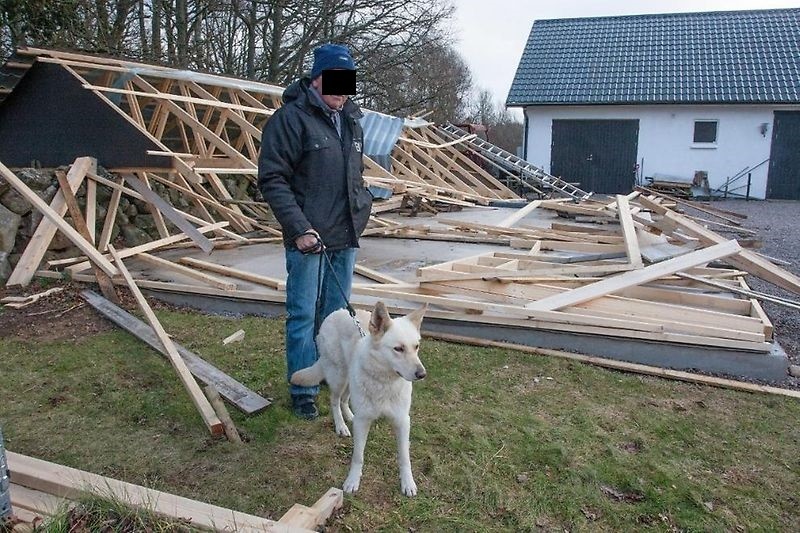
Here's what happened when a neighbor met Gorm. A large garage was just framed, and half the roof was laid. But then came the storm
I have no personal experience of the practical difference and I'm hardly an expert. However, all of my own "research" for the upcoming build has pointed to it making a difference. All the sources I've consulted suggest that the entire thermal bridge breaker must be covered by the wall, but whether that's right or wrong isn't for me to answer, I'm just conveying other people's words.KnockOnWood said:
OK, so let's hear what kind of research it is, and which sources you are relying on!Voh said: