
Hello!
I'm in the process of adding to the house and trying to handle some parts myself, like drawings and such.
I have a contractor to pour the slab and they can make calculations for rebar and thickness but they need column loads from me.
I'm planning to use glulam and have checked Moelven's calculation program but I'm not entirely sure I've understood it correctly. https://www.moelven.swelagerbalk.inadire.se/Account/Login?ReturnUrl=/
It's the calculation for the load-bearing beam and in my case, the beam for a floor will be supported by two columns, and what I'm wondering is how the column load in the attached image compares to reality? The program doesn't know what my floor consists of or how I'm going to load it?
In my case, it will be a loft for normal occupancy.
Can I use the information provided in the calculation, according to the image?
Best regards
I'm in the process of adding to the house and trying to handle some parts myself, like drawings and such.
I have a contractor to pour the slab and they can make calculations for rebar and thickness but they need column loads from me.
I'm planning to use glulam and have checked Moelven's calculation program but I'm not entirely sure I've understood it correctly. https://www.moelven.swelagerbalk.inadire.se/Account/Login?ReturnUrl=/
It's the calculation for the load-bearing beam and in my case, the beam for a floor will be supported by two columns, and what I'm wondering is how the column load in the attached image compares to reality? The program doesn't know what my floor consists of or how I'm going to load it?
In my case, it will be a loft for normal occupancy.
Can I use the information provided in the calculation, according to the image?
Best regards
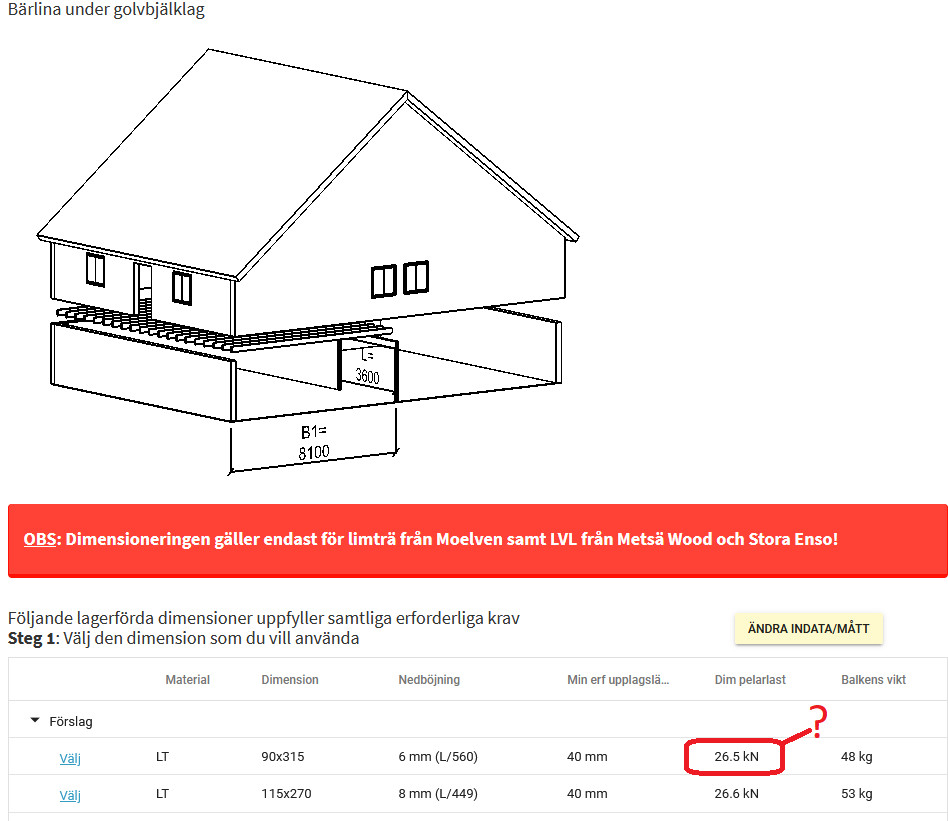
If all input is correctly filled in and the conditions apply to your beam, you can leave the marked column load to the builder.
Yes, the lengths are correct, there is nothing more to specify.B bossespecial said:
Dumb question 2: Does the calculation assume a column at each end of the main beam and loading per column?
Yes, I assume that

There's something that doesn't add up. The information about the building depth and column load doesn't seem to match. A building depth of 16 m also sounds completely unreasonable.
The thing is, I was planning to have the beams lengthwise, the room is 8100 mm long internally. But I think it sounds low with a calculated load of 10 tons for 25 m2 including all materials.J justusandersson said:
If the house is 8.1 meters wide inside and the glued laminated beam is an extension of the basement's sole plate, the load per meter on the beam must be at least 8x3/2 = 12 kN. It can be significantly more depending on the construction. With a beam length of 3.6 meters, 12 kN/m means a load on each pillar of just under 22 kN. Is there something you are not mentioning...
J justusandersson said:If the house is 8.1 meters wide inside and the glulam beam is an extension of the basement's heart wall, the load per meter on the beam must be at least 8x3/2 = 12 kN. It can be significantly more depending on the construction. With a beam length of 3.6 meters, 12 kN/m means a load on each pillar of just under 22 kN. Is there something you're not telling...
Facts:J justusandersson said:If the house is 8.1 meters wide inside and the glulam beam is an extension of the basement's heart wall, the load per meter on the beam must be at least 8x3/2 = 12 kN. It can be significantly more depending on the construction. With a beam length of 3.6 meters, 12 kN/m means a load on each pillar of just under 22 kN. Is there something you're not telling...
The house is 7200 mm wide externally.
This room to be added is 8400 mm long externally, same width. It connects to the existing gable, so it will be an extension of the house.
It is a 1 1/2-story solution.
There is no basement involved.
The floor in question will cover half the room's area, the rest is open from the ground floor to the ridge. The loft floor extends from the house's old gable to the new end, which is 8400 mm minus 300 for the aerated concrete's thickness.
The alternative would have been to lay the floor the other way and have a carrying beam of 8100 mm, but that would mean it becomes thicker and takes ceiling height, and I prefer the proposed solution better.
But is it all correct, the question is? You talk about significantly more load?
I can't quite figure out the geometry. If the existing house is 7.2 m wide externally, shouldn't the extension also be 7.2 m? So it's the upper floor joists that you want the glulam beam to carry? What does the roof truss construction look like in the extension? Is there a ridge beam? Is it only in the extension that it should be open to the ridge?
I understand it's tricky to sort out without pictures, but it involves an extension of the house that is completely independent of the old house, apart from them being connected.J justusandersson said:I can't quite figure out the geometry. If the existing house is 7.2 m wide externally, shouldn't the extension also be 7.2 m? So it's the upper floor's joist that you want the glulam beam to support? What does the rafter construction look like in the extension? Is there a ridge beam? Is it only in the extension that it should be open to the ridge?
In the new section, the room will be open up to the ridge, about 6.5 m. In half of that area, there will be a loft, a mezzanine.
The new room will be 8400 mm long.
The width of the room, also the width of the house, will be 7200 mm.
So, the same as the old house, it will be an extension of the old house.
The joist will run from the old gable to the new gable. A distance of 8400 mm including the thickness of the outer wall.
The girder in the new gable might be formed by embedding the beams in the lightweight concrete.
What I'm wondering about is on the side that connects to the old house, where I don't think I dare to hang a new floor on the old plank wall but thought to support it with pillars.
There will also be a pillar there to support the ridge beam.
But the glulam beam should still only be 3600 mm?
So the beam should go across the length of the house and support one short side of the mezzanine floor? Were you planning to have 8.1 m long floor joists resting on the support beam?
It's not a good solution to use 8 m long floor joists. You'll need to reconsider that. Either add an additional support beam halfway or use a strong gluelam beam (with at least 3 pillar supports) along the edge of the mezzanine and place the floor joists in the other direction.