I have extended a room and now during the fall, I have noticed some drafts in various places and brought this up with the carpenter. I borrowed a thermal camera from a friend and found several areas where it is significantly colder (a difference of 5 degrees or more compared to the other walls). I also brought this up with the carpenter, who then asked what is acceptable and what is not. I obviously have no idea and wonder if there is some form of building standard that can help with what needs to be addressed and what is acceptable?
Asking the question here before I contact an inspection company.
It is an extension of about 15 sqm to an existing room, making it almost 30 sqm. New walls on the expanded part but under the existing roof (removed storage/shed). Essentially, all discrepancies are where the ceiling & wall meet, but also some other places (e.g., larger area in the ceiling and some places by the doors that have been built). Insulation in the ceiling has been replaced even in the old part of the room. From what I sent to the carpenter:
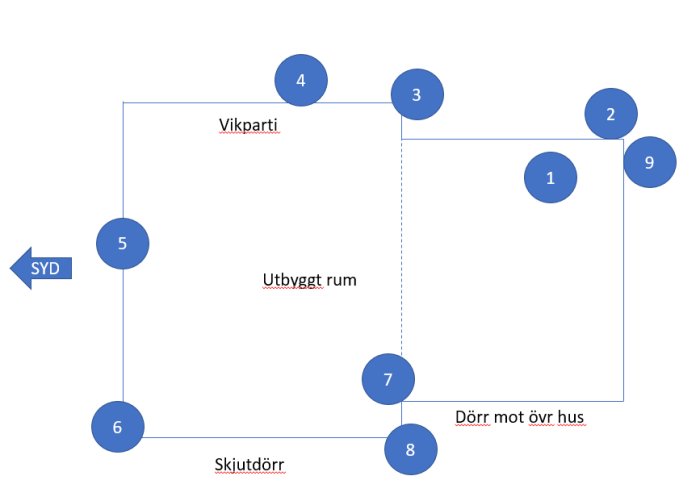
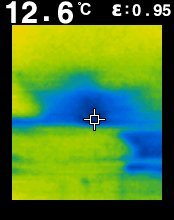
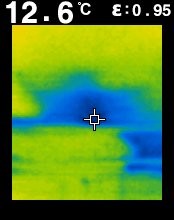
1. Cold draft in ceiling (FLIR101)
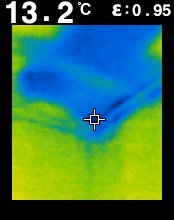
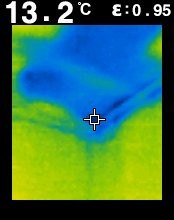
2. Cold draft corner ceiling/wall (FLIR102)
3. Cold draft by sliding door. (FLIR103)
4. Cold draft ceiling/wall (FLIR104)
5. Cold draft ceiling/wall, (FLIR106)
6. Cold draft corner ceiling/wall (FLIR107)
7. Cold draft corner ceiling/wall (FLIR108)
8. Cold draft by door (FLIR 109a & FLIR109b)
9. Heat loss bathroom which is adjacent to the extended room. FLIR110)
Doesn't look good... something is definitely wrong, I've seen older houses where the wind blows straight through with similar issues, but if it's newly renovated it shouldn't look like that...
We need more info about the house itself, the year it was built, for example, and how he built the new part and with which materials.....
The extension was done this summer. Wooden house built in 2010 but it's only the expanded room where we have these problems. How... studs, insulation, panel, plasterboard on the inside. Not sure what to write
If you look at the image flir1 & 2, if it were typical cold draught due to a thermal bridge like a wall plate between the wall and roof, it would have been linear. In your image, it looks like there's missing insulation where cold air is getting in. Such a large area with that shape could also indicate moisture. You should check this out, get up into the attic and look. A surveyor might be recommended.
It may be difficult to demand the carpenter for that without initially bearing the cost yourself, but later based on the inspection results, you may be able to request action and then include the inspection as part of it (assuming the carpenter does not do this initially). And the important thing here is also what you have ordered from the carpenter, which I cannot read in the thread.
Click here to reply
Vi vill skicka notiser för ämnen du bevakar och händelser som berör dig.




Niclar72 said: