
2,402 views ·
14 replies
2k views
14 replies
What is considered draft? (Measured with infrared thermometer)
Hello!
I live in a cold corner apartment (condominium). The floors are cold and the walls facing the corner are icy. Measuring the temperature in the middle of the room shows it is exactly as it should be, about 21 degrees. But it feels drafty.
I measured the temperature using an IR thermometer which showed that the corners of the apartment are about 13-14 degrees and I'm wondering if that is normal or acceptable?
The association is generally resistant to complaints so I would like to have more information, but maybe this is just how it should be.
I can also add that if I have candles lit in the window near one of the corners, they flicker quite a bit.
Thanks in advance!
I live in a cold corner apartment (condominium). The floors are cold and the walls facing the corner are icy. Measuring the temperature in the middle of the room shows it is exactly as it should be, about 21 degrees. But it feels drafty.
I measured the temperature using an IR thermometer which showed that the corners of the apartment are about 13-14 degrees and I'm wondering if that is normal or acceptable?
The association is generally resistant to complaints so I would like to have more information, but maybe this is just how it should be.
I can also add that if I have candles lit in the window near one of the corners, they flicker quite a bit.
Thanks in advance!
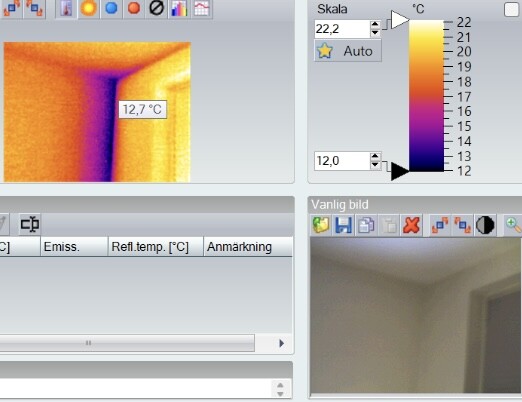
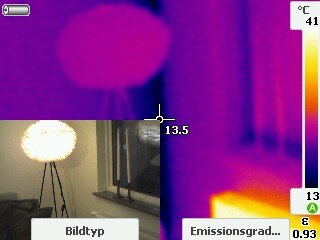
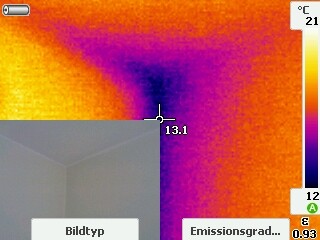

I would say it's completely normal for corners against outer walls to appear like that on a thermal camera. There is simply no air circulation there.tottoiz said:
I would probably focus on the window as a more likely source of the draft.
Note that drafts are difficult to see with the thermal camera because it measures the temperature of surfaces and not the air temperature. So you have to look for characteristic "veils" that appear where cold air flows over a surface.
Aha okay! Is there any way to measure the veils?C cpalm said:I would say that it is completely normal for corners against exterior walls to look like that on the thermal camera. There is no air circulation there.
I would focus on the window as a more likely source of the draft.
Note that drafts are difficult to see with a thermal camera as it measures the temperature of surfaces and not the air temperature. So you have to look for characteristic "veils" that appear where cold air flows over a surface.
Logically, it should be in the association's interest to fix something like this (we are going to have a 5-year warranty inspection where I would like to bring this up), it should mean that the radiators have to work more when it's so cold otherwise?
That's what it's called thenKarl-Ove Qvarfordt said:
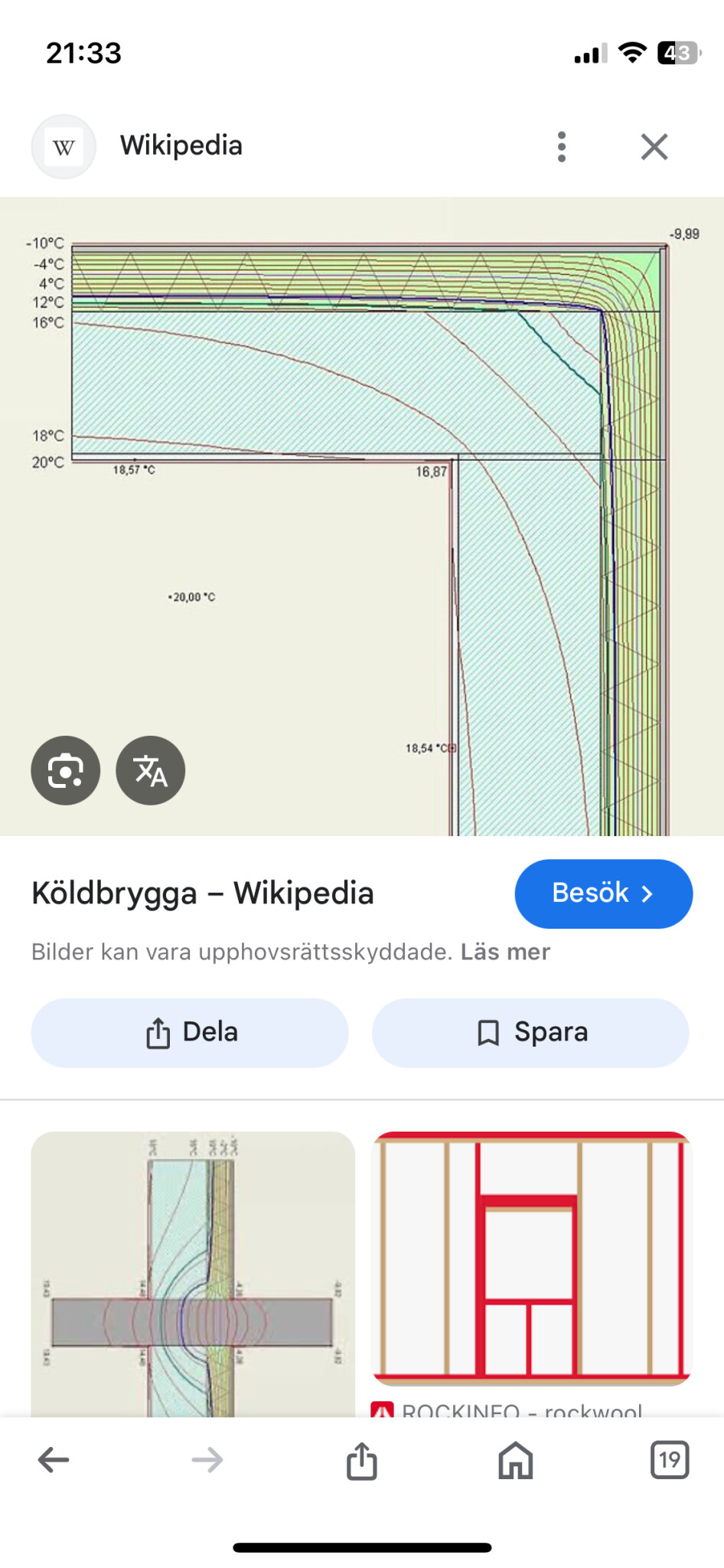
 but do you know if there is any sort of guideline or so for what is reasonable for a thermal bridge? Thinking that it stays 13-14 degrees compared to the rest of the room?
I would make sure to measure several corners to see if there is any difference. Of course, within a short timeframe so that the result is as accurate as possible.
You mean so that you can get a useful number/measurement in some way from the image? No, not anything that in this context is directly meaningful that I can think of. It's more that you can see where it pulls, how much in relative terms, and to some extent be able to assess the "wind direction".
Then it's probably more relevant to measure the air temperature with a regular thermometer in exposed areas. But to be relevant, you should stick to measurements in the "living zone". That it is cold on, for example, the window sill or in a corner is not so interesting if you want to demonstrate a problem.
Draft is not necessarily a thermal economic problem in itself. See it more as ventilation in the wrong place causing a potential comfort problem, and, in a modern "tight" house, a sign that something is not as it should be. But comfort is also important.
I'm not questioning that, but experienced and actual are different things, therefore a figure on the floor's temperature is not irrelevant.
Exactly, I would like something to lean on. Not just my "feelings," which unfortunately don't sway the board. The thing with the living zone is also problematic; I have, for instance, my living room where the cold corner is (and the ice-cold gable wall), which can basically only be furnished one way. So the fact that the temperature is okay at the coffee table is little consolation when the sofa is next to the wall. The same with one of the bedrooms that faces the same wall. The bed must be placed against the wall that is ice-cold, the alternative is to place it in front of the radiator, which also becomes a problem.C cpalm said:You mean so that you can obtain a useful number/measurement in some way from the image? No, not anything that in this context is directly meaningful that I can think of. It's more that you can see where it's drafty, how much in relative terms, and to some extent be able to assess the "wind direction".
It's probably more relevant to measure the air temperature with a regular thermometer in exposed places. But to be relevant, you should stick to measurements in the "living zone." That it's cold, for example, on the windowsill or in a corner is not so interesting if you want to demonstrate a problem.
Drafts are not necessarily a problem of energy efficiency in themselves. Consider it more as ventilation in the wrong place that causes a potential comfort issue, and, in a modern "tight" house, a sign that something is not as it should be. But comfort is important too.
The house is from the '60s but fully renovated in 2019. Everyone who comes here thinks it's cold. (And how you can make a bathroom in modern times without underfloor heating and just a small towel dryer as heating is a mystery to me.)
But thanks for the explanations and everything! I will probably bring it up at the inspection anyway and hope for receptiveness.
Houses from the 60s unfortunately have rather poor insulation.
Click here to reply