This is a very interesting Off Topic discussion! At least it's not about building houses.
What is hay and what is straw?
In my world, hay is grass with possibly seed (seed = protein and fat).
Nowadays, when farmers harvest the grass every fourteen days, there isn't much seed in the hay for the most part.
Straw = grass, wheat, rye, barley, timothy, oats, tufted hairgrass, wavy hairgrass or whatever it might be that grows, where the seed has been threshed away, so only the stalk remains.
Am I somewhat right so far, Haavard (I got the impression you were an agronomist)?
For many years, before we had to euthanize our horse due to illness, it was mainly fed with grass seed straw.
It was prone to laminitis and couldn't tolerate stronger feed.
Anyway, what does straw contain? Well, cellulose.
Straw contains lots of nutrients in the form of cellulose, which the microbes in horses' and cows' stomachs can break down and convert into sugars, which mammals can assimilate.
That's why we have cattle! To turn "worthless" grasslands into high-value fat and protein.
Have a nice weekend! Hopefully with a good steak of "nature meat."
In Sweden, houses are built from straw from barley, wheat, rye, or oats. In parts of the USA, they use a lot of rice straw. Straw from grass seed production (where I come from we would call it seed hay - it easily gets confusing when you're not speaking the same language...) has a nutritional content that lies between hay and "regular" straw.
Straw contains nutrients, but much less than hay and is probably not something given to animals that are meant to produce meat or milk. As a pastime and for animals that cannot tolerate strong feed, it is probably better.
Here is actually the best inventory I've seen of Swedish clay houses, even though that's not the actual focus. I've visited several of these. There is a zoom feature so you can read the text. http://www.stjarnsund.com/attachments/Studieresorna_A3.pdf
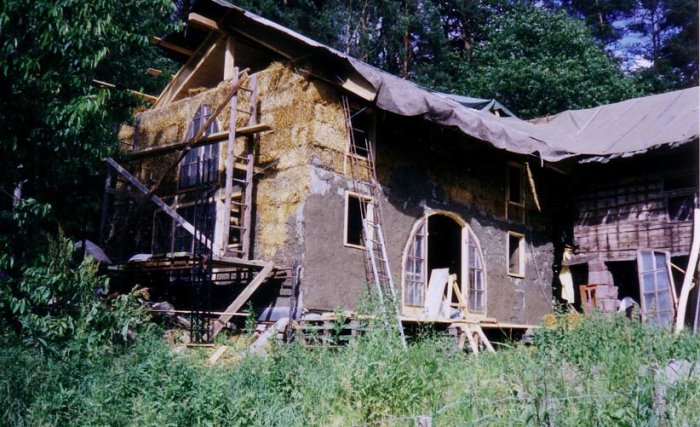
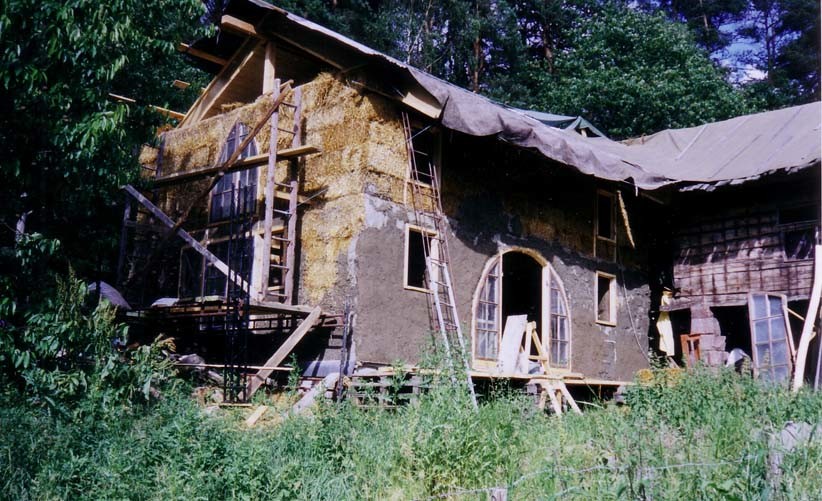
Maja Lindstedt's clay house in the critical stage. Small picture of the finished result in the inventory above, if it really is the same one. Personally, I have been involved in such constructions, so I'm mostly curious about what they did with the garden after this
No, that's Lena Falkheden's house. (So picture 3 from 2007). Must be an old picture because that house was built around the millennium shift? I was there 3-4 years ago and it was finished then. Nice windows from some hospital in Göteborg.
I myself have also visited a number of the houses. I've been inside five and seen two or three from the outside.
No. 10 -05/2 -06 looks funny, have you been there? 11 and 12 -05 are straw-clay houses. Do you know the technique there?
You go to Norway. (Not Svalbard unless you live there). Or Greenland. Iceland is also an option, but I think it's difficult to get there for foreigners without a big wallet.
Russia probably works too, but I don't know anything about that.
No, that is Lena Falkheden's house. (That is, image 3 from 2007). It must be an old picture because that house was built around the turn of the millennium, right? I was there 3-4 years ago and it was finished then. Nice windows from some hospital in Göteborg.
I understand..
haavard said:
I myself have also visited a number of the houses. I've been inside five and seen two or three from the outside.
We must have been in different houses then.
haavard said:
Nr. 10 -05/2 -06 looks fun, have you been there?
Sure, they are two different houses in a village, they have different colors.. I organized a study visit there for an eco-village association from Göteborg in the summer of 2001. Per A guided for two hours for 50:- per person!
haavard said:
11 and 12 -05 are straw bale houses. Do you know the technique there?
They are not built using the same technique. The church is made of pressed blocks, the houses in Hare Krishna's village I'm not sure about as it was a long time ago, but I have been on a guided tour there as well.
They are not built using the same technique. The church is made of compressed blocks, those houses in the Hare Krishna village I'm not sure about as it was a long time ago, but I have been on a guided tour there too.
No, not on these. Lerhalmsblock is closest to a variant of adobe, which actually contains much less straw (in the church the blocks are not load-bearing, as in adobe).
I made this tiny article as part of the project to fundamentally fix the clay house articles. http://sv.wikipedia.org/wiki/Mackelering
This is the translation of cob. Kubbhus, however, is something else.
The houses you liked (Solvik) are made in a variant of mackelering (lerbröd).
It was me who did this on Wp:
Roughly fixing the articles, they are to be further verified based on the German, French, and English wiki links, the point of the project is to break down the article Jordhus into its proper internationally grounded components.
The houses in the Hare Krishna village I saw ten years ago and don't fully remember, but it was definitely load-bearing wood, and then I think it was insulated with straw bales. Clay inside and outside. It was definitely not cob, wattle and daub, clay loaf, clay straw blocks, or wood chip clay; it was either straw bales or clay straw.
Click here to reply
Vi vill skicka notiser för ämnen du bevakar och händelser som berör dig.