
51,113 views ·
34 replies
51k views
34 replies
Choosing concrete for casting a tabletop

Hello!
I am going to cast a tabletop for a new dining table. The mold (1800x800x35mm) is built from formwork plywood and reinforced with 4 pcs of fi12 iron lengthwise and 8 pcs of bistål40 crosswise. I will cast the slab with the mold lying on the floor and will borrow a vibrostick from work for this.
Now to my question: On the internet, there are very varied recommendations regarding the choice of concrete type. I was thinking of casting with weber C32/40 Gjuta Fin. Has anyone used this before for similar tasks?
For those who have done this before, what concrete did you use and how did the result turn out?
Also wondering about post-treatments, how did you do it (method and products) and how did the result turn out?
Thanks in advance!
I am going to cast a tabletop for a new dining table. The mold (1800x800x35mm) is built from formwork plywood and reinforced with 4 pcs of fi12 iron lengthwise and 8 pcs of bistål40 crosswise. I will cast the slab with the mold lying on the floor and will borrow a vibrostick from work for this.
Now to my question: On the internet, there are very varied recommendations regarding the choice of concrete type. I was thinking of casting with weber C32/40 Gjuta Fin. Has anyone used this before for similar tasks?
For those who have done this before, what concrete did you use and how did the result turn out?
Also wondering about post-treatments, how did you do it (method and products) and how did the result turn out?
Thanks in advance!

That won't be an easy slab! 20mm is enough. Maybe a thicker edge on the outside would suffice? Personally, I like to set the slab on sawhorses when I cast, but you'll need a few.
Expanderbetongen is hard and the surface becomes like glass, very nice. Finbetong becomes matte and may feel a bit porous. Haven't tested casting fin, but it could work depending on what surface you want.
Concrete is cheap enough that you can buy a few different bags and make some test pieces.
Another idea could be self-leveling compound. I haven't used it for such large slabs myself. But for smaller pieces, it's superior. No vibration or straightening. And easier to mix.
Post-processing always changes the color. Don't like it... But seek and you shall find.
Expanderbetongen is hard and the surface becomes like glass, very nice. Finbetong becomes matte and may feel a bit porous. Haven't tested casting fin, but it could work depending on what surface you want.
Concrete is cheap enough that you can buy a few different bags and make some test pieces.
Another idea could be self-leveling compound. I haven't used it for such large slabs myself. But for smaller pieces, it's superior. No vibration or straightening. And easier to mix.
Post-processing always changes the color. Don't like it... But seek and you shall find.
Okay, thanks for the response. How do you keep your discs protected from stains and dust-free if you don’t treat them afterwards?
I thought about using expansion mortar but chose (out of frugality) fine concrete instead. I’ll go buy a bag of expansion mortar and test cast with both. I’ll get back with pictures and reflections afterwards.
Does anyone have tips on what post-treatment is required? Sanding? Impregnation? Oil or wax or something else? I want to achieve an even gray surface without visible aggregate. Of course, I also want a disc that is durable, dust-free, and resistant to stains.
I thought about using expansion mortar but chose (out of frugality) fine concrete instead. I’ll go buy a bag of expansion mortar and test cast with both. I’ll get back with pictures and reflections afterwards.
Does anyone have tips on what post-treatment is required? Sanding? Impregnation? Oil or wax or something else? I want to achieve an even gray surface without visible aggregate. Of course, I also want a disc that is durable, dust-free, and resistant to stains.
There will be some stains, but the expander can handle more than regular concrete.
There are 2-3 good threads here on the forum about surface treatment, but can't find them right now.
Test first, it's easy to be disappointed.
Sand the edges, but the rest shouldn't be necessary. If you sand, the ballast will come through.
But if you want completely even color, you'll have to work a lot. Reinforcement usually shows as lines, among other things.
You can take the first bag with expander, wait a little, and then use fine concrete.
It's a bit cheaper, and you can use the bags you've bought.
There are 2-3 good threads here on the forum about surface treatment, but can't find them right now.
Test first, it's easy to be disappointed.
Sand the edges, but the rest shouldn't be necessary. If you sand, the ballast will come through.
But if you want completely even color, you'll have to work a lot. Reinforcement usually shows as lines, among other things.
You can take the first bag with expander, wait a little, and then use fine concrete.
It's a bit cheaper, and you can use the bags you've bought.
Ok, I actually think the surface looks nice as it is when using shuttering plywood as a mold, so skipping sanding sounds good!
For surface treatment instead: what do you recommend if you've tried a few different ones?
I'm considering stone soap or linseed oil directly on the unsanded surface, has anyone tried??
For surface treatment instead: what do you recommend if you've tried a few different ones?
I'm considering stone soap or linseed oil directly on the unsanded surface, has anyone tried??
Cast yesterday 6 test pieces, 3 with Weber's expander mortar EXM702 and 3 with Weber's gjuta fin. They will rest for a few days to cure now, will get back with the results...

Exciting! You will probably notice a big difference in surface area.
Did you vibrate at all? Careful with the dosing of the concrete?
You can probably remove the edges fairly quickly, but for the best surface wait at least 3 days before turning.
Did you vibrate at all? Careful with the dosing of the concrete?
You can probably remove the edges fairly quickly, but for the best surface wait at least 3 days before turning.
Yes, really exciting right now! I was planning to remove the formwork on Thursday evening when the slabs have been water-cured for 4 days. That should suffice...
Vibrating: I used a vibration rod (22 mm tube) for about 30 seconds per test piece (200x200x35mm). Hopefully enough to get the air out but not enough to separate the concrete. We'll see on Thursday!
As for the mix, I followed the dosing instructions on the bag for each type of concrete, no issues. Surprisingly, the water dosing differed quite a lot, 2.5 liters/bag for gjuta fin and 3.5 for expanderbruket. Naturally, a bit more vibration was required for the stiffer gjuta fin than for the expanderbruket. Will get back on Thursday!
Vibrating: I used a vibration rod (22 mm tube) for about 30 seconds per test piece (200x200x35mm). Hopefully enough to get the air out but not enough to separate the concrete. We'll see on Thursday!
As for the mix, I followed the dosing instructions on the bag for each type of concrete, no issues. Surprisingly, the water dosing differed quite a lot, 2.5 liters/bag for gjuta fin and 3.5 for expanderbruket. Naturally, a bit more vibration was required for the stiffer gjuta fin than for the expanderbruket. Will get back on Thursday!

Will be interesting to follow! Hope there will be pictures 
I applied silicon sealant in the form seams before casting. Unfortunately, I seem to have been temporarily blind in the hardware store as I accidentally bought white silicon, we'll see if it discolors...
How risky it is to cheat with the water addition depends a bit on what you are going to use the concrete for. The amount of water in the mix is directly linked to how impermeable the concrete becomes when it is fully hardened. For a pallet or window sill that is not exposed to any moisture, it shouldn't pose problems. What I'm making is a dining table that I want to be as resistant as possible to spilled wine and such... Also, there's probably no reason to have a looser consistency than properly mixed expansion mortar, it is very runny.
What is it that you have cast, sinuslinus? How did the result turn out?
Funny that you mention bridges, my everyday profession. Despite many years of experience with concrete and fully certified to lead the castings of the nation's infrastructure, I feel a certain uncertainty about a project like this... It might have something to do with the fact that it’s the professional workers on the construction sites who do the actual work though
How risky it is to cheat with the water addition depends a bit on what you are going to use the concrete for. The amount of water in the mix is directly linked to how impermeable the concrete becomes when it is fully hardened. For a pallet or window sill that is not exposed to any moisture, it shouldn't pose problems. What I'm making is a dining table that I want to be as resistant as possible to spilled wine and such... Also, there's probably no reason to have a looser consistency than properly mixed expansion mortar, it is very runny.
What is it that you have cast, sinuslinus? How did the result turn out?
Funny that you mention bridges, my everyday profession. Despite many years of experience with concrete and fully certified to lead the castings of the nation's infrastructure, I feel a certain uncertainty about a project like this... It might have something to do with the fact that it’s the professional workers on the construction sites who do the actual work though
S
sinuslinus
Träskalle
· Östergötlands län
· 5 723 posts
sinuslinus
Träskalle
- Östergötlands län
- 5,723 posts
It might also be that there are slightly different surface finish requirements for infrastructure and furniture.
I imagine the form carpenters wouldn't be so cocky if they had to hand-sink drawers. ;-)
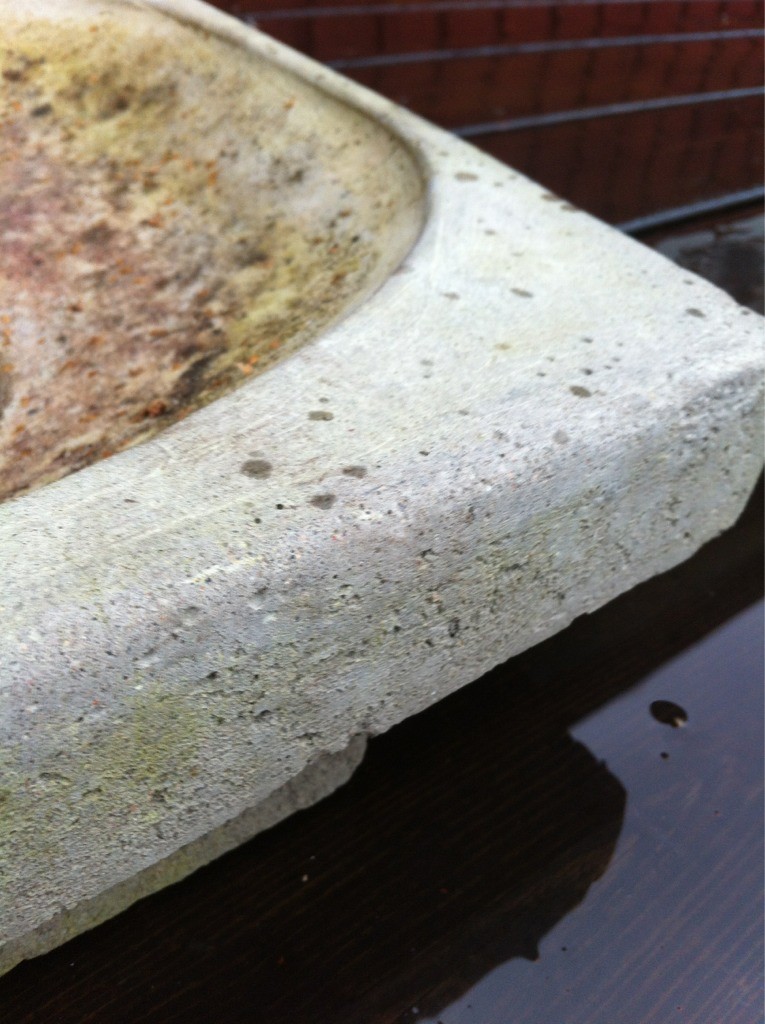
So, what have I cast? It's an artistic school project, not a birdbath as one might think. Even though it's been lying in the garden at the country house for the past few years hehe.
I can post a picture over the weekend, but it's a casting of my butt, which I then cast into a chair seat. Of all the strange and conceptual things I've done, this is probably the most impractical. :-D
I imagine the form carpenters wouldn't be so cocky if they had to hand-sink drawers. ;-)
So, what have I cast? It's an artistic school project, not a birdbath as one might think. Even though it's been lying in the garden at the country house for the past few years hehe.
I can post a picture over the weekend, but it's a casting of my butt, which I then cast into a chair seat. Of all the strange and conceptual things I've done, this is probably the most impractical. :-D
S
sinuslinus
Träskalle
· Östergötlands län
· 5 723 posts
sinuslinus
Träskalle
- Östergötlands län
- 5,723 posts
Incidentally, water glass is what is usually recommended if you're going to have any surface treatment. However, I've never really understood what it is...
And to reduce the weight, you can try casting in some lighter sheet material. It will still weigh much more than you want. It will also make it much easier to attach to the undercarriage.
Have you thought about color? You can mix in up to 10% pigment, but you might know that from your profession. For example, the Årstabron for train traffic, which is colored red.
And to reduce the weight, you can try casting in some lighter sheet material. It will still weigh much more than you want. It will also make it much easier to attach to the undercarriage.
Have you thought about color? You can mix in up to 10% pigment, but you might know that from your profession. For example, the Årstabron for train traffic, which is colored red.