I'm going to install a wall-mounted Norrgavel desk with an Elfa shelving system. I bought concrete plugs and screws that fit the system, 8mm plugs.
When I started drilling, I noticed that I reached some organic material and not concrete like it is in all other walls (the apartment is from the early 1900s).
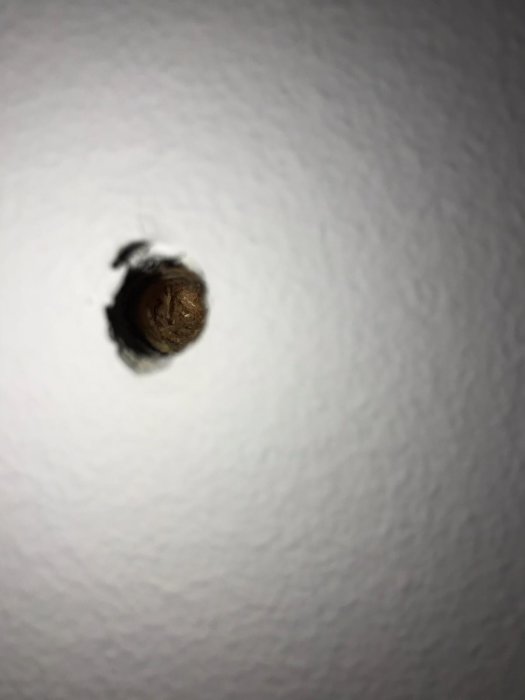
I've googled and understood that when you reach wood, it's sufficient to use wood screws, but I'm unsure if it’s pure wood I've hit, or chipboard or something else? I managed to snap a photo where you can see beyond the 2 cm of plaster I drilled through.
What do you think the material is, and what should I use to mount the desk?
Given the construction year, it's not original particle boards in af.
Is it not reed?
It was common to plaster on it before.
(if so, you've got a h-ll of a job ahead of you).
There should be timber behind, but it doesn't withstand pressure well.
I think they're called reverterade walls
If it's particle board, just use wood screws.
Going to set up a wall-mounted Norrgavel desk with an Elfa shelf system. Bought concrete plugs and screws that fit the system, 8mm plugs.
When I started drilling, I noticed that I reached some organic material and not concrete as it is in all the other walls (the apartment is from the early 1900s).
I have googled and understood that when you reach wood, just wood screws are enough, but I am unsure if it's pure wood I reached, or chipboard or something else? Managed to snap a picture where you can see beyond the 2 cm gypsum I drilled through.
What do you think the material is and what should I use to mount the desk?
[image]
I think it looks like träullit, don't know anything that holds in it, but have personally managed to screw through and into standing planks.
Difficult to say as there are many uncertain factors.
Something heavy (shelf/bracket etc.) protruding from the wall creates a large moment that wants to pull out the screw/plug.
Plug and expander need something solid to "expand against" to hold.
Even if you find wood inside the wall, it will require pressure against the wall, so if the outer layer is soft, it will be pushed in.
It's good then if you can attach a larger board (plywood, mdf) that distributes the pressure and is stable enough to withstand the load of what is hung up.
If everything hangs on long elfa tracks, it is an advantage as it distributes the load.
In the early 1900s, the wall usually consists of brick with a reed mat and plaster on the outside. You need to get into the brick (or other stable wall material) for it to hold.
I have drilled in as far as my wood drill reaches without hitting any form of brick. The hole is 8.9cm deep, with the first 2cm being plaster or stucco as mentioned before, and the rest might be reed mat or something similar.
This wall is a wall between two rooms (bedroom and kitchen), and I had guessed the wall might be 1.5 dm or a little more. Could it be that there is no brick in this wall? We have encountered brick when drilling both in the hallway and also in another wall in the bedroom (towards the neighboring house).
Does this mean I should abandon the whole idea, or could it work with the plaster anchors that were previously recommended?
Regarding strain, the table is 120 cm wide and 50 cm deep and will be my daily desk with a laptop and monitor. I was planning to install 3 Elfa "carriers" for the desk.
It is clearly a plank wall with plaster on reed matting on both sides. The planks are usually 2, 2 1/2, or 3 inches thick and 6-8 inches wide. They are tongue-and-groove and joined with a large number of coarse nails that are set at an angle. Plaster + reed matting is usually about 3 cm thick. Sometimes, so-called spräckpanel (splintered paneling) occurs closest to the plank frame. These are ordinary boards that are set diagonally and splintered with an axe. The only way to attach heavy objects to such a wall is with long screws. One should have a variety of screws in different lengths at hand. You never know in advance how long a screw will be needed.
Click here to reply
Vi vill skicka notiser för ämnen du bevakar och händelser som berör dig.