
4,844 views ·
19 replies
5k views
19 replies
Change floor plan, demolish wall and knee walls.
Hello!
I have a house built in 1938, Brick with air gap and plaster. The house was originally built as two apartments, the layout is not to our liking on the upper floor..
I have a friend with a similar house who has undergone a similar renovation, though not in his possession..
The plan is to remove the attic spaces, change the layout, and add a bathroom on the upper floor, as well as insulate against the outer roof with air gap and cellulose.
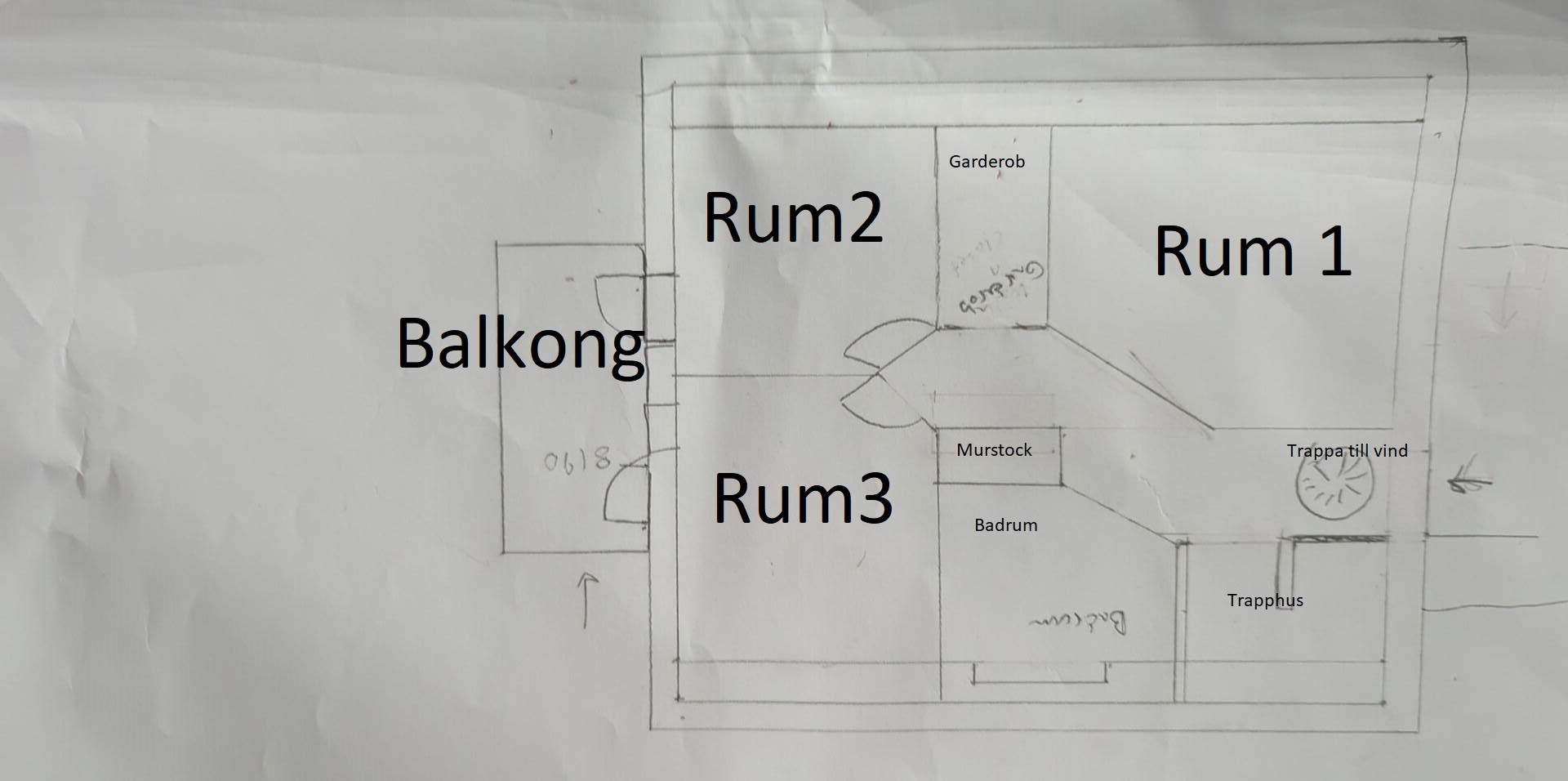
I am attaching the original drawings from when the house was built, as well as what I've sketched with my ideas
I was hoping to get answers to the questions below:
1. Can the wall in front of the stairs be cut away a bit to create the hallway?
2. Can the attic spaces be removed without affecting the load-bearing capacity? It looks like it's just a plank wall since the trusses seem to have reinforcement far out. The room in front of the stairwell has almost no attic today, and the same applies to the stairwell, so I assume it's not a problem, but a pro can definitely comment!
3. General advice doesn’t hurt
Otherwise, I'll simply double-check with a structural engineer!
Have a great weekend!
I have a house built in 1938, Brick with air gap and plaster. The house was originally built as two apartments, the layout is not to our liking on the upper floor..
I have a friend with a similar house who has undergone a similar renovation, though not in his possession..
The plan is to remove the attic spaces, change the layout, and add a bathroom on the upper floor, as well as insulate against the outer roof with air gap and cellulose.
I am attaching the original drawings from when the house was built, as well as what I've sketched with my ideas
I was hoping to get answers to the questions below:
1. Can the wall in front of the stairs be cut away a bit to create the hallway?
2. Can the attic spaces be removed without affecting the load-bearing capacity? It looks like it's just a plank wall since the trusses seem to have reinforcement far out. The room in front of the stairwell has almost no attic today, and the same applies to the stairwell, so I assume it's not a problem, but a pro can definitely comment!
3. General advice doesn’t hurt
Otherwise, I'll simply double-check with a structural engineer!
Have a great weekend!



You can assume that the walls drawn on the section drawing are load-bearing, so there are load-bearing parts in the knee wall, i.e., the parts that are part of the roof trusses. However, it is usually possible to open between the roof trusses. It is also possible to renovate and make reinforcements in other ways, see https://www.byggahus.se/forum/threads/jag-har-rivit-kattvind-nu-dunsar-det-i-hela-huset.481655/.
In houses from that time, it is not standardized, so it is best to hire a structural engineer with experience from that period to investigate what applies to your house.
In houses from that time, it is not standardized, so it is best to hire a structural engineer with experience from that period to investigate what applies to your house.
BirgitS said:
You can assume that the walls drawn on the sectional drawing are load-bearing, so there are load-bearing parts in the attic walls, i.e., the parts that are part of the trusses. However, it's usually possible to open between the trusses. It is also possible to remodel and make reinforcements in other ways, see [link] .
In houses from that time, it is not standardized so it's best to hire a structural engineer with experience from that time period to examine what applies to your house.
Yes, I saw that post, but these paths to the attic spaces are extremely thin. It's standing planks and reeds, I haven't observed anything of a heavier construction.You can assume that the walls drawn on the sectional drawing are load-bearing, so there are load-bearing parts in the attic walls, i.e., the parts that are part of the trusses. However, it's usually possible to open between the trusses. It is also possible to remodel and make reinforcements in other ways, see [link] .
In houses from that time, it is not standardized so it's best to hire a structural engineer with experience from that time period to examine what applies to your house.
At the same time, one room has almost no attic space and the stairwell has no attic space at all.
While a room on the gable end has two large ones, about 2.3m ceiling height inside.
It may be the lack of kattvind by the stairs that causes there to be a wall in front of it (meaning the roof truss goes there instead).
Plank walls were also used for load-bearing interior walls at that time.
But I'm not a structural engineer, so hire one.
Plank walls were also used for load-bearing interior walls at that time.
But I'm not a structural engineer, so hire one.
We live in a brick house from 1935 with quite similar conditions as yours but not with two apartments. Same roof and beam construction, we moved the knee wall and the ceiling on one side of the house inwards about 40 cm and installed a new fiber gypsum wall with strong beams when we renovated a poorly done additional insulation. Same type of partition wall like you have that we removed. Plank, straw, and plaster.
The other side of the house is the stairwell, no knee wall, and a bathroom with a very small knee wall.
Talked to quite a few different very knowledgeable builders before, including a structural engineer, and none of them thought it was load-bearing, but we still put strong beams in the new wall.
The other side of the house is the stairwell, no knee wall, and a bathroom with a very small knee wall.
Talked to quite a few different very knowledgeable builders before, including a structural engineer, and none of them thought it was load-bearing, but we still put strong beams in the new wall.
Do you happen to have any pictures of how you placed the beams? And also the result on the wall?F FMagnus said:We live in a brick house from '35 with fairly similar conditions to yours, though not with 2 apartments. Same roof and beam construction, we moved the attic walls and ceiling on one long side of the house inward about 40 cm and set up a new fiber gypsum wall with sturdy beams when we redid an old subpar insulation. Same type of klossong wall as you have that we removed. Plank, straw, and plaster.
The other long side has the stairwell, no attic, and a bathroom with a very small attic.
Spoke with quite a few different very knowledgeable builders before including a structural engineer and none of them thought it was load-bearing, but we still put in sturdy beams in the new wall.
Would be appreciated!
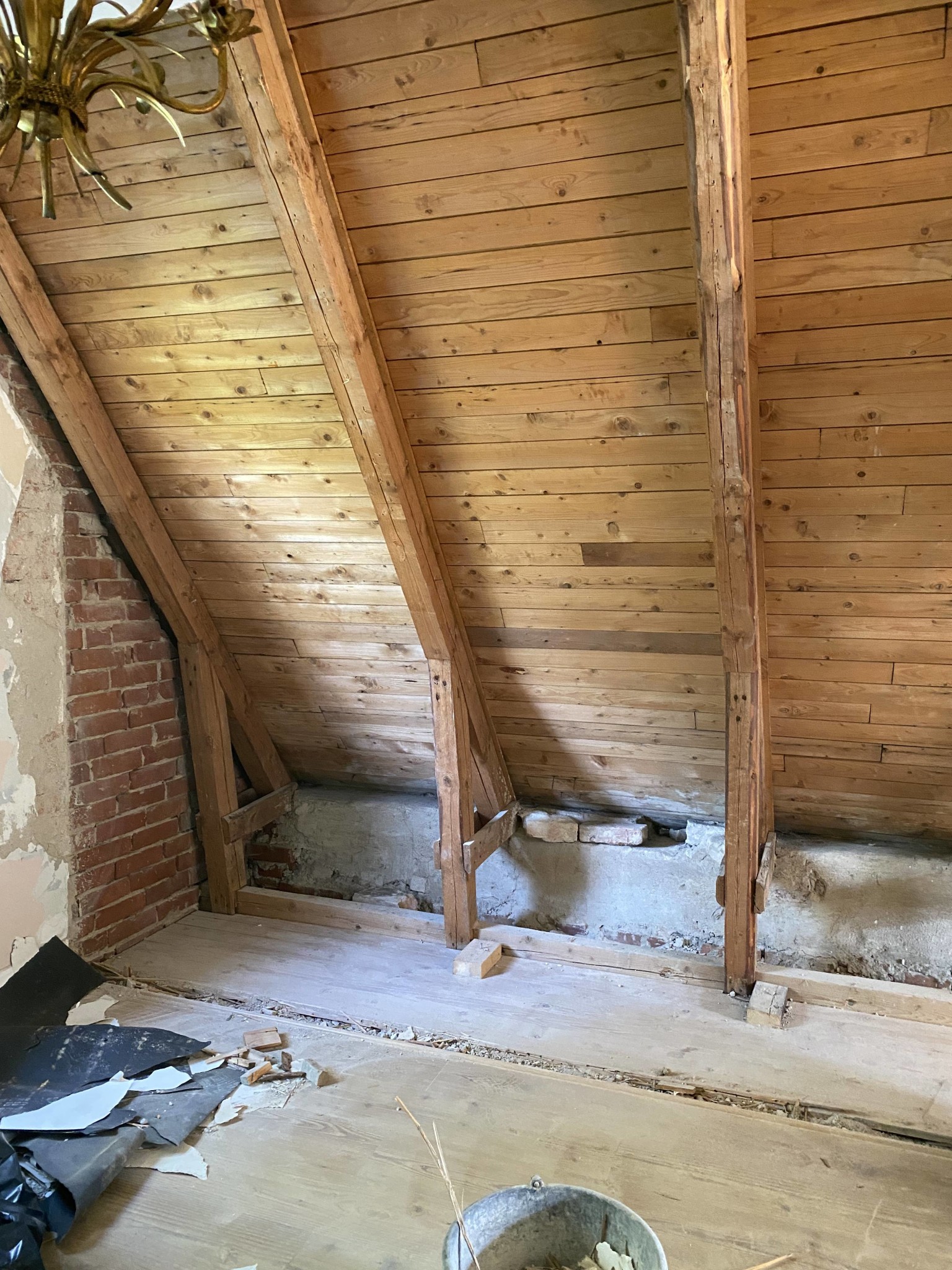


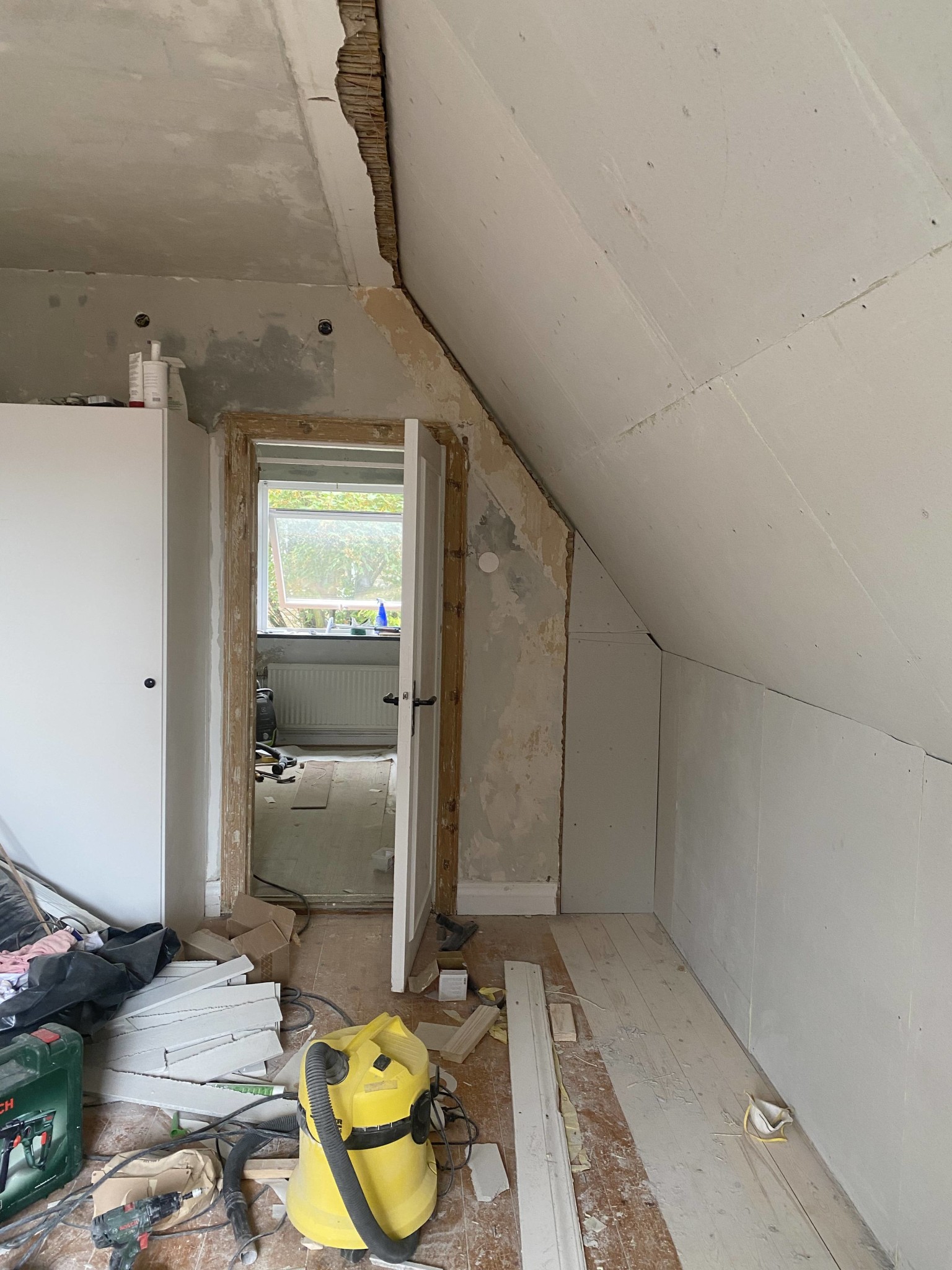
Thank you very much!F FMagnus said:
Which insulation did you use? Or, well, the entire sandwich layer would be interesting!
Sounds like a good solution, how thick insulation have you used?F FMagnus said:
Addition: the iCell boards and Hunton boards are almost exactly the same price!F FMagnus said:
The previous owner had filled the entire kneewall space with an incredible amount of fiberglass insulation, just stuffed in. Plus, they had lowered the sloped ceilings and insulated there as well. The air quality in the bedrooms was very poor, but it got much better afterwards. So far, it's working well with 120 mm of insulation, but this winter we've lowered the temperature in the house significantly, so it's been about 17 degrees upstairs now, and we haven't tested it in summer yet, as the work was done last fall.
Zoldot said:
Yes, I saw that post, but these paths to the kattvindarna are extremely thin. There are standing planks and vass, I haven't observed anything of thicker construction there.
At the same time, one room has almost no kattvind and the staircase has no kattvind at all.
While a room at the gable has two large ones, about 2.3m ceiling height inside.
Hi!
Your house and the house in the post with bouncy floors being referred to have different load-bearing solutions even though they look similar geometrically. The kattvind walls, in your case, are not load-bearing. But do not remove the horizontal "ceiling beam" as it is important.
//Linda - constructor