
Hello,
I am going to redo my old deck that has sagged. It was untreated wood in the supporting structure, grrrr?
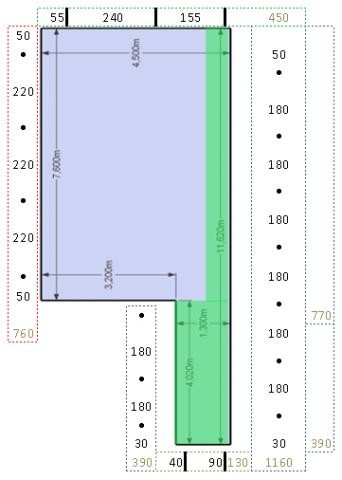
It will now be expanded by about 50 cm and extended along the house (the additional part is shown with a green background in the attached image).
There are currently 2 rows of pillars with 4 in each, located 50 cm from the house, and 240 cm from the first row. The center-to-center distance is about 230 cm.
I won't be able to choose thicker beams than 45x145 for either the supporting beams or the joists.
Is this okay? Can I use the existing 8 pillars and add my 10? Any other suggestions?
I hope the image is understandable.
/Magnus
I am going to redo my old deck that has sagged. It was untreated wood in the supporting structure, grrrr?
It will now be expanded by about 50 cm and extended along the house (the additional part is shown with a green background in the attached image).
There are currently 2 rows of pillars with 4 in each, located 50 cm from the house, and 240 cm from the first row. The center-to-center distance is about 230 cm.
I won't be able to choose thicker beams than 45x145 for either the supporting beams or the joists.
Is this okay? Can I use the existing 8 pillars and add my 10? Any other suggestions?
I hope the image is understandable.
/Magnus

Hello,
I'm a bit lazy and I'm pasting my response from a similar question in the Deck Forum that might help you calculate the dimensions for your particular deck.
The table that is commonly referred to here is the one called Thorstensen's table, which originates from Norwegian Building Research. Additionally, a spacing of two meters results in a total of five plinths over eight meters since you need to have a plinth in the "zero position."
I have compiled Thorstensen's table and a few other tables here.
Hope they can be of help.
One example of solving your cousin's deck is to do the following.
The deck is 3.5 x 7.5 meters. We assume that the decking is going to be lengthwise and that we can place the first support beam at the façade or that the first row of plinths can come up against the house.
To minimize the dimensions of the timber, we choose to place a row of plinths in the middle, making the span for the floor joists 3.5/2=1.75 meters. Looking at the lower table, we see that we can manage with 45x120, which has a maximum span of 1.90 meters.
With this in mind, we look at the upper table. 1.75 is not listed, but 1.80 is. This is perfectly fine as it gives us a little extra margin, however small. Then look in the column for 1.80 and consider how closely you want to set the plinths.
If you choose to place a total of five plinths in each row, you get a spacing of 7.5/4=1.875 meters. This shows that we are on the borderline for using 45x145 as a support beam (maximum plinth distance is 1.85). It is probably okay, but if you want a little margin, use 45x170 as the support beam.
Note that these values apply to wood of class K18/C18, and not all lumber yards will have this in stock.
I'm a bit lazy and I'm pasting my response from a similar question in the Deck Forum that might help you calculate the dimensions for your particular deck.
The table that is commonly referred to here is the one called Thorstensen's table, which originates from Norwegian Building Research. Additionally, a spacing of two meters results in a total of five plinths over eight meters since you need to have a plinth in the "zero position."
I have compiled Thorstensen's table and a few other tables here.
Hope they can be of help.
One example of solving your cousin's deck is to do the following.
The deck is 3.5 x 7.5 meters. We assume that the decking is going to be lengthwise and that we can place the first support beam at the façade or that the first row of plinths can come up against the house.
To minimize the dimensions of the timber, we choose to place a row of plinths in the middle, making the span for the floor joists 3.5/2=1.75 meters. Looking at the lower table, we see that we can manage with 45x120, which has a maximum span of 1.90 meters.
With this in mind, we look at the upper table. 1.75 is not listed, but 1.80 is. This is perfectly fine as it gives us a little extra margin, however small. Then look in the column for 1.80 and consider how closely you want to set the plinths.
If you choose to place a total of five plinths in each row, you get a spacing of 7.5/4=1.875 meters. This shows that we are on the borderline for using 45x145 as a support beam (maximum plinth distance is 1.85). It is probably okay, but if you want a little margin, use 45x170 as the support beam.
Note that these values apply to wood of class K18/C18, and not all lumber yards will have this in stock.
Thank you so much,
Hmm, it sounds like a span of 2.40 between support beam 1 and 2, and 2.20 between the pillars for these is a bit too much for 45x145? And even though I have it tighter to support beam 3 and between the pillars for this one, right?
/Magnus
Hmm, it sounds like a span of 2.40 between support beam 1 and 2, and 2.20 between the pillars for these is a bit too much for 45x145? And even though I have it tighter to support beam 3 and between the pillars for this one, right?
/Magnus
Click here to reply