Hello
I am going to build an interior wall with wooden studs and to save on centimeters and match the door frame, I have now chosen 45*45 mm studs. Previously, I used 70*45 but changed my mind. I will be using 1200 mm and 900 mm gypsum after the OSB boards. My question now is what cc distance is recommended for 45*45 studs.
I have read that for 1200 gypsum the minimum cc distance is 600 mm and for 900 mm, 450 mm. I guess these recommendations are mainly aimed at 70-95 mm studs since these are the most common.
Therefore, I wonder if you have other experiences and can recommend a reasonable cc distance.
Hello
I am going to build an interior wall with wooden studs, and to save on centimeters and match the door frame, I chose 45*45 mm studs. I previously took 70*45 but changed my mind. I will use 1200 mm and 900 mm gypsum after the OSB boards. My question now is what cc distance is recommended for 45*45 studs.
I have read that for 1200 gypsum the minimum cc distance is 600 mm and for 900 mm, 450 mm. I guess these recommendations are mainly aimed at 70-95 mm studs as they are the most common.
Therefore, I wonder if you have other experiences and can recommend a sensible cc distance.
Thanks in advance
What room is the wall for? How long is the wall? Any angle that stabilizes it?
If it doesn't require a stable wall, 600 works. It will be a bit shaky, but it probably will be with anything when using 45s. I recently demolished such a wall in the upstairs that I hadn't really noticed was flimsy; however, the wall we built at the other end of the upstairs with 70s turned out much more stable. But when OSB, gypsum, door, etc. are installed, it becomes quite stable, as long as the wall isn't very long. But if you're already at it, maybe cc450 doesn't matter much, a few hundred more and you'll have more studs to hit when you need to hang something heavy.
However, if it's a bathroom or the like where you want a stable wall, I wouldn't take a chance.
What is the room the wall is for? How long is the wall? Any angle that stabilizes it?
If it's nothing that requires a stable wall, then 600 is fine. It will be a bit wobbly, but that's probably true for everything when using 45s. I recently demolished such a wall upstairs and didn't particularly notice that it was flimsy. However, the wall we built at the other end of the upstairs with 70s is much more stable. But when OSB, gypsum, doors, etc., are mounted, it becomes quite stable, as long as the wall isn't very long. But if you're at it, maybe cc450 doesn't make much of a difference; it would cost a few hundred more, and you'd have more studs to hit when hanging heavy items.
However, if it's a bathroom or similar where you want a stable wall, I wouldn't take the chance.
Hi, yes it would be good to know, sorry. I’m going to divide my living room to create a bedroom. The height is 2.55m and the length is 3.81m. By other things that stabilize, I assume you mean the surrounding walls which are made of brick and plaster. I interpret your answer as the shorter the cc, the more stable considering it's 45*45. OSB also stabilizes it. I was considering 300 cc, because one of the gypsum boards is 1200 and the other 900, so it seems like a good number to aim for. So it's possible to build with 45*34 but it's naturally more stable with 70-95. But how big is the difference really in the stable experience?
Hello, yes it might be good to know, sorry. I'm going to divide my living room to create a bedroom. The height is 2.55m and the length is 3.81m. With something else stabilizing, I assume you mean the surrounding walls which are brick and plastered. From your answer, I interpret that the shorter the cc, the more stable it is considering that it is 45*45. OSB also stabilizes then. I was thinking about 300 cc since one of the plasterboards is 1200 and the other is 900, it feels like a good number to aim for. So it is possible to build with 45*34 but it becomes more stable with 70-95, of course. But how big is the difference really in the stable experience?
Thinking more if there are angles or anything else. If you imagine a plywood board standing on the long side, it's quite wobbly. But if you have two at an angle to each other, they are very stiff.
But if it's just one long straight wall, you don't have that. I wouldn't say that it helps much with slightly denser studs, what matters most is the size of the depth. OSB or plaster stabilizes in two dimensions, in the directions it is long. But it doesn't offer much in the other direction. But with that ceiling height and wall length, I wouldn't dare go under 70 studs.
Thinking more if there are angles or other factors. If you imagine a plywood board standing on its long side, it's quite wobbly. But if you have two at an angle to each other, they are very rigid.
But if it's just one long straight wall, you don't have that. I wouldn't say that slightly denser studs help much; the biggest factor is the depth size. OSB or plasterboard stabilizes in two dimensions, in the directions it's long. But the other way, it doesn't offer much. But with that ceiling height and wall length, I wouldn't have dared go below 70 studs.
Hi,
The way you put it forth in this educational manner makes it sound so logical and reasonable that I can't help but agree. I'm incredibly frustrated that I ordered the wrong dimensions for the materials. But it would have been worse if I had built with the wrong dimensions too. Thank you!
Hello
When you present it in this educational manner, I feel that it sounds so logical and reasonable that I can't help but agree. I feel incredibly frustrated that I ordered the wrong dimensions of the material. But it would have been worse if I had built with the wrong dimensions as well. Thanks!
There is nothing strange or unusual about using 45x45 studs for non-load-bearing interior walls. Cc60 works fine and is sufficiently (for the most part) stable, especially with 2x boards. If you want to use 90cm plasterboard, then go for cc45.
One problem with 45x45 is finding sufficient quality; I very often find they are anything but straight from the hardware store.
There is nothing strange or unusual about 45x45 studs for non-load-bearing interior walls. Cc60 works fine and it is sufficiently stable (for the most part), especially with 2x layers of boards. If you want to use 90cm gypsum, go for cc45.
One problem with 45x45 is finding ones of sufficient quality, I find they are very often anything but straight from the building supply store.
Hello Richard from the Real Norrland. That was funny. Is there a fake Norrland? Now I'm curious about where it's located.
Anyway, thanks, I also read up on this, but considering they are going into a brick and lightweight concrete wall that is also not straight. I am now thinking that it feels more stable with 70 studs since the 45 studs can also be difficult to find straight. Have you connected 45 studs to wood or concrete?
I don't quite understand what you mean, but of course, 70mm is more stable, but I have both variants in my house, and I don't feel any direct difference. I have chosen to position 45x70 the "wrong way" sometimes to avoid working with crooked 45x45. Connecting to wood or concrete is probably done the same regardless of stud dimension.
I don't quite understand what you mean, but obviously, 70mm is more stable, though I have both versions in my house and I don't notice any significant difference. I have chosen to set the 45x70 the "wrong way" sometimes to avoid working with crooked 45x45s. Connecting to wood or concrete is done the same way regardless of the stud dimension.
As an answer to the first question, see the picture
[image]
Everyone knows that the rooting fence is located in the morelan Slussen and Gamla stan.
I think the problem might be the sound. The wall will probably let through a lot more noise due to the weak construction. This can partly be compensated with double plasterboards, but it probably won't be a quiet room.
I think the problem could be the sound. The wall will probably let through a lot more sound due to the weak construction. Can be compensated with double plasterboard, but it probably won't be a quiet room.
Hi, yes I'm also considering that. I've read about putting insulation strips between the "stud frame" and the floor/wall/ceiling. But I've also heard of others who haven't done that. I'd gladly hear about experiences regarding this as well.

Tomtom79 said:
What is the room the wall is for? How long is the wall? Any angle that stabilizes it?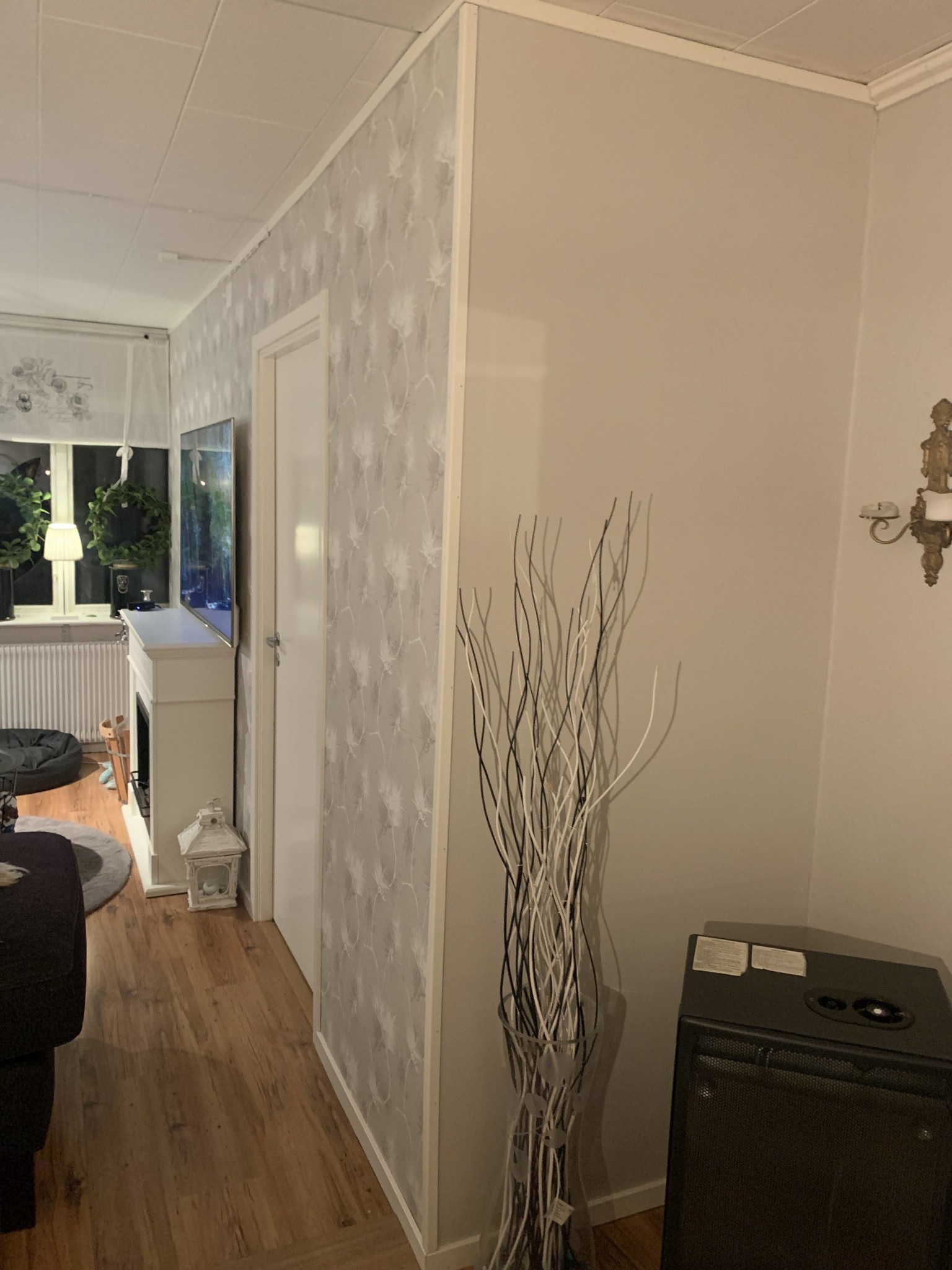

Rickard. said:
There is nothing strange or unusual about 45x45 studs for non-load-bearing interior walls. Cc60 works fine and it is sufficiently stable (for the most part), especially with 2x layers of boards. If you want to use 90cm gypsum, go for cc45.