I am going to replace the roof on the house. Currently, there is masonite as the underlay with Kvartotak, which will be replaced with tongue-and-groove boards and concrete tiles.
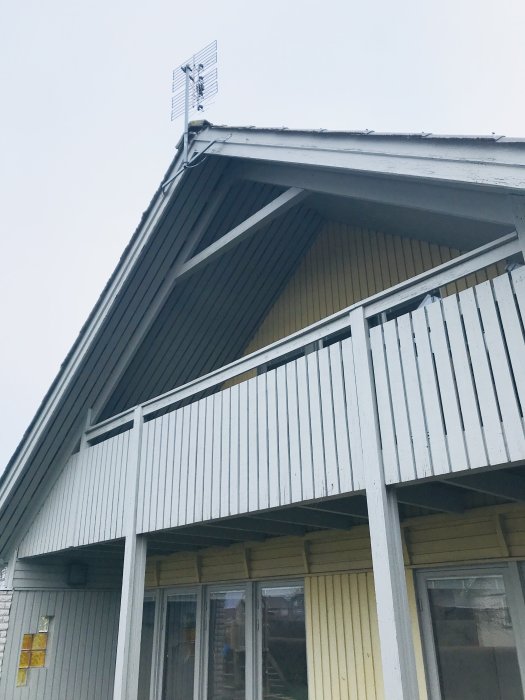
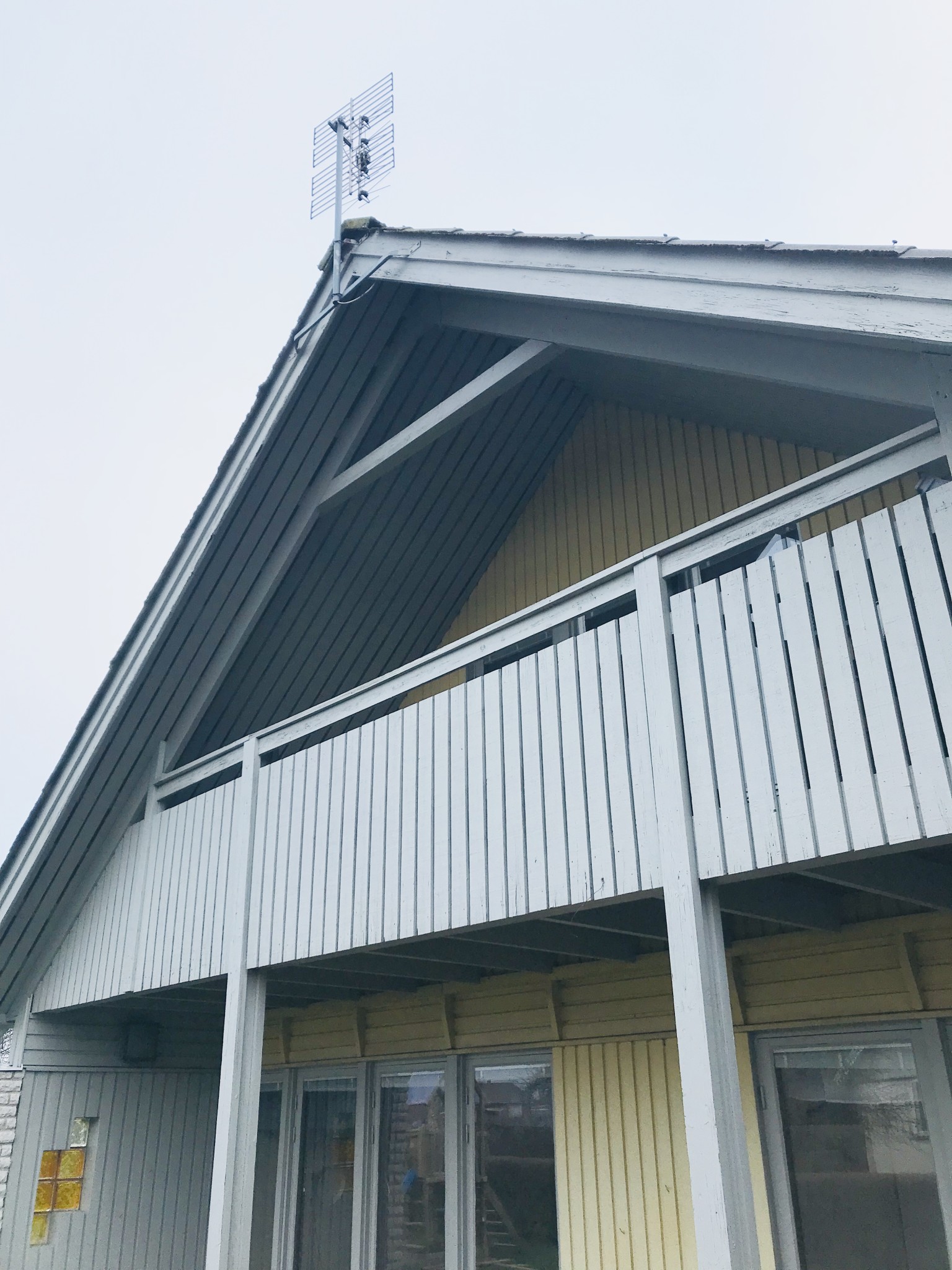
The problem that has arisen is that at the built-in balcony, the rafters are spaced at 155cm center-to-center, which doesn't work well with tongue-and-groove boards.
Ideally, it would be best to simply place a new rafter in between, but then I would have to dismantle the balcony to make room for the lower beam, and that lower beam would need to span 8.7m unsupported.
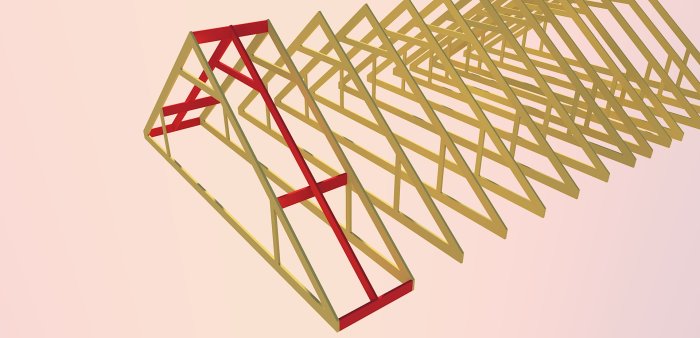
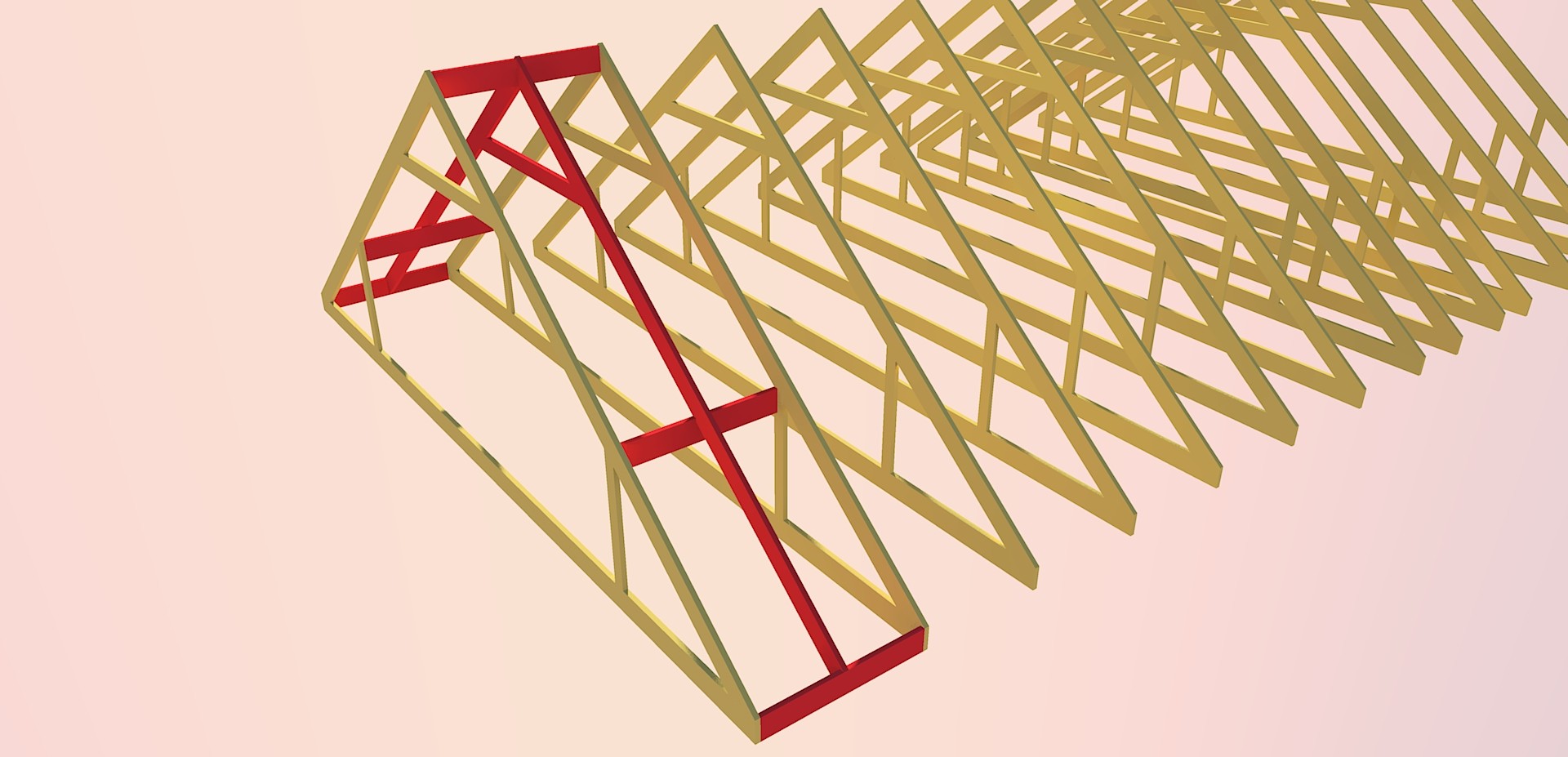
I have sketched a solution where you attach beams between the existing rafters and place a beam on top as a sort of rafter. The red part in the image.
The span of the rafters is about 8.7m with a 38-degree pitch. The upper beam is 45x195mm.
Has anyone encountered the same issue, or perhaps has another solution?
I would suggest that you add some more cross braces to shorten the span of the rafter running parallel to the roof slope. You could skip the horizontal brace at the ridge. Kvartotak, is it a type of metal roof? If so, you should be aware that the roof will become significantly heavier and consider whether the rafters can support this increase in weight.
I have still not found a good solution to the problem. I've had a contractor who calculated on my solution above, but he stated that it's not feasible to achieve it in my desired dimensions without using underarm.
I have considered two other options.
Option 1. Thicker battens
Using 45x95mm K24 "lying down" as battens, while the rest of the roof uses 45x45 as battens.
Option 2. Thicker tongue and groove boards
Using thicker tongue and groove wood where the balcony is. Perhaps 30 or 34mm. I don't know if there are tongue and groove boards that thick?
The contractor I used didn't even want to calculate these options and dismissed them outright.
Today's designers cannot profit from anything that falls outside standard solutions.
I think your drawn solution looks absolutely brilliant.
My only suggestions are to remove the lower nogging and try to have the truss resting on the wall plate instead, and to have the ridge board positioned on the underside of your new truss. You could also place a nogging in the upper collar tie to reduce the span.
If you then use 23 mm tongue and groove sheathing, it will be extremely stable.
I have investigated my first solution a bit more today and realized that it wasn't as easy as I thought. The truss in the gable wall is located inside the stud frame, which means that I need to modify it and the facade to be able to fasten the crosswise studs. I also discovered that the supporting legs are not placed in the same location in the last two trusses.
Therefore, I'm thinking that the solution with thicker raw timber would be the simplest solution. But I am having trouble finding an engineer who is willing to calculate it.
I am quite convinced that it would have worked to just run the raw boarding as it is now since the battens will still lie on the trusses plus one centered between the trusses. But can’t you build a new truss like the one on the outermost part that you place against the outer wall, as the c/c measurement to the outermost truss should then be approximately 1200 mm due to the wall's thickness. If it still feels like the c/c measurement is too long, you can also place "kortlingar" between the new truss and the outermost one that rests against the underside of the raw boarding, giving the centrally placed batten between the trusses support from the kortlingar. It seems like the simplest solution if you don’t just proceed with it as it is now and place thicker support battens on the outermost part.
Today's designers can't calculate anything that falls outside of standard solutions.
I think your drawn solution looks absolutely brilliant.
My only suggestions are to remove the lower brace and try to get the rafter to stand on the wall plate instead, as well as to get the ridge board to lie on the underside of your new rafter. You could also place a brace on the upper tie beam to reduce the span.
If you then go up to 23 mm tongue and groove boards, it will become extremely stable.
Today's designers can calculate a lot more than in the past. The problem today is that no one wants to pay for it.
I'm quite convinced that it would have worked just to run the raw cladding as it is now, since the battens will still lie on the rafters plus one centered between the rafters. But can't you build a new rafter like the one that sits at the far end which you lay against the outer wall because then the c/c measurement to the outermost rafter should be about 1200 mm due to the wall's thickness. If it still feels like the c/c measurement is too long, you could also place "blocking" between the new rafter and the outermost one that lies up against the underside of the raw cladding, providing the battens centered between the rafters with support from the blocking. Feels like the simplest solution if you don't just proceed as it is now and lay thicker battens at the far end.
Yes, that thought has crossed my mind. However, I don't have thicker walls than about 1425mm if you place against the nailing battens. But my thought now is to add an extra rafter against the frame and use thicker raw cladding in that section. I have seen something called German raw cladding which is 28.5mm or alternatively using 34mm smooth cladding.
Even though many say you can just go with thicker raw cladding or thicker battens, I would like to have a structural calculation on it. But it seems impossible to find a constructor willing to calculate it. Of all those I have contacted, one has returned with a price; he would charge 10,000 for it. Most others say it’s too small a job or they don’t have the time.
Okay, but are you going to tear down the panel to get in there? But if you do that and then lay down the thicker råspont, there shouldn't be any problems. You can also screw a beam on the side of the rafters to reduce the c/c measurement further. Otherwise, you could build a new truss between the old ones as you mentioned. You might need to embed a new beam from the outer support leg to the wall so you have something to place the support leg on from the new truss. The decking from the balcony should work as an underarm, preventing the upper legs from spreading apart. But you might need to add glulam beams to support the upper legs, which might be unnecessarily complicated? 10000 bucks, they sure know how to charge, but they also need food on the table. Feels unnecessarily expensive, better to spend it on something more fun.
Last edited:
Click here to reply
Vi vill skicka notiser för ämnen du bevakar och händelser som berör dig.

Matti_75 said:
Today's designers can't calculate anything that falls outside of standard solutions.