
Hello.
The house renovation is in full swing and there are lots of things to figure out/solve in order to do it in the best way.
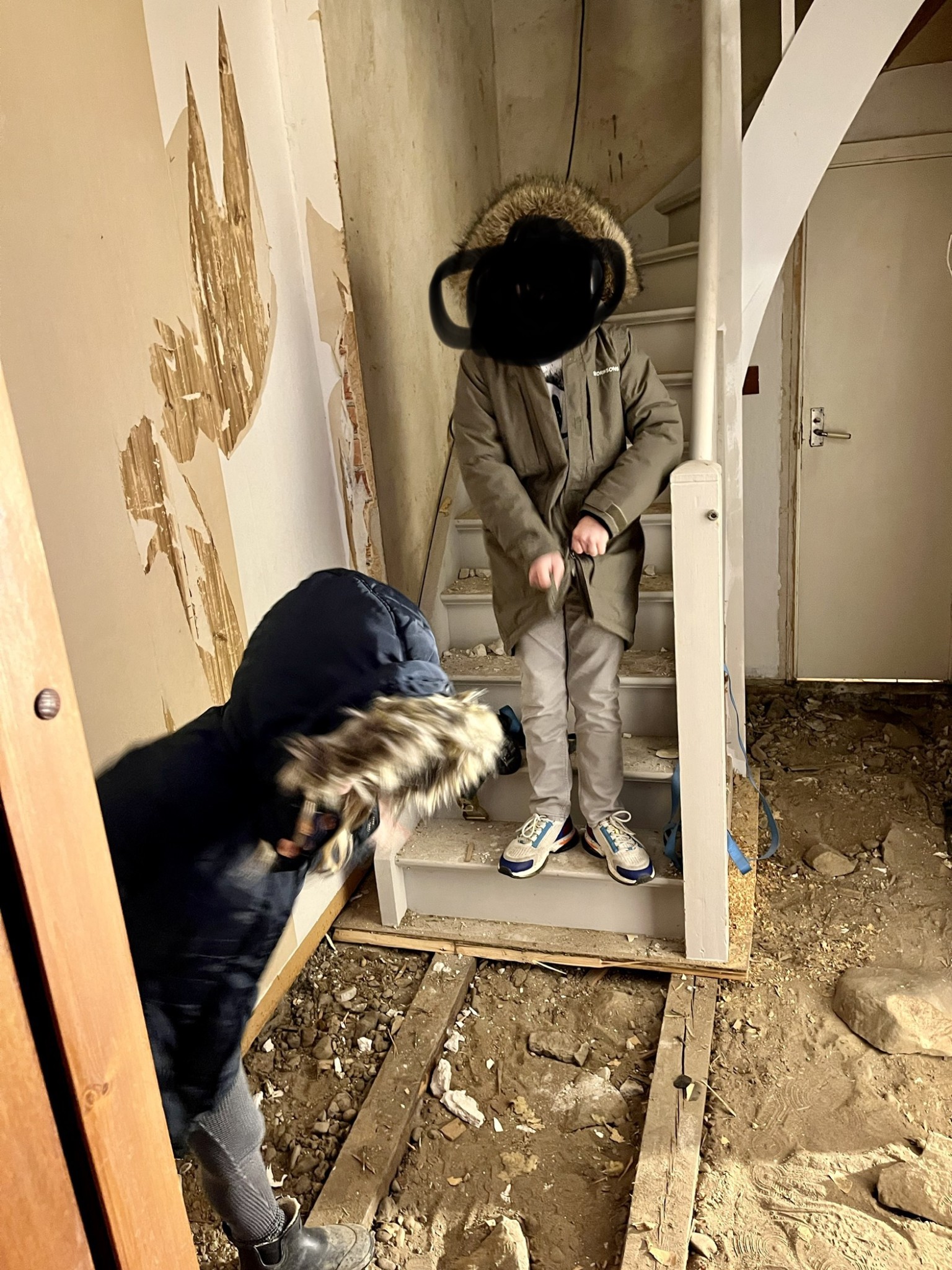
The next question I need help with is the staircase that stands on kärnvirke. 2 beams under it. These have then lain directly in the sandy soil and it seems to have worked well. BUT now I want to cast a slab under it and am wondering what the best solution is.
Can you cast kärnvirke into the slab, i.e., push it under the insulation so that the staircase stands directly on it and lay concrete and underfloor heating around it?
Or should you try to replace the beams with iron?
Or should you remove them and hope that I can raise the staircase a few cm and try to cast under it and then lower it onto the slab?
I really don't want to remove it. It is painted and I have no idea about the fastening...
Grateful for tips!
The house renovation is in full swing and there are lots of things to figure out/solve in order to do it in the best way.
The next question I need help with is the staircase that stands on kärnvirke. 2 beams under it. These have then lain directly in the sandy soil and it seems to have worked well. BUT now I want to cast a slab under it and am wondering what the best solution is.
Can you cast kärnvirke into the slab, i.e., push it under the insulation so that the staircase stands directly on it and lay concrete and underfloor heating around it?
Or should you try to replace the beams with iron?
Or should you remove them and hope that I can raise the staircase a few cm and try to cast under it and then lower it onto the slab?
I really don't want to remove it. It is painted and I have no idea about the fastening...
Grateful for tips!
I totally agree with you and with new wood, I wouldn't think about it. What makes me consider/investigate is that it has actually been lying directly in the ground for 70-100 years and is heartwood without any sign of damage.F fribygg said:
Cut or 'fine' the staircase if needed, if you are skeptical about foundation paper or pallet blocks, you could possibly use double bark to isolate the wood from stone/concrete.Dr Benz said:
I had something similar, our staircase went around a post and it went down into the concrete floor and had been like that for at least 20 - 25 years before house fungus started to grow...
Replaced the post timber and cast a post shoe into the concrete floor instead.
Replaced the post timber and cast a post shoe into the concrete floor instead.
Ok. I need to remove the studs and try to lift it so that it can be cast underneath. I don't want to risk anything. Should one still lay tar paper considering that the slab will be insulated against the foundation?F fribygg said:
I don't want to risk that. However, it will be insulated underneath but it might still risk moisture with all that it entails?K Kurtivan said:
The capillary force is enormous, so if you now insulate and install underfloor heating, there is a risk that you change the conditions and actually draw in moisture.
However, I wouldn't be particularly worried if you're just adding a bit, but with a lot of insulation, it is a real problem.
This can be counteracted by having base heat in the summer and floors that allow moisture to pass through.
However, I wouldn't be particularly worried if you're just adding a bit, but with a lot of insulation, it is a real problem.
This can be counteracted by having base heat in the summer and floors that allow moisture to pass through.
What do you mean by just complementing?tttomten said:
The capillary force is enormous, so if you now insulate and install underfloor heating, there is a risk that you might change the conditions and actually draw in moisture. However, I wouldn't be particularly worried if you're just complementing, but with a lot of insulation, it is a real problem. It can be counteracted by having basic heating in the summer and floors that allow moisture to pass through.
If I place the staircase on top of the slab, i.e., remove the joists and let it stand directly on the concrete, is something moisture-breaking needed then?
Supplement-insert some insulation.
If you can access it, you should definitely use something that stops potential moisture migration.
Ok I understand. The idea is to dig out underneath with about 40-50 cm. The rest of the house and lay gravel and insulation and then cast a slab on that. But you should still have something in between for safety's sake?
Click here to reply
Similar threads
-
Gjuta platta på vintern, risker?
Grund & Markarbeten -
Gjuta platta i befintlig plintgrund
Grund & Markarbeten -
Bör vi gjuta plintar för trädäck byggt på stenplattor?
Altan & Uteplats -
Gjuta in ventilationsrör i existerande gånger?
Ventilation -
Gjuta bärlina. Liggande regel mellan betong och bjälklag?
Utbyggnad och tillbyggnad