I am completely fed up with sagging gates and plan to do it properly once and for all.
I will build a driveway gate with approximate dimensions (H x W) 1500 x 3500mm.
The idea is to build the gate in pressure-treated wood with angled supports according to all the rules. But it will be heavy, and free-hanging, without front wheels.
The gate will be opened/closed occasionally, maybe once a week, perhaps later with a gate motor.
Possibly I might build a framework of steel, but it's costly, plus I currently don't have access to a welder or a flat surface to build on. Regardless, I plan to clad it with pressure-treated wood.
But the main question here relates to the post.
I have an HEA 100 beam leftover, and the idea is to cast it down about 1000mm so that it sticks up about 1500mm (total length 2500mm).
The question is as follows: how large a hole do I need to dig? I was thinking of casting straight down into the ground, and in my mind, I imagined the size of an oil drum, so about 700mm in diameter and about 1000mm deep.
The thing is, I'm planning to hand dig it, obviously not all in one evening, the soil here consists of 90% semi-light sand.
Should I maybe make the casting in a different shape than a cylinder? L-shaped?
With that weight and length, you probably need a bit more as a counterweight, it will be several tons of pull on the top hinge, maybe a brace on the back from the top of the post extending about 3 - 4 meters away with a strong anchoring in the ground. Building in wood might be a bit difficult; the gate will likely sag on its own when the wood gives way.
Unfortunately, I can't brace the post with an angle brace since it's a corner post, or jonden, I can do that, but then the brace only has an effect when the gate is open.
How big are the "posts" for these gates, for example?
Have I placed the thread in the wrong forum section? Someone who might work with this should be able to give a hint?
Probably the right forum section, but the number of people working on installing larger gates is likely small here...
(Additionally, it's definitely a chain. Someone calculates how the foundation should be cast, someone designs the form, someone builds the form, someone fills it with concrete, someone installs the gate...)
But, I can share my thoughts on the project, even though I neither install gates nor am particularly trained in calculating such things...
1: There are two ways to counteract the weight: either by digging deeper straight down or making the "block" L-shaped beneath the gate (as you mentioned. However, since the gate must open, the L-shape should be more like a "fan with a stick". In any case, the keyword here is dig. You will have to dig a ****load. Is it doable? Are there cables/sewage/etc. in the way?
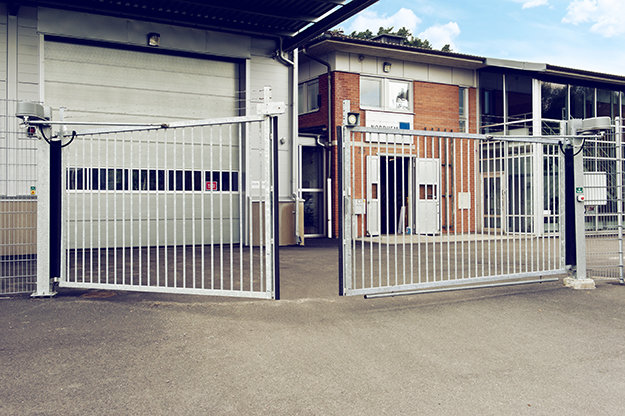
2: Have you requested a quote from a company that actually installs real gates, like the one in the picture above? So you have some cost reference?
3: What do you have against the wheel at the far end? It must be the simplest solution if you have to have a swinging gate and are unsure how to dimension the whole thing?
It's definitely doable to dig, I'm not in a hurry a few wheelbarrows a week until the hole is big enough
I don't know what a company would charge. However, the fence store claimed that the post for their steel gate of 2000x3500mm needed a casting hole of about 300x1000mm.
Which I personally think feels flimsy, on the other hand maybe their steel gate doesn't weigh anything. What do I know.
Regarding front wheels, the ground slopes, and it's troublesome in the winter.
The plan is to dig a huge hole and pour a foundation shaped like an upside-down mushroom. Simply put, I dig a hole about 1000mm x 1000mm and cast the bottom first, then the rest up with a 400mm casting tube, then backfill the material around.
This means I need to dig out 1 cubic meter, which translates to two wheelbarrows 20 times.
Perhaps a smaller project to rent an auger and drill really deep and then use the ground as a casting mold? A big advantage is that the ground around the hole is undisturbed and already compacted. Less material to handle back and forth.
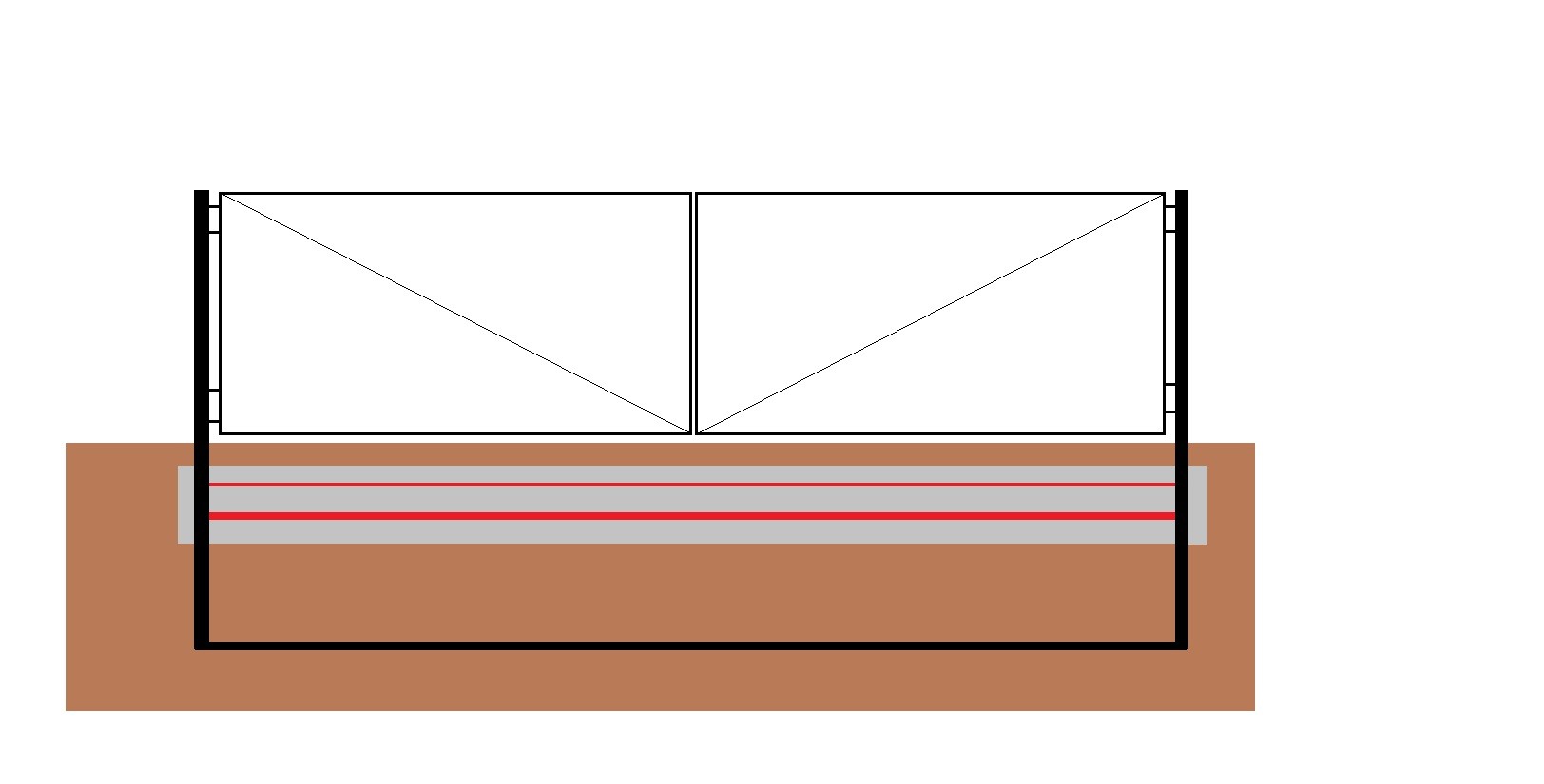
Here's how we solved the same problem a couple of years ago.
Absolutely not measured in proportions.
The gate that was up was 5.5m wide and 2.5m high, yet a car managed to miss this plank-covered gate...
I recall that the concrete slab was about 10cm thick and was located 30-40cm below ground, as we drove in and out with heavy machinery (not necessary if you’re driving in and out with a regular car).
In the absence of a welder, you can always bolt things together
Black is steel in the frame
Red is to indicate the reinforcement in the concrete
Gray is concrete