Hello,
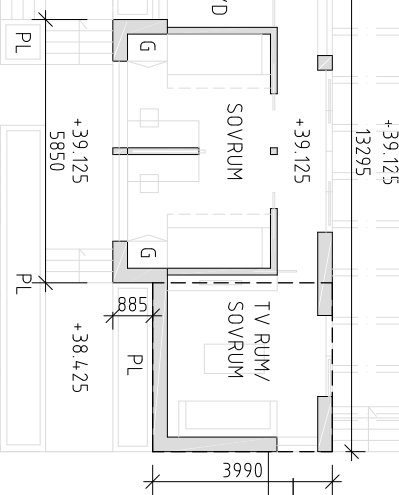
We are planning to build a single-story house with a building area of 157 sqm and have designed the house to include an additional 15 sqm extension (the detailed plan does not allow for more). However, we would like to cast the entire slab now to avoid re-establishment and to maintain uniformity as the slab will be polished. The extra part of the slab is therefore included in the building permit, and the inspector has approved that we cast everything now. But - the house supplier is skeptical about the solution due to the risk of water being absorbed into the sill. When we've consulted others, they suggest that this should be taken seriously but it is certainly solvable, for example, by welding roofing felt onto it. Do you have any good ideas for solutions that the house supplier can accept?
The outer walls of the house should rest on some form of edge elements, among other things, to avoid thermal bridges. I would consider it as two separate slabs with their own edge elements. When the first house is built, you can cover the "extension slab" temporarily with something water-repellent, preferably with a slight slope.
The outer walls of the house should be on some form of edge elements, among other things, to avoid thermal bridges. I would consider it two separate slabs with their own edge elements. When the first house is built, you can temporarily cover the "extension slab" with something water-resistant, preferably with a slight slope.
Okay, it might be reasonable to set it up that way. To clarify: the extra slab will become a living room that can be accessed via the corridor, so it won't be separated in any way in the end.
Do you have any ideas on what that water-resistant material could be? The house manufacturer is, as I mentioned, skeptical and believes that water can rise quite high when the rain is pounding here on the west coast...
It is certainly possible to solve it with tar paper, but it requires priming and hot-gluing the tar paper to the concrete, which is not very temporary. You can also lay a loose tar roof (or other waterproofing layer) on the concrete with a substantial upturn against the facade, but that is quite an expensive solution.
A better temporary solution might be to assemble a makeshift roof with a few degrees of slope and choose a roofing material depending on how long it needs to last, where a new sturdy PVC tarp might be the simplest option.
One must consider the integrity of the main building. It must function well even if for some reason you do not undertake the extension. I agree with @Rickard.ag to choose a temporary solution that fits the planned time.
You must also solve the problems with a huge thermal bridge. In principle, you can only solve it by casting 2 separate slabs with insulation in between. The undeveloped slab also has a completely different exposure class, which entails a different concrete mix and more reinforcement.
It can certainly be solved with felt, but it requires priming and hot gluing the felt to the concrete, which isn't very temporary. You can also place a loose felt roof (or other sealant directly) on the concrete with significant overlap against the facade, but it's quite an expensive solution.
A better temporary solution might be to build a makeshift roof with a few degrees of slope and choose a roofing material depending on how long it needs to last, where a new durable PVC tarp might be the easiest option.
Good question - our plan is to apply for an "attefall" extension right after the final approval and start, but we also know that the money might run out and other things might get in the way. So the solution should probably last for at least a year.
Priming and hot gluing, in what way is it not temporary? Is it difficult to remove, for example? It does sound good otherwise. Loose felt roof or makeshift roof might also be an option, but there the Building Department might start having opinions if it adds height.
You also have to solve the problems with a huge thermal bridge. In principle, you can only solve it by casting 2 separate slabs with insulation between. The unbuilt slab also has a completely different exposure class, which entails a different concrete mix and more reinforcement.
Thermal bridge is a good point. One additional reason we've wanted to cast it uniformly is that we might need to pile. It becomes complicated to cast another piece of slab since that construction has to be cast in and stand on piles. We're considering digging down to bedrock instead and filling up, and that would simplify this as well since we can more easily do a separate casting. What do you think?
It's not difficult to cast a slab later just because it's piled; the first slab just needs to be prepared with dowels, which is not a problem for an engineer to solve.
If it's so close to bedrock that it can be filled, it sounds like it's too short to pile. Perhaps you should consider founding on pillars to the bedrock instead? If the ground cannot support a slab on the ground, that is, that's the first thing you need to sort out.
It's not difficult to cast a slab later just because it's piled; the first slab just needs to be prepared with dowels, which is not a problem for a structural engineer to solve.
If the bedrock is close enough to fill out, it sounds like it's too short for piling. Perhaps you should consider foundation on pillars down to the bedrock instead? Unless the ground cannot support a slab on grade, that's the first thing you need to determine.
Thank you! I'll note preparing with dowels.
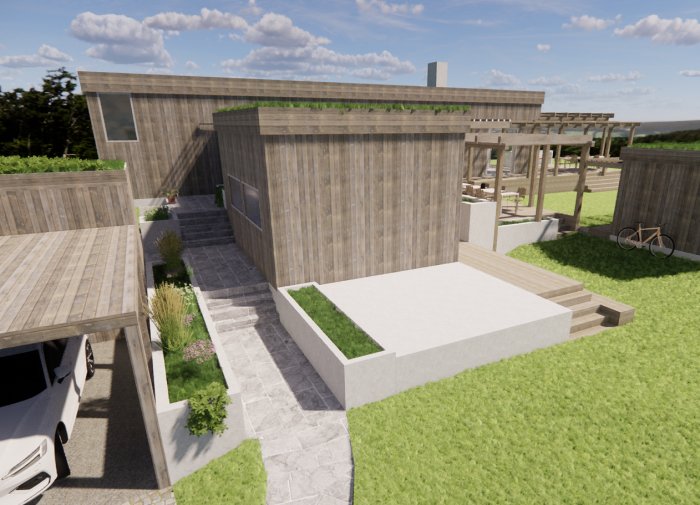
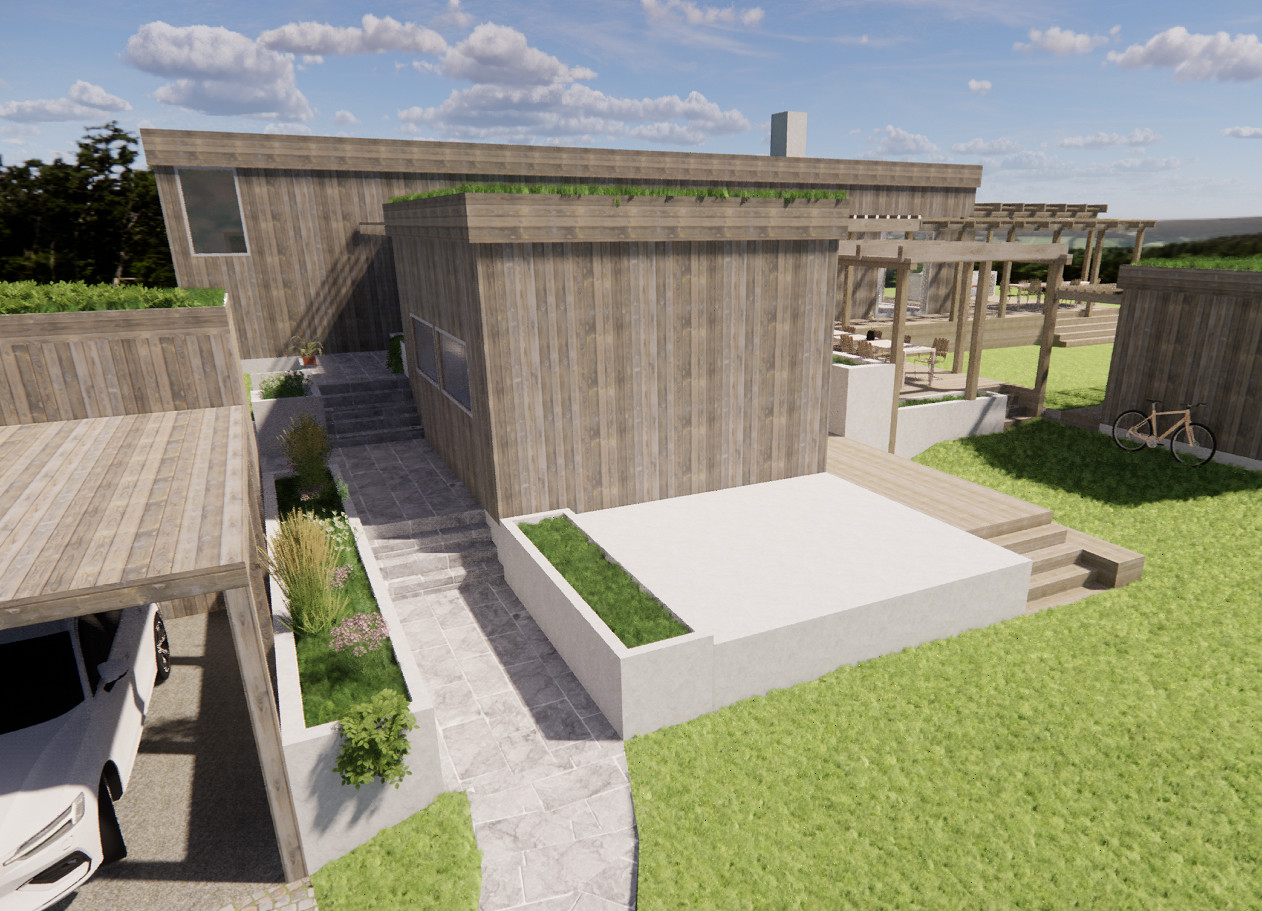
Regarding the depth, this might be something of a borderline case. I'm attaching an overview here. At the back, we have exposed bedrock that slopes down to a lawn on clay (see sketch), so there's no chance to place the house directly on this due to the variation. A geotechnical engineer friend firmly believes we should skip the geotechnical investigation because "it costs more than it's worth" and either go for piling or excavation depending on the cost. Excavator #1 thinks we should pile, and #2 wants to excavate down to the bedrock and fill up (he will have blast rock leftover from a parallel build). #1 said pillars would be more expensive than piles.
Thoughts? All are warmly welcome - we are right in the middle of this choice right now and find it quite challenging.
Poles may become cheaper, but they will be too short. They won't have lateral stability, the minimum length for a pole is 3 m. One trick might be to drill them 0.5 m into the rock, but it's not the same price.
It feels like large amounts need to be excavated, make sure to get concrete price quotes if you're going to compare solutions. If you can get free blasted rock, maybe it will be okay? Honestly, it feels like guesses from the contractors. My advice is to have a designer make the foundation drawings first so that you have something to inquire about. They will need to be developed anyway, so you're starting at the wrong end, in my opinion.
Piles may become cheaper but they become too short. They will not have lateral stability, the minimum length for a pile is 3 m. A trick could be to drill them 0.5 m into the rock, but it's not the same price.
Seems like large amounts to excavate, make sure to get concrete price quotes if you are comparing solutions. If you can get blasting stone for free, maybe it will be okay? Honestly, it feels like guesses from the contractors. My advice is to let a designer create the foundation plans first so you have something to ask about. They have to be made anyway, so I think you're starting at the wrong end.
Really great input, wish I had gotten it earlier. What do you work with to have such insight? The contractor suggested pinned piles to solve the lateral stability, and I've received a (high) quote for this. A friend suggested screwed piles but I'm not sure how they differ really.
The amounts are quite substantial, I've tried to calculate myself in 3D after my test pits and I estimate a need of about 600 m3 fill and about 500 m3 clay to be removed. We get the stone for free and the transport should be quite reasonable, the blasted masses are only 15-20 minutes away.
Regarding the work order. A complicating factor is that we currently have a temporary exemption on the road that expires in February, allowing us to transport whatever we want, but then it reverts to an 8T axle load limit. So we're trying to be proactive. Therefore, one idea now is to excavate and fill at the same time as the blasting with shared commencement notice. During the uncovering, we’ll see if any piles are needed if the rock extends down too much anywhere. How does that sound?
The current house (which has been demolished) stood partially on rock or a large block, hard to see because there's a lot of the foundation left unfortunately. The demolisher left before I could ask them to move anything around...
I understand that it feels tempting to push forward now that there is no weight limitation on the road. When is the excavator scheduled to start? As mentioned, it would be good to have the foundation drawings ready before they begin digging. You can get the foundation drawings relatively quickly. Where in the country is the house supposed to be built? The depths are not very deep under most of the house, so digging for piers must be much less extensive than digging everything out and backfilling?
Vi vill skicka notiser för ämnen du bevakar och händelser som berör dig.





Rickard.ag said:
How temporary is it?

