I've torn down all the drywall in a bedroom (I couldn't be bothered to strip all the layers of wallpaper, and I want to run some wiring that I want recessed).
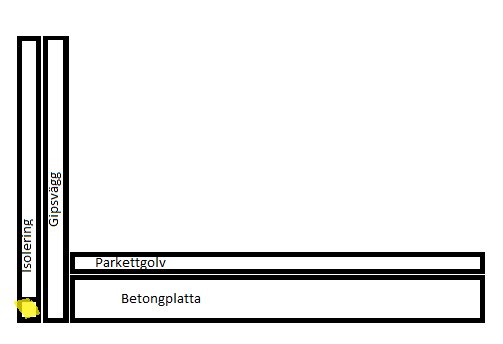
The drywall panels are attached outside the base plate (concrete), which means I can't access and remove the entire panels.
I've made a simple sketch of what it looks like (it's mostly for illustration). The yellow-marked part I guess is a sill that the panel is attached to at the bottom. The rest of the panel was nailed to the studs located in the insulation (not drawn).
As it stands today, I've cut the drywall with a multi-tool at the bottom and removed as much as I could of the panels, but about 15cm of the panel remains that I can't access (unless I tear down the exterior wall made of brick) that lies below the concrete slab.
The house is from 1973. From what I understand of the construction, the slab was poured after the drywall was put up.
I plan to build a new wall of OSB+drywall.
The question is, can I build a new wall standing on the drywall panel that remains (with OSB standing on the remaining drywall) and then build with drywall over the OSB panel?
It seems not ideal to have plaster directly against the concrete, but if it's lasted since '73, it should be fine. I would place a nogging between the studs to give the wall support at the bottom and continue building with OSB and plasterboard.
It seems questionable to have plasterboard directly against the concrete, but if it has held up since '73, it might be okay. I would place a nogging between the studs to support the wall at the bottom and continue building with OSB and plasterboard.
Thanks for the response! That was somewhat my thought too. Can I stack OSB on the existing edge with the plasterboard that's left, or should I skip that idea and instead go with plasterboard only and somehow try to fill any gaps?
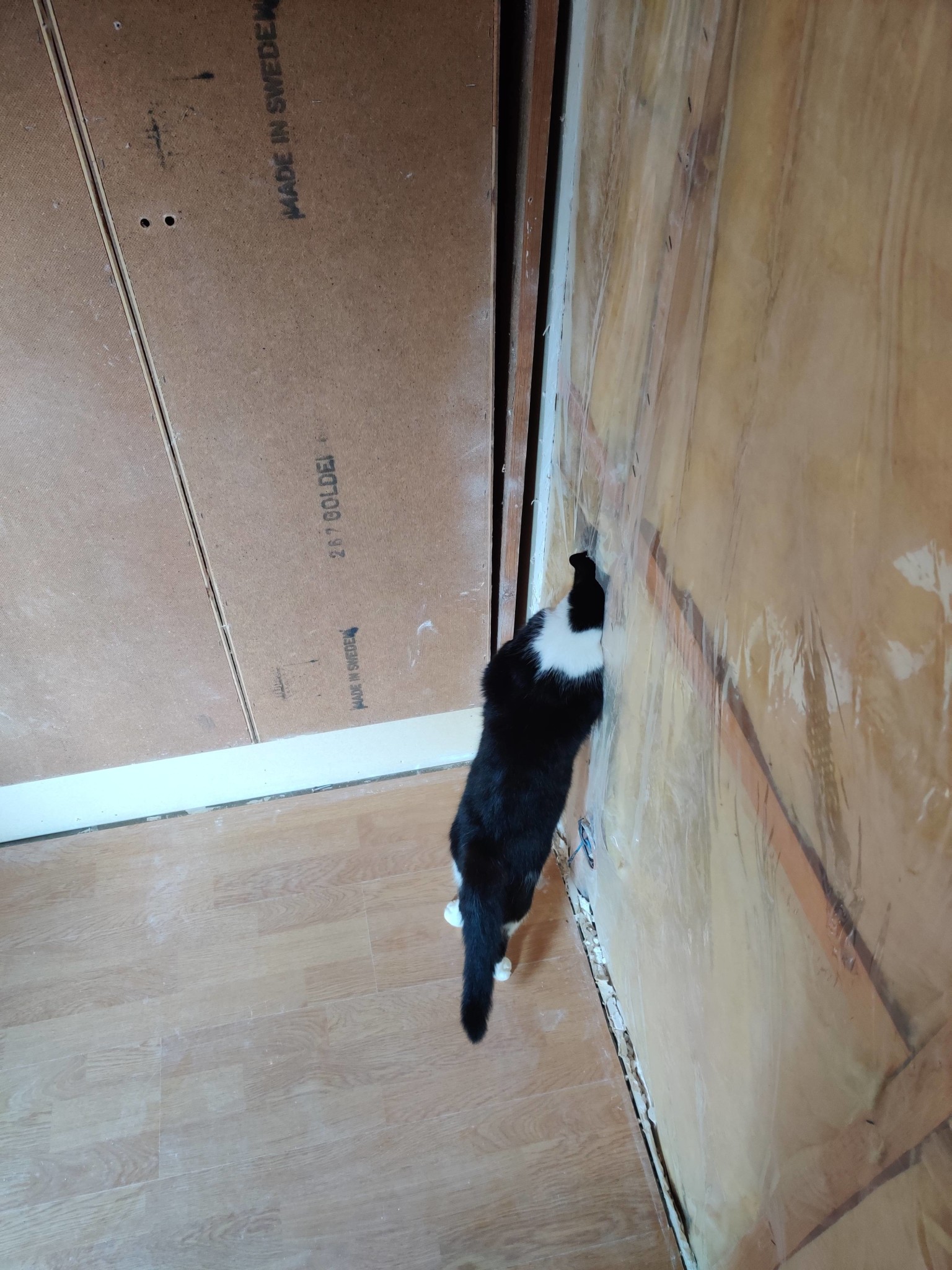
Before I realized how it was mounted and brought out the multitool, the existing plasterboard got quite an ugly edge, see picture (the cat naturally wanted to join the inspection too).
If you have something to attach the OSB to at the bottom, that's fine. Otherwise, you need to insert a horizontal beam between the vertical ones to have something to screw the OSB into. Do it the same way it's done above the cat
If the walls are plastic-covered, the plastic should be repaired.
It could be that you have floating floors - possibly with a thin layer of finish on top of foam which in turn is on the poured slab. That's how it was in our house which is built in '72. That is, the gypsum does not extend beyond the slab itself but only beyond the upper layer. I doubt that the wall would have been built with insulation, etc. before the concrete slab was poured.
If the sill is not damp/damaged, there is no reason to touch it.
(we removed the entire floor down to the joists but I don't recommend that unless you have problems...)
That's how it looks in our house as well (basement with concrete joists); on the ground floor, they've first cast the joists, then built all the walls, then poured an additional 5-10cm. Have broken the plasterboard in the bathroom at the bottom (should have cut it neatly as TS did), currently working on embedding studs now.
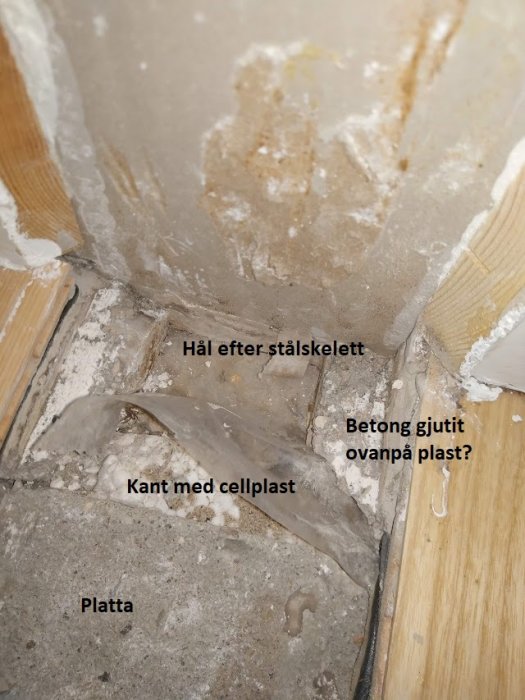
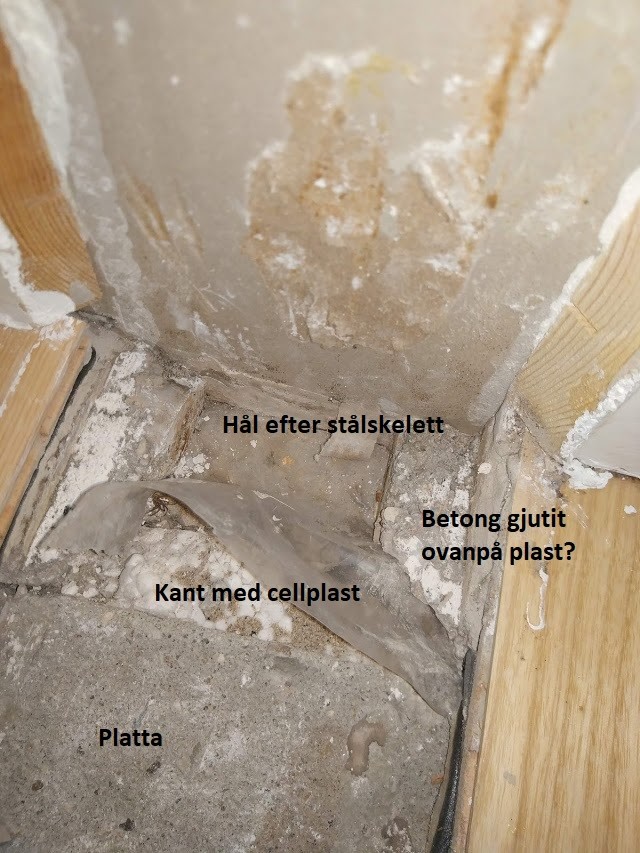
We have just taken down a partition wall that ended against the outer wall and have found a similar construction. The house is originally from 1897 but was completely renovated at the start of the 00s and had a slab cast with underfloor heating. I expected the slab to at least go under the gypsum boards against the outer wall, but when I opened it up, I see that the slab ends followed by a couple of centimeters wide edge of foam. After that, there is another thin layer of concrete seemingly cast _on top of_ a vapor barrier/plastic that is in the wall, probably to support the last part of the floor? Strange construction, but I had the same thoughts as TS and thought that the foam would be an expansion joint against the stone foundation... But I also find it strange and wonder a bit what the gypsum+insulation rests on. Why would one cast the slab in two stages? I mean, what are the advantages of this?
Click here to reply
Vi vill skicka notiser för ämnen du bevakar och händelser som berör dig.