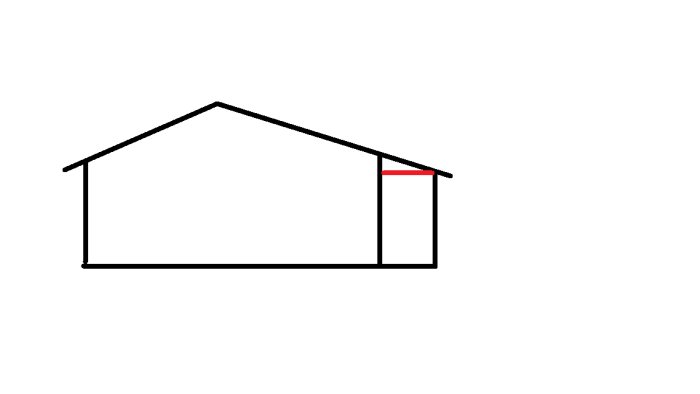
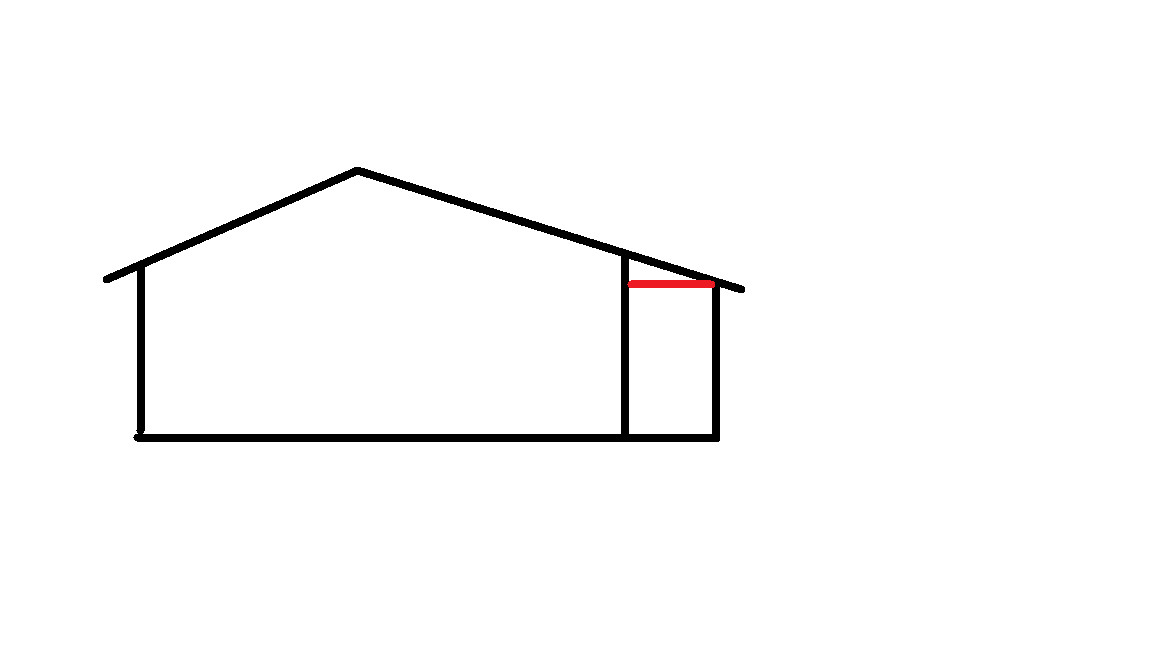
But the horizontal rule is not attached to anything other than the short vertical board. I understand that it would take a load if it were attached to the house somehow, but it isn't.
I apologize for my categorical statement!
I misinterpreted the picture, which actually isn't very clear.
And I blame myself (which I'm usually good at )
You tricked me by calling it a truss, which it actually isn't.
In principle, the picture is correct, but the joints that are supposed to absorb the torques m1 and m2 are so weak that they have no practical significance.
Only in principle?
Otherwise, I wrote, "If the attachment is very weak, the load it takes will be weak."
And yes, if it's a pair of small negligible nails, the effect might be negligible. But it's not obvious to me in the picture.
If the truss looks like Nerres picture in post #32, you can remove the horizontal rule as it would then lack function. HOWEVER, a truss with that design needs a collar beam (or a tie rod) to prevent the side walls from bowing out. If the rafter rests both on a ridge beam and on the side wall, no collar beam is needed.
If a rafter rests on both a ridge beam and an outer wall, only vertical roof loads occur on the latter. And naturally, an internal moment in the rafter.
For that "truss" to be able to bear any additional roof load, an extra brace is required so that two triangles are formed. As it looks now, the lower part can undoubtedly be removed. There are certainly very complicated ways to describe the forces in the construction, but I usually think of it as if all the joints are held by just one nail and that the braces are easy to bend.
If the roof truss looks like Nerres' picture in post #32, you can remove the horizontal brace since it would lack function in that case. HOWEVER, a truss of that design needs a collar tie (or a tension rod) to prevent the sidewalls from bulging out. If the rafter rests both on a ridge beam and on the sidewall, no collar tie is needed.
The extension was built in the 60s and withstands massive snow loads, so it looks like you and justus can breathe easy in this case.
BUT, I will still reinforce with brackets - you know, for a good night's sleep.
Oh really, one might have almost thought so earlier.
Attaching metal brackets on the opposite side of the plank piece that reinforces the triangle. Had some lying around.
That's not how I perceived it
Didn't you want to remove the horizontal rule? You can do it without trouble. As previously mentioned, its only function is to put the inner ceiling in.
Now I don't have the energy to read through everything where people are guessing and whatnot, the lower rule only counteracts deflection, thus helps to stiffen and reduce the actual deflection of the roof, but not a load-bearing function if it is attached as you write.
You can remove it, however, there is a risk that the roof will sink a few cm when there is snow/ice over that specific area.
Vi vill skicka notiser för ämnen du bevakar och händelser som berör dig.



 )
)useless said: