hantverkare1 hantverkare1 said:
A collar tie does not bear the weight of the roof. It holds the truss and walls together to prevent them from spreading out

Google roof truss and read about its function and parts. Or tear it off and keep your fingers crossed.
It is not a collar tie.
 
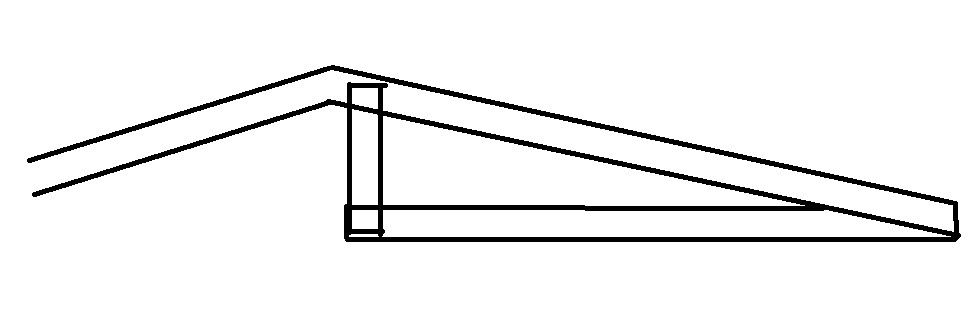
The rule in this case doesn't go from wall to wall, it's cut in the middle.

A diagram showing a roof structure with a support beam halved, not spanning wall-to-wall.
 
  • Like
Nyfniken and 1 other
  • Laddar…
N Nerre said:
The rule in this case does not go from wall to wall, it's cut in the middle.

[image]
If it is as you describe, then TS can remove the beam.

TS can see this best for themselves.
 
N Nerre said:
The beam in question doesn't go wall to wall; it's cut in the middle.

[image]
You mean that if the tie beam doesn't go wall to wall, it has no effect on the moment or tensile force in the wall? That's wrong, but the fastening will indeed take on significant load.
 
hantverkare1 hantverkare1 said:
A tie beam does not bear the weight of the roof. It holds the truss and walls together to prevent them from spreading out

Google roof truss and read about its function and parts. Or remove it and cross your fingers.
Exactly, and this is not a "tie beam" as we concluded earlier in the thread.

I greatly appreciate everyone involved in the thread. I'm seriously considering removing the loosely hanging board and moving it up a bit, fastening it in a better way—both in the old outer wall and in the load-bearing roof beam. This way, I should get more ceiling height and a more stable structure.

Now I did have 60 cm of snow on the roof at the beginning of the year without seeing any problems with the existing construction...
 
Put a proper hanband in place BEFORE you dismantle the existing studs, so you can be completely sure that nothing happens.
 
I take one at a time, so it should be okay. As mentioned, it's attached with ONE nail at one end and TWO nails at the other end. With an air gap between the studs. I am sure that this joint doesn't bear any load at all - otherwise, the nail would have bent.
 
A Acer767 said:
I take one at a time, so it should be okay. As mentioned, it's held with ONE nail at one end and TWO nails at the other end. With an air gap between the studs. I'm sure this joint doesn't carry any load at all - otherwise the nail should have bent.
Why are you asking here if you're sure?
 
  • Like
Filip94 and 2 others
  • Laddar…
A Acer767 said:
I am sure that this band doesn't take any load at all
Then one really wonders why this thread exists ..
 
  • Like
Anna_H and 1 other
  • Laddar…
@elpaco and @hantverkare1

I hinted at it in the first post. You don't need to feel hurt in any way. I appreciate the posts.

Moreover - "before I was sure I was dead sure" - i.e., I can be wrong, likely!
 
A Acer767 said:
@elpaco and @hantverkare1

I alluded to it in the first post. You don't need to feel hurt in any way. I appreciate the posts.

Moreover - "before I was sure, I was dead sure" - i.e., I could be wrong, likely!
If I'm not too unlucky in my thinking, the horizontal rule takes no load at all and should be removable?

It takes no vertical load. It can take torsional load. It can take horizontal load. If the attachment is very weak, the load it takes will be weak.

I believe neither I nor the craftsman are hurt. I think we're trying to get you to understand that you have misunderstood how this part of the truss works.
 
elpaco elpaco said:
If I'm not too unlucky in my thinking, the horizontal rule doesn't take any load at all and should be able to be removed?

It doesn't take any vertical load. It can take torsional load. It can take horizontal load. If the attachment is very weak, the load it takes will be weak.

I don't think either I or the craftsman are hurt. I think we're trying to get you to understand that you've misunderstood how this part of the truss works.
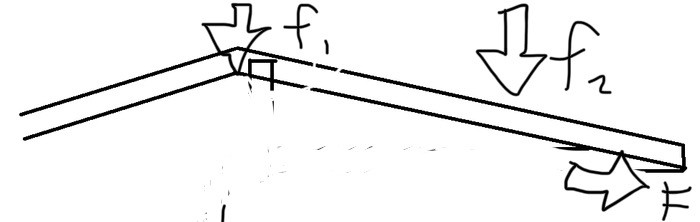
Isn't it you who have misunderstood the picture then?
 
G Grillo said:
Isn't it that you have misunderstood the picture then?
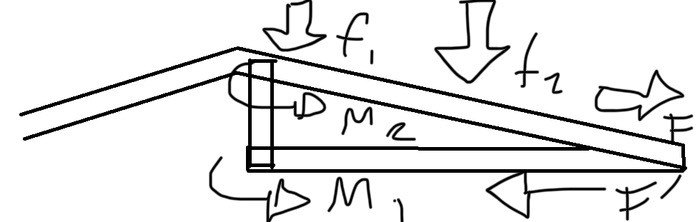
Does this make it easier??

Diagram of force vectors on a beam, labeled f1 and f2, illustrating load and stress points for construction analysis.

Diagram of a roof truss with labeled forces and moments, showing vector directions f1, f2, and moments M1, M2. Arrows indicate force application points.
 
  • Like
Geatki
  • Laddar…
elpaco elpaco said:
Does this make it easier??

[image]

[image]
The beam is not attached as in your sketch according to TS
 
In principle, the picture is correct, but the joints that are supposed to take up the torques m1 and m2 are so weak that they have no practical significance.
 
  • Like
Daniel 109
  • Laddar…
Vi vill skicka notiser för ämnen du bevakar och händelser som berör dig.