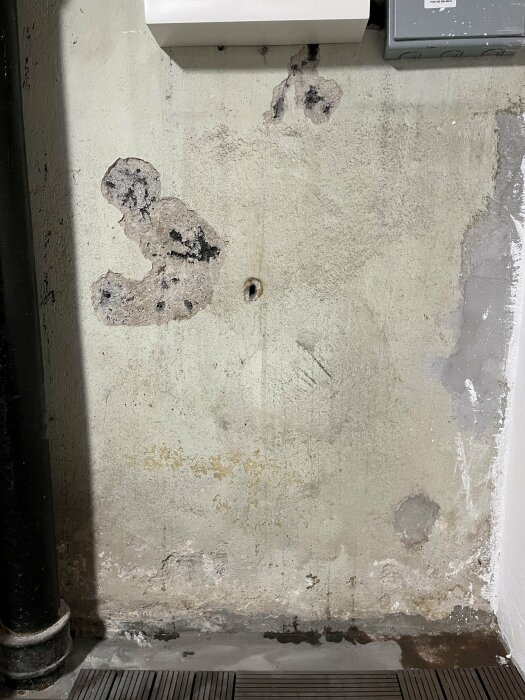
I'm thinking of replastering and painting it, but I'm unsure if it's possible to plaster on the existing surface. I can knock off the plaster that's obviously loose. The rest holds somewhat, so it would be easiest if it could stay. However, I'm not sure what kind of paint it's coated with and if plastering over it is possible. It doesn't seem to absorb much - if I spray water on it, it just runs off - so maybe some kind of plastic paint? In that case, lime plaster might not work well, I guess? I might have to knock down all the plaster and start from scratch. Alternatively, just fill the holes and paint over the whole thing with another plastic paint? It's an interior wall in the basement.
If you don't have obvious hollow sounds when you tap on the surface without the plaster coming off and there are no obvious problems with the paint currently applied being too dense, it seems to be a good candidate for just plastering/filling the damage. If there is a risk of incoming ground moisture, maybe gypsum plaster isn't suitable although it is wonderfully easy to work with. A cement-based plaster is likely recommended or a cement-based filler like CM 850.
Absolutely do not repaint the wall with any ordinary plastic paint. A paint chip to a professional paint company can sometimes be enough to understand what it is painted with. In a similar situation, I myself used Beckers Mineral Sockelfärg with good results both given moisture migration and cleanability.
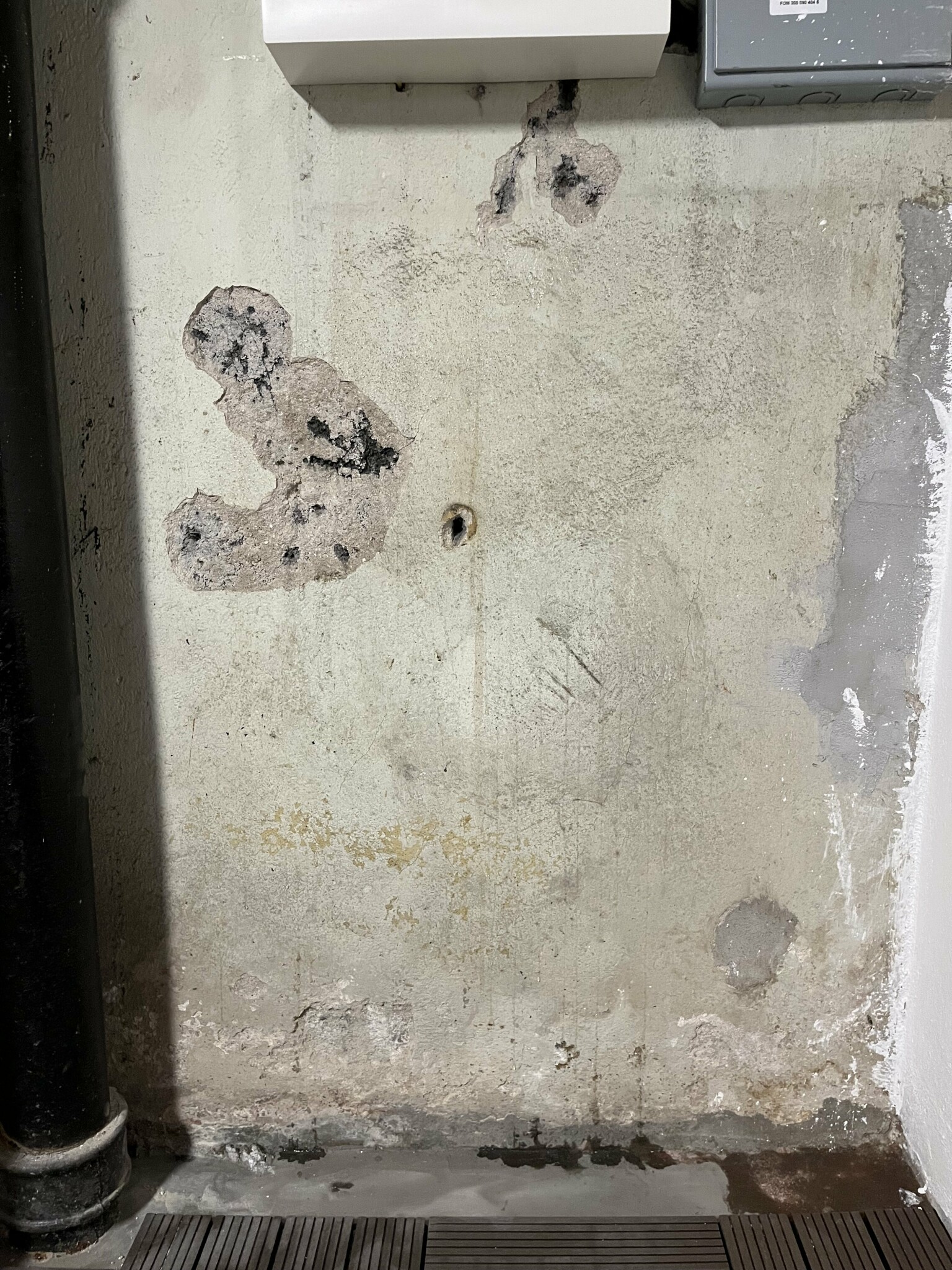
I have this adorable wall in the basement:
[image]
Isn't it cute?
I'm planning to replaster and paint it, but I'm unsure if it's possible to plaster over the existing surface. I can knock off the plaster that is clearly loose. The rest is fairly stable, so it would be easiest if it could stay. However, I don't know what type of paint it was painted with and if it's possible to plaster over it. It doesn't seem to absorb much - if I spray water on it, it just runs off - so maybe some kind of plastic paint? If that's the case, it probably won't work well with lime plaster, I guess? Perhaps I'll have to knock off all the plaster and start over from scratch. Alternatively, just fill the holes and paint over the whole thing with another plastic paint? It's an interior wall in the basement.
Everything that is loose must go, can you remove any paint flakes? If you can, test by burning it—if it burns, it's some form of plastic paint. If it's plastic paint, I would sand it all off and paint with a breathable paint like, for example, silicate paint. Otherwise, if you continue to paint with dense paints like plastic paints, you will encounter the same problem again.
The plaster that is falling off is as dry as tinder, so I wonder if moisture is really the problem. The plaster has probably been there since the 50s or something, so it might not be entirely unexpected that it has run its course. Maybe it's just as well to knock it all down while I'm at it.
Meanwhile, I attempted to repair some holes in the plaster on another wall. It is definitely lime plastered, so I am using lime mortar. However, it's extremely difficult to work with, and I wonder if I'm doing something wrong. It's very hard to get the plaster to adhere to the surface. If I try to throw it on, it splatters in all directions, and if I apply it with a trowel, it sticks poorly around the edges of the repair. Trying to float it afterward only results in it crumbling and falling off. Completely impossible to achieve a smooth surface
The right consistency of the mortar is also a good prerequisite; then you apply more mortar than the surrounding connection and then scrub it off when it has dried for a suitable length of time... what kind of mortar is it?


AJ82 said:
I have this adorable wall in the basement: