I have a general question about how to do a calculation and a specific example that I want to check. It's been a while since high school physics and I want to learn the principle.
I want to understand how to calculate the load on, for example, brackets that are loaded by an overhang so that a lever effect occurs. I want to translate the result of the calculation (Nm?) into weight in kg, as this seems to be the standard measure in trade.
In other words: The question I want to be able to answer is whether, for example, a bracket that can handle a maximum weight of X kg will withstand the load from a shelf/countertop, etc., with known dimensions and weight.
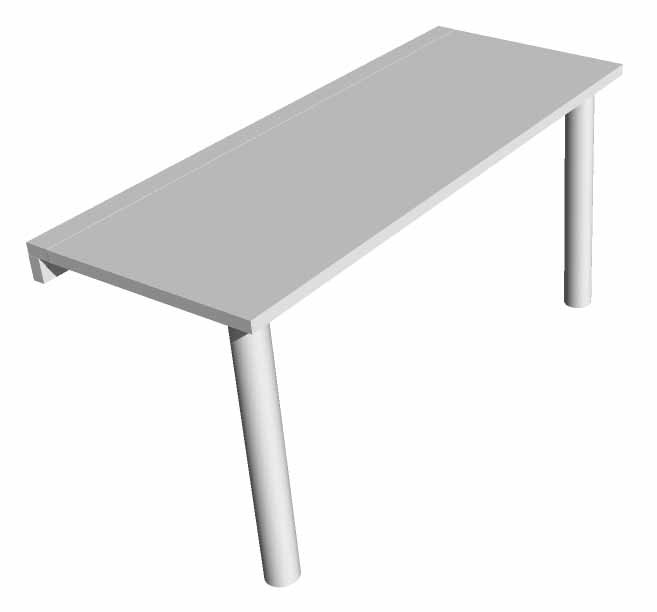
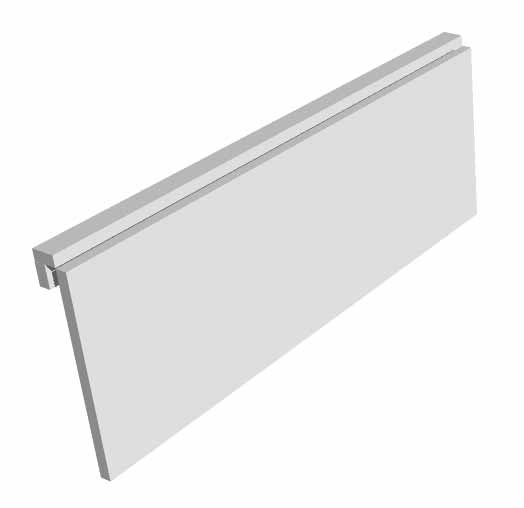
Specific example: I'm interested in building a foldable countertop that is attached to wall 1 at the short end of the board with folding brackets. When folded down, the long side of the board will run parallel to wall 2. The board will be about 1500 mm. The intention is to have a flexible workbench in a small kitchen. In this case, I have planned to have support on the other short end and in the middle, but would like the option to make those supports foldable as well. I'm thinking of folding brackets with a beam as long as the width of the countertop, which folds down as arms before the board comes down. It's interesting to be able to calculate the load on these as well. Alternatively, legs attached to the board with sturdy hinges that fold out when the board is folded down.
And of course, to hear if the forum thinks this is a crazy idea.
Bonus Question: What weight should I calculate for the board to withstand at its weakest point? Should withstand grocery bags, large pots, leaning against it, and other kitchen work. Pots and bags are probably maximum 20 kg but might require more for some reason I haven't thought of?
I don't know how to calculate, but I have a solution proposal.
Assume you can use wall 1 for storing the board. You attach the board with hinges to a beam or strip on wall 1. On the underside at the free end, you add a folding support.
The maximum length of the board is determined by the bench height and ceiling height.
Make the board in solid plank and not finger-jointed wood so the deflection becomes manageable.
I don't know how to calculate it, but I have a proposed solution.
Assuming you can use wall 1 for storing the board. You attach the board with hinges to a stud or strip on wall 1. On the underside at the free end, you place a retractable end.
The maximum length of the board is determined by the bench height and ceiling height.
Make the board in solid wood and not laminated wood so that bending becomes manageable.
That question is quite tricky But if you do a simplified estimate and assume some values, and for simplicity's sake, 1 kg equals 10 N (actually 9.81). The console can handle a maximum load of 10 kg (100 N) specified at the farthest end of the console, which is 750 mm long = 134 Nm (100 N/0.75m). If you double the lever arm, you must halve the weight to not exceed the maximum torque if all the load lands at the end of the board. But in reality, the board's weight is distributed over the entire length, but point loads far from the console provide very high torque. Still, you don't need to take any of that into account or calculate it. The big problem will be the wall attachment, and what your wall can handle should be tested practically with tensile tests of different screw joints and possible reinforcements in the wall. So to keep it simple without major calculations and without significantly affecting the wall, attach two legs under the board that fold out when you lower the board. This way, most of the load will be absorbed by two legs and a bit by the console/wall. The only time the consoles will be maximally loaded is when the board is folded up, and then there is no torque to consider
I have a similar problem that I solved in the following way. I divided a board to create a 6 cm wide strip and a 54 cm wide flap. I joined these two parts with four hinges in cast brass (everything else is junk). I attached the strip to the wall with the help of another strip of approximately the same dimension. On the front edge of the underside of the flap, I screwed in brackets for two adjustable-height IKEA legs. It looks like this:
When I don’t want the flap raised, I unscrew the legs. Then it looks like this:
It's tricky to get it right with foldable brackets. I usually expect a table or board to withstand the weight of two adult men, i.e., around 200 kg. The IKEA legs can handle 75 kg each, if I remember correctly. In this case, it would be 50 kg per leg and 100 kg on the hinges and screws in the wall.
You won't have any major problems with torque with that construction. Instead, it's the shear forces that will be the determining factor (i.e., the screws will be "sheared off" the wall rather than pulled out of the wall).
I would like to call them shear forces, but that's the point. I had a few lines about torque in my post that I deleted because I didn't think it belonged in the thread.



 But if you do a simplified estimate and assume some values, and for simplicity's sake, 1 kg equals 10 N (actually 9.81). The console can handle a maximum load of 10 kg (100 N) specified at the farthest end of the console, which is 750 mm long = 134 Nm (100 N/0.75m). If you double the lever arm, you must halve the weight to not exceed the maximum torque if all the load lands at the end of the board. But in reality, the board's weight is distributed over the entire length, but point loads far from the console provide very high torque. Still, you don't need to take any of that into account or calculate it. The big problem will be the wall attachment, and what your wall can handle should be tested practically with tensile tests of different screw joints and possible reinforcements in the wall. So to keep it simple without major calculations and without significantly affecting the wall, attach two legs under the board that fold out when you lower the board. This way, most of the load will be absorbed by two legs and a bit by the console/wall. The only time the consoles will be maximally loaded is when the board is folded up, and then there is no torque to consider