
37,947 views ·
38 replies
38k views
38 replies
Enclose the railing on a 70s pine staircase in plaster.
Has anyone tried building in their old pine staircase with plasterboard?
Currently renovating the staircase at home and thinking about enclosing the middle railing by attaching plasterboard to the "spindle" or whatever you'd call the bars in the middle.
It is a classic 1977 pine staircase. The steps are another story; this concerns the other parts of the staircase, the railing consisting of about 100 horizontal 5x2 cm and long pine bars that sit about 10 cm apart, extending from the basement all the way up to the upper floor.
Has anyone built in a similar staircase and has pictures of how it turned out?
I understand it will be a staircase that lets through less light, but since it will be white and have LED lighting, I think this will be compensated.
I am also removing the small wooden pieces that sit under each step to make a more open staircase.
Currently renovating the staircase at home and thinking about enclosing the middle railing by attaching plasterboard to the "spindle" or whatever you'd call the bars in the middle.
It is a classic 1977 pine staircase. The steps are another story; this concerns the other parts of the staircase, the railing consisting of about 100 horizontal 5x2 cm and long pine bars that sit about 10 cm apart, extending from the basement all the way up to the upper floor.
Has anyone built in a similar staircase and has pictures of how it turned out?
I understand it will be a staircase that lets through less light, but since it will be white and have LED lighting, I think this will be compensated.
I am also removing the small wooden pieces that sit under each step to make a more open staircase.
If you mean those that sit on the inside edge of the steps, remember they are there for safety reasons! They prevent small children from slipping in or crawling through the stairs.
I haven't plastered a splje before, but I would make sure the boards are attached to a beam both at the top and bottom. Then you need to have a functioning handrail.
Then they must be really small kids, it's quite unlikely that a child would slip and fall between two steps. And should they by any chance, they would fall 2.4 meters. There's a considerably greater risk that they would climb over the railing at the top and fall down.arneswede said:If you mean those sitting on the inner edge of the stair step, remember they are there for safety reasons! They prevent small children from slipping in or crawling through the stairs. I haven't drywalled a spindle before, but I would make sure the panels are attached to some sort of stud both at the top and bottom. Then you must have a functioning handrail.
The way I've thought of building it (See quick sketch, it's hard to see what it says) is like built-in railings in the middle of the staircase. So that would be the functioning handrail.
I'm drywalling both sides of the "spindle," which will be a total of 7.6cm thick with the drywall. I'll finish with a new 9.5x9.5 post at the bottom. On top of the drywall, I'll put a 9.5x2cm cap that will be the handrail.
I think this will look nice. I'm just a bit worried it might feel closed in and not airy, which is why I'd like to have a picture if anyone has one. However, everyone seems to have open airy staircases nowadays..
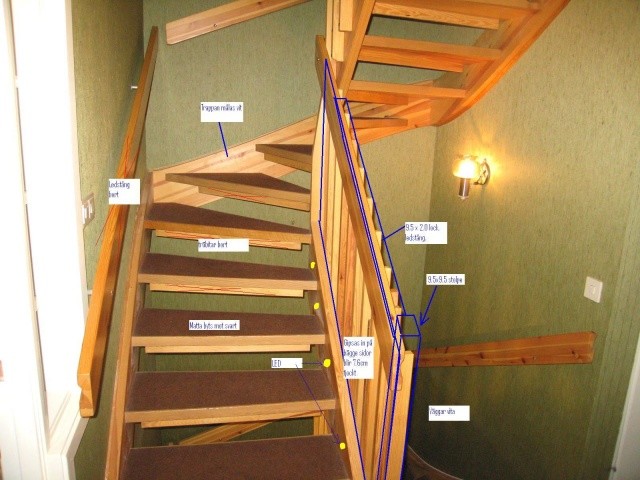

I don't think the railing will be stable enough and that the plaster will crack in the filled joints. However, that's just what I think, it could just as easily work.
There will be no joints. I'm using full sheets.jeppeknaster said:
The railing is stable today and won't be less stable with the drywall.
I've already covered some of it and put up a post.
Just waiting for the LED lighting, then I'll build it all in.
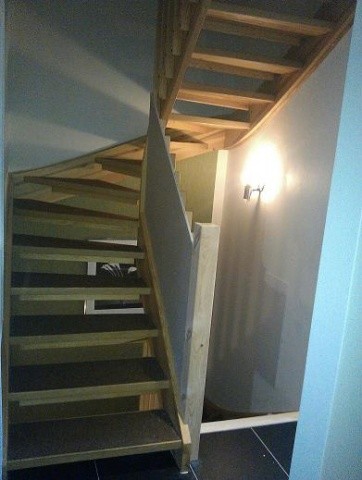
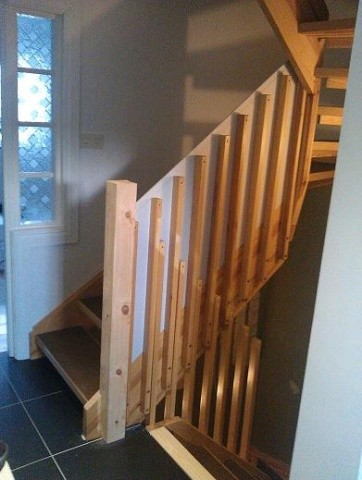
I'll take some pictures so you can give your feedback...

I'm not going to comment on how you go about it, but I can promise it will look nice, and if you paint it white, it won't be too dark. The neighbor has done it; step-kit in oak, a thin oak board on top of the white-painted covered railing, white-painted walls, and several wall lamps. Here we don't have a basement, so he placed full risers and also made a closet under the stairs.
Something like this, you got the idea.
It's even more stable than before thanks to the post and the fully screwed plasterboard in the old railing pins.
Just waiting now for the LED spotlights as mentioned.
Anyone got a good idea on how I should turn them on? I can't decide.
Considering having them controlled by a timer or darkness sensor so they turn on automatically when it gets dark? Or maybe with a motion sensor?
I could have them controlled with a light switch but it's a bit tricky to install new switches since it's a three-story switch connection.
It's even more stable than before thanks to the post and the fully screwed plasterboard in the old railing pins.
Just waiting now for the LED spotlights as mentioned.
Anyone got a good idea on how I should turn them on? I can't decide.
Considering having them controlled by a timer or darkness sensor so they turn on automatically when it gets dark? Or maybe with a motion sensor?
I could have them controlled with a light switch but it's a bit tricky to install new switches since it's a three-story switch connection.
I don't think it's so much about safety thinking but maybe more as a reinforcement so that the steps don't flex down too much when they are loaded. You have to think for a moment before tearing them out to avoid subsequent problemsarneswede said:
 . I don't think those small boards were nailed in solely for decorative purposes, and perhaps the step suspension is calculated based on them being there and dampening the creaking?
The maximum opening between the steps can be a maximum of 10cm, our staircase has 14cm.gaia said:I don't think it’s so much about safety thinking, but maybe more like stiffening so that the steps don’t flex too much when they’re loaded.
You have to think for a moment before tearing down to avoid follow-up problems
When we inspected the house, it was flagged for having too large a gap.
My little son likes to dangle his legs through the stairs, so we have a gate up and down.
But if he stumbles on the stairs, the journey would probably follow the stairs downward.
New stairs seem to have nylon washers between the tread and the riser to prevent creaking.
Stiffening I don't really believe in either, they are 2 cm thick and are attached with three screws in 5 cm thick steps in pine that do not flex. And I guess there will be less squeaking if I remove the strip.
I believe in Tiger79's reasoning about safety.
Just one important thing... these are general building codes, advice, and guidelines. That is, the opening SHOULD not be larger than 10 cm. If you want an opening of 20 cm, that is up to you.
If it is a multi-family house, it is different. The same applies to railings. It is completely optional to have railings. If there are walls as in my case, there is not even a SHOULD.
It is a common safety exaggeration where one might suspect in rare cases that there is a minimal risk that a child could fall down between the steps so it is secured with a small piece of wood.
A curious child 40 years ago crawled down between the steps, fell 2.4 meters, and broke a leg. After that, the building guidelines are that all stairs in the future SHOULD have a 10 cm gap between the steps. Could it be so?
Anyway, probably 99% of all children who can move/crawl by themselves and would be able to crawl down between the steps have a body and skull significantly thicker than 10 cm in diameter, which is why SHOULD is just ridiculous.
I think it looks too bad so they should be removed regardless. No one will inspect my house, and if they do, they can remark on the stairs and I will ignore the remark as best I can.
I believe in Tiger79's reasoning about safety.
Just one important thing... these are general building codes, advice, and guidelines. That is, the opening SHOULD not be larger than 10 cm. If you want an opening of 20 cm, that is up to you.
If it is a multi-family house, it is different. The same applies to railings. It is completely optional to have railings. If there are walls as in my case, there is not even a SHOULD.
It is a common safety exaggeration where one might suspect in rare cases that there is a minimal risk that a child could fall down between the steps so it is secured with a small piece of wood.
A curious child 40 years ago crawled down between the steps, fell 2.4 meters, and broke a leg. After that, the building guidelines are that all stairs in the future SHOULD have a 10 cm gap between the steps. Could it be so?
Anyway, probably 99% of all children who can move/crawl by themselves and would be able to crawl down between the steps have a body and skull significantly thicker than 10 cm in diameter, which is why SHOULD is just ridiculous.
I think it looks too bad so they should be removed regardless. No one will inspect my house, and if they do, they can remark on the stairs and I will ignore the remark as best I can.


Nice staircase - I probably would have been content with just painting it white..
What do you mean by "the other side of the plaster facing down? It ends up being more or less just a white wall?!
But fun to see - Update us so we can see pictures..
Good luck!
What do you mean by "the other side of the plaster facing down? It ends up being more or less just a white wall?!
But fun to see - Update us so we can see pictures..
Good luck!
The wooden pieces that are now to be removed are called "child safety strips," and it is probably quite good for these to be present in new construction. Personally, I would have left them as they are because I would have had a hard time forgiving myself if a visiting child crawled through and fell down the stairs.
If you're building new, I don't think it makes sense to reason that following general recommendations is optional. They help ensure that regulations are followed. In the example of stairs, the regulation is: Stairs, ramps, balconies, and the like in areas where children may be present, should be designedso that the risk of child accidents is limited. By following the general recommendation of a maximum of 10 cm between the steps, one has fulfilled the regulation. If one does not follow the general recommendation, an alternative method must be shown to meet the regulation.
Now, it's a staircase from the 1970s, and no one is going around measuring the distance between steps, so you do as you please. It looks like it's going to be nice too
If you're building new, I don't think it makes sense to reason that following general recommendations is optional. They help ensure that regulations are followed. In the example of stairs, the regulation is: Stairs, ramps, balconies, and the like in areas where children may be present, should be designedso that the risk of child accidents is limited. By following the general recommendation of a maximum of 10 cm between the steps, one has fulfilled the regulation. If one does not follow the general recommendation, an alternative method must be shown to meet the regulation.
Now, it's a staircase from the 1970s, and no one is going around measuring the distance between steps, so you do as you please. It looks like it's going to be nice too