
4,346 views ·
15 replies
4k views
15 replies
Built-in speaker in exterior wall
Hi.
Building a house that has a total of 240mm insulation in the exterior walls.
https://www.hifiklubben.se/bowers--wilkins-bb-6w-backbox/bwbb6w/
Is it a problem to install two of these in the exterior wall?
Googling says that they are 8.5 cm deep and placing them on OSB, so it is about 7.5 cm of insulation I will need to carve out. This leaves 16.5 cm of insulation remaining outward, is that sufficient?
Of course, I will ensure that the moisture barrier remains intact.
Building a house that has a total of 240mm insulation in the exterior walls.
https://www.hifiklubben.se/bowers--wilkins-bb-6w-backbox/bwbb6w/
Is it a problem to install two of these in the exterior wall?
Googling says that they are 8.5 cm deep and placing them on OSB, so it is about 7.5 cm of insulation I will need to carve out. This leaves 16.5 cm of insulation remaining outward, is that sufficient?
Of course, I will ensure that the moisture barrier remains intact.

Self-builder
· Stockholm
· 8 612 posts
It's probably not a problem, they are not that big so it will just be a small area on the wall that has slightly less insulation...B bassebus said:Hi.
Building a house with a total of 240mm insulation in the exterior walls.
[link]
Is it a problem to install two of these in the exterior wall?
Googling says they are 8.5 cm deep and installing them on OSB so approximately 7.5 cm of insulation will need to be hollowed out. This leaves 16.5 cm of insulation facing outwards, is that enough?
I will, of course, ensure the waterproofing layer remains intact.
Overall, it will slightly increase heat leakage, but it shouldn't cause any drafts or similar issues.
It is deeper than that, 136mm, https://www.bowers-wilkins-custom-id.com/wp-content/uploads/2016/03/BB-6C.pdfB bassebus said:
Then skip the backbox, and the speaker itself will take up less space. Its purpose is only to create a sealed space against the room and compensate for the broken sealing layer outward. If you're building new, you might as well just create a recess tailored for the speaker in the insulation and seal it.B bassebus said:
What I'm concerned about is the code inside the box. I assume that if it were completely uninsulated outward, the metal box would get cold in the winter and then condense against warm air inside.
But I hope that the insulation that remains outside is good enough to prevent this?
These are two different boxes, the one you linked is 6C and is mainly used for ceiling speakers, which are deeper.H hapazard said:
Here is the document for 6W:
https://www.bowers-wilkins-custom-id.com/wp-content/uploads/2016/03/BB-W6.pdf
This is something of this size that should go in:
https://www.hifiklubben.se/bowers--wilkins-cwm362-in-wall-hogtalare/bwcwm362wh/
Okay, so I don't need to be worried about any sparks/short circuits/whatever from the speaker that could lead to a fire in the wall?H hapazard said:
I'm thinking that without a box, it might be unavoidable for the speaker to "lay against" the moisture barrier plastic.
I can get the box for ~950:- from Germany, the question is whether it's worth the time to tinker with a custom solution.
Now I don't know what you're planning to put in these boxes, but wouldn't a pair of Klipsch AW-650 under the eaves suffice?
Edit: I might have misunderstood, and you didn't want the speakers on the outside at all but were only clarifying that it was an exterior wall for the insulation question.
Edit: I might have misunderstood, and you didn't want the speakers on the outside at all but were only clarifying that it was an exterior wall for the insulation question.
Last edited:
The fire protection in the box is not meant to prevent a fire from the speaker from spreading but to compensate for the fire barrier between rooms (inner wall/floor) being broken.B bassebus said:What I'm worried about is the code inside the box. I assume that if it were completely uninsulated outward, the metal box would get cold in the winter and then condense against warm air inside. But I hope the insulation that remains outside is good enough to avoid this?
There are two different boxes, the one you linked is 6C and is mainly used for ceiling speakers that are deeper.
Here is the document for 6W:
[link]
This is something of this size that should go in:
[link]
Ok, so I don't need to worry about any kind of sparks/short circuit/whatever from the speaker that could lead to a fire in the wall? I think that without a box, it's probably inevitable that the speaker will "lie against" the vapor barrier plastic.
I can get the box for ~950:- from Germany, the question is whether it's worth the time to build a custom solution.
The speakers are passive, how often are these seen burning? (I've been looking for an active subwoofer for in-wall installation myself, but they hardly seem to exist precisely because you don't want to build in an always-on amplifier).
If you're still worried, you could lay some fiberglass insulation between the speaker and the vapor barrier.
But if they only cost 950 and don't build up much, it might be easier to buy the back box. They are also insulated on the inside, so you can count on a bit higher insulation.
Self-builder
· Stockholm
· 8 612 posts
With 16 cm of insulation left, I wouldn't worry about condensation at all. Maybe if it's 16mm, but even that is usually enough (it's what I have in some places in our campervan, which also has an exterior made of metal.)B bassebus said:What I'm worried about is the code inside the box. I assume that if it were completely uninsulated outward, the metal box would get cold in the winter and then condense against warm air inside. But I hope that the insulation left outside is good enough to avoid this?
There are two different boxes, the one you've linked is 6C and is primarily used for ceiling speakers that are deeper.
Here is the document for 6W: [link]
It's something in this size that needs to go in: [link]
Ok, so I don't need to worry about any kind of sparks/short circuits/whatever from the speaker that could lead to a fire in the wall? I think that without a box it is probably inevitable that the speaker will "rest against" the waterproofing plastic.
I can get the box for ~950:- from Germany, the question is if it's worth the time to tinker with a DIY solution.
You don't have an installation layer? I have a pair of CMW7.5 which are slightly deeper in the outer wall. With OSB+gypsum and a 45 mm installation layer, I was only missing 2-3 cm, so I skipped hollowing out inside the moisture barrier where there is 180 mm of loose-fill insulation. Haven't noticed any problems so far, except that a little sound leaks through the outer wall when playing loud. 
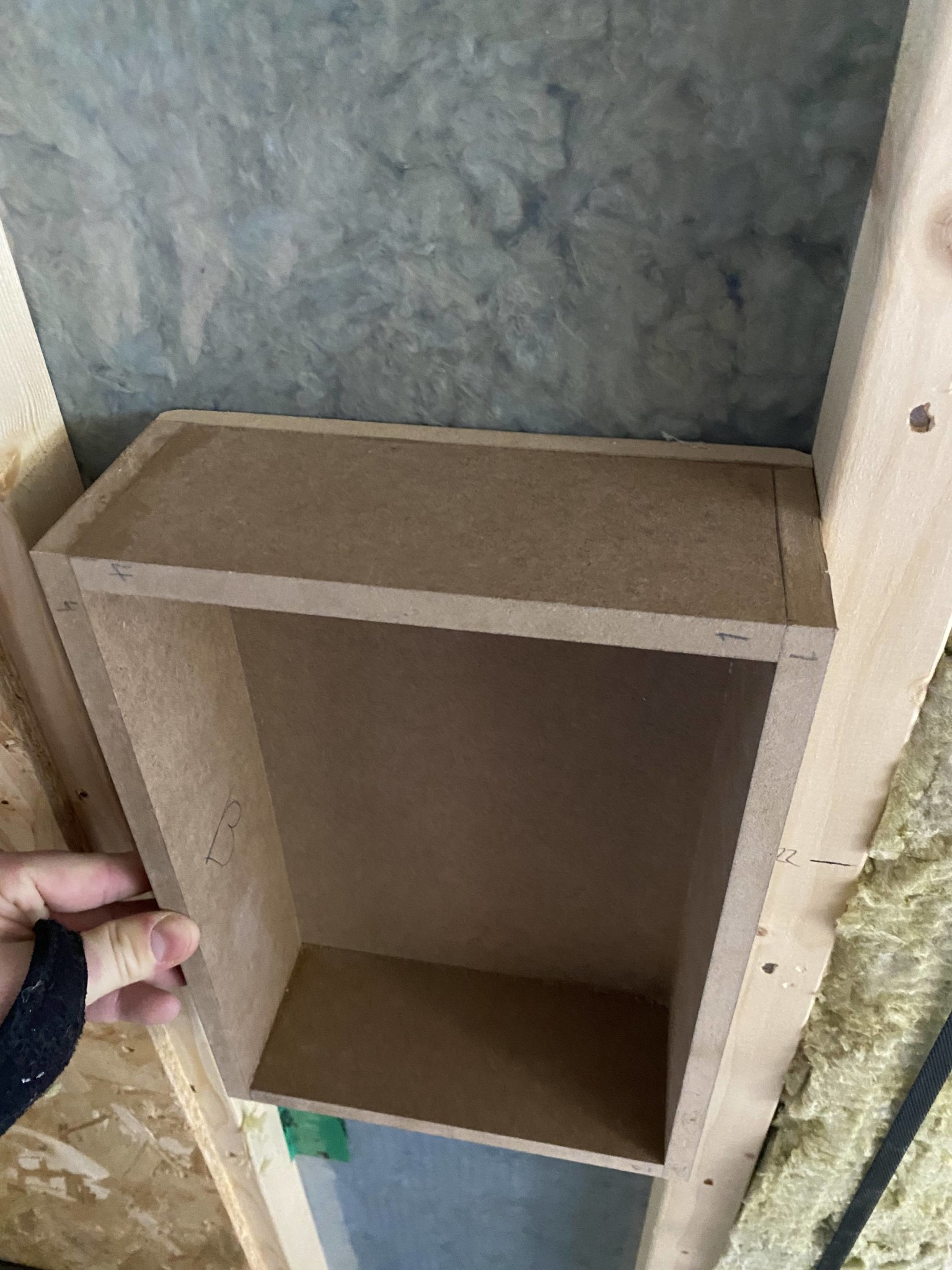
Do you have any installation spaces behind the moisture barrier, or is the moisture barrier directly on the interior wall panels? I have a bit more insulation, 200+100mm. So I was able to install my speakers before the moisture barrier. However, I made my own simple boxes out of MDF. The sides and back piece let the wall with OSB act as a front baffle, just like BW does. It took a couple of hours in total. Better than a metal backbox, and almost no cost. Some form of box is needed, especially as you mentioned yourself, to not push against the plastic. If it starts vibrating with the speaker, the whole wall becomes a membrane.

The temperature inside the box will be almost the same as inside the room since the speaker itself doesn't insulate much compared to the remaining insulation in the wall, and it's when the temperature goes below the dew point that condensation occurs. There will just be a slightly increased energy flow through the wall when the thermal resistance decreases in the wall. You still have the same temperature difference between the inside and outside, and since most of your thermal resistance is in the wall and very little in the speaker, the temperature inside the box will not decrease much.
Since you will go through the diffusion barrier, it's a good idea to try to seal your box as tightly as possible. It seems to be diffusion-tight in itself, which is good.
I have built in plastic-wrapped (diffusion sealing) particleboard boxes in the ceiling for future speakers that have removed 1/3 of the insulation in the attic locally, which is a similar situation. Right now, they are behind the gypsum board and unused, but I haven't seen any trace of moisture there during the several years they have been there.
Since you will go through the diffusion barrier, it's a good idea to try to seal your box as tightly as possible. It seems to be diffusion-tight in itself, which is good.
I have built in plastic-wrapped (diffusion sealing) particleboard boxes in the ceiling for future speakers that have removed 1/3 of the insulation in the attic locally, which is a similar situation. Right now, they are behind the gypsum board and unused, but I haven't seen any trace of moisture there during the several years they have been there.
Thank you for all the answers!
I have a 45mm rule as installation space, then comes the plastic, then 195mm more insulation. So I was thinking of cutting the plastic, scooping out what is needed, then taping a new plastic as a pocket.
I think I'll go with the suggestion Mojjen made and use MDF. Do I need to make allowance for including some type of insulation in the box like B&W's own boxes have, or is it unnecessary in this case?
I have a 45mm rule as installation space, then comes the plastic, then 195mm more insulation. So I was thinking of cutting the plastic, scooping out what is needed, then taping a new plastic as a pocket.
I think I'll go with the suggestion Mojjen made and use MDF. Do I need to make allowance for including some type of insulation in the box like B&W's own boxes have, or is it unnecessary in this case?
Damping material in the cabinets is good for the sound, but if it isolates too much, you risk moving the dew point inside the cabinet and your extended diffusion barrier, thereby risking moisture inside the cabinet (unless the front of the cabinet including the speaker is also completely sealed).
I thought I'd check before I do something dumb. See attached image.
The idea is to
1) cut the plastic
2) scoop out 3cm of insulation
3) place a new plastic that goes into the hole created and tape it tightly
4) install the box.
The installation space has 45mm of insulation, so there are 195mm of insulation left outward. After scooping out 30mm, I have 165mm of insulation left behind the box outward. Is that enough?
Thanks!
The idea is to
1) cut the plastic
2) scoop out 3cm of insulation
3) place a new plastic that goes into the hole created and tape it tightly
4) install the box.
The installation space has 45mm of insulation, so there are 195mm of insulation left outward. After scooping out 30mm, I have 165mm of insulation left behind the box outward. Is that enough?
Thanks!
Self-builder
· Stockholm
· 8 612 posts
Hollowing out 30mm on such a small piece won't have a significant impact.B bassebus said:Thought I'd check before I do something dumb. See attached image.
The idea is to
1) cut the plastic
2) hollow out 3cm of insulation
3) place a new plastic that goes into the hole created and tape it tightly
4) put in the box.
The installation space has 45mm of insulation, so there is 195mm of insulation remaining outward. After hollowing out 30mm, I have 165mm of insulation left behind the box outward, is that enough?
Thanks!
Just make sure you get the vapor barrier tight with proper tape that lasts over time, not some "duct tape"
Yeah, I've got the taping under control, I've used 12 rolls so far
the most tedious thing I've done in the entire house build.What I'm worried about is not the surface, but that I might go below some "critical threshold" in insulation thickness or cause damage by moving the vapor barrier so that it starts to form condensation in the wall, which then leads to moisture damage...?