
2,331 views ·
8 replies
2k views
8 replies
Built-in niche bathroom / framework
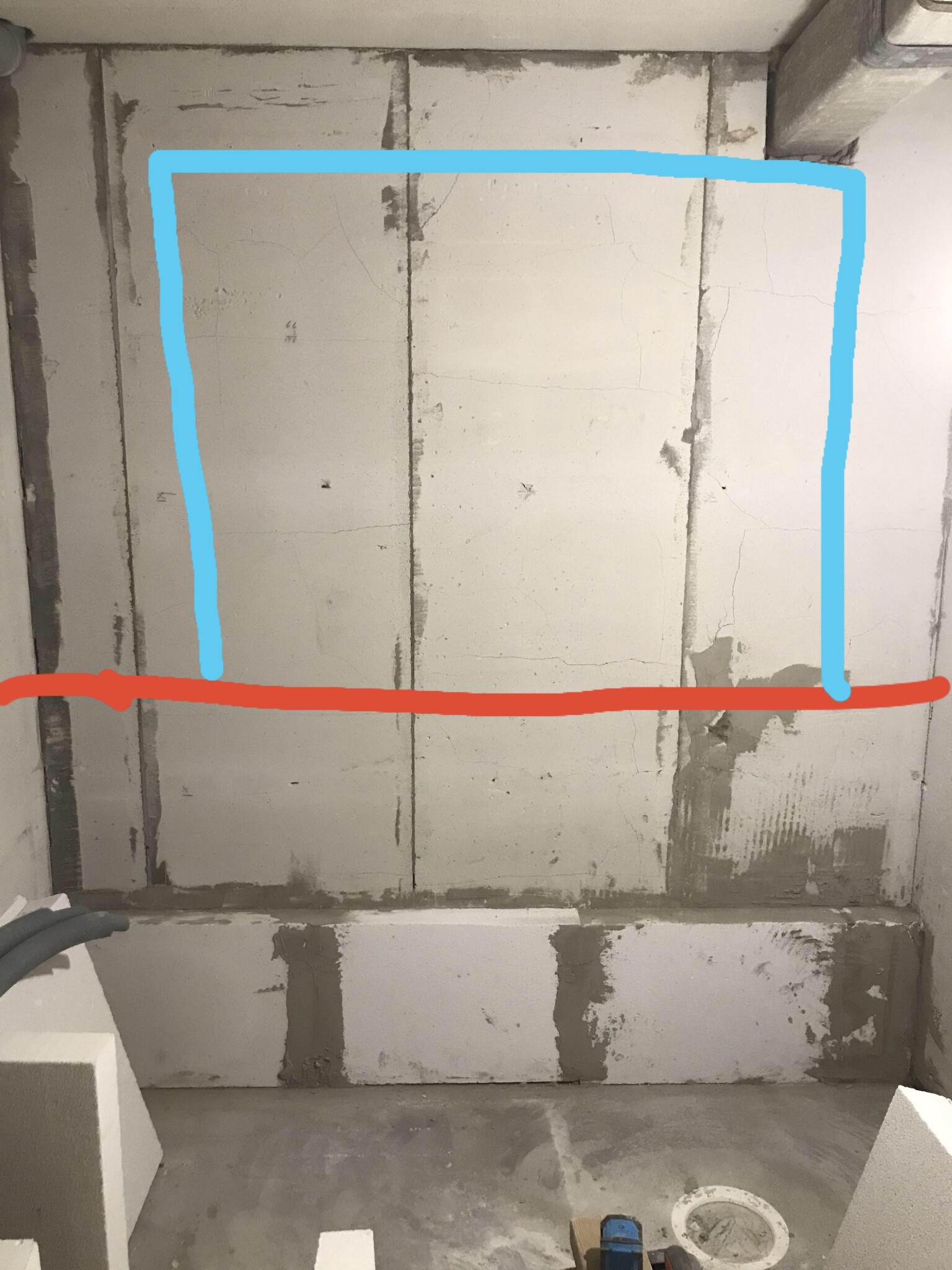
Planning to build a recessed niche on the bathroom wall, have laid the bottom course, will add another up to the red line. Then I plan to build up along the sides (red line), but unsure how to solve the overhang??
I just saw that ready-made frames for niche installation are sold. I think I need some form of profile here. The wall is lightweight concrete, so it doesn't really support installing rebar, etc.
Ideas?
Width 200cm, height 210cm. Do I need to think smaller?
I just saw that ready-made frames for niche installation are sold. I think I need some form of profile here. The wall is lightweight concrete, so it doesn't really support installing rebar, etc.
Ideas?
Width 200cm, height 210cm. Do I need to think smaller?

KJD said:
Thinking of making a built-in niche on the bathroom wall, bricked the bottom course, going to lay another one up to the red line. Then thinking of bricking up along the sides (red line), but unsure how to solve the overhang??
I just saw that ready-made frames for niches for built-ins are being sold. I think I need some form of profile here. The wall is lightweight concrete so doesn't quite hold for setting reinforcing bars, etc.
Ideas?
Thinking of making a built-in niche on the bathroom wall, bricked the bottom course, going to lay another one up to the red line. Then thinking of bricking up along the sides (red line), but unsure how to solve the overhang??
I just saw that ready-made frames for niches for built-ins are being sold. I think I need some form of profile here. The wall is lightweight concrete so doesn't quite hold for setting reinforcing bars, etc.
Ideas?
Width 200cm, height 210cm. Do I need to think smaller?
Came across an article about this that seems to recommend wet room board, which also aligns with what I've seen before, and considerably easier than lightweight concrete blocks, but the question is if I can get plaster to adhere to wet room board? And here even on the underside of the wet room board. I assume so, but at the same time, I've never used wet room board before. Anyone with experience?Thinking of making a built-in niche on the bathroom wall, bricked the bottom course, going to lay another one up to the red line. Then thinking of bricking up along the sides (red line), but unsure how to solve the overhang??
I just saw that ready-made frames for niches for built-ins are being sold. I think I need some form of profile here. The wall is lightweight concrete so doesn't quite hold for setting reinforcing bars, etc.
Ideas?
Width 200cm, height 210cm. Do I need to think smaller?
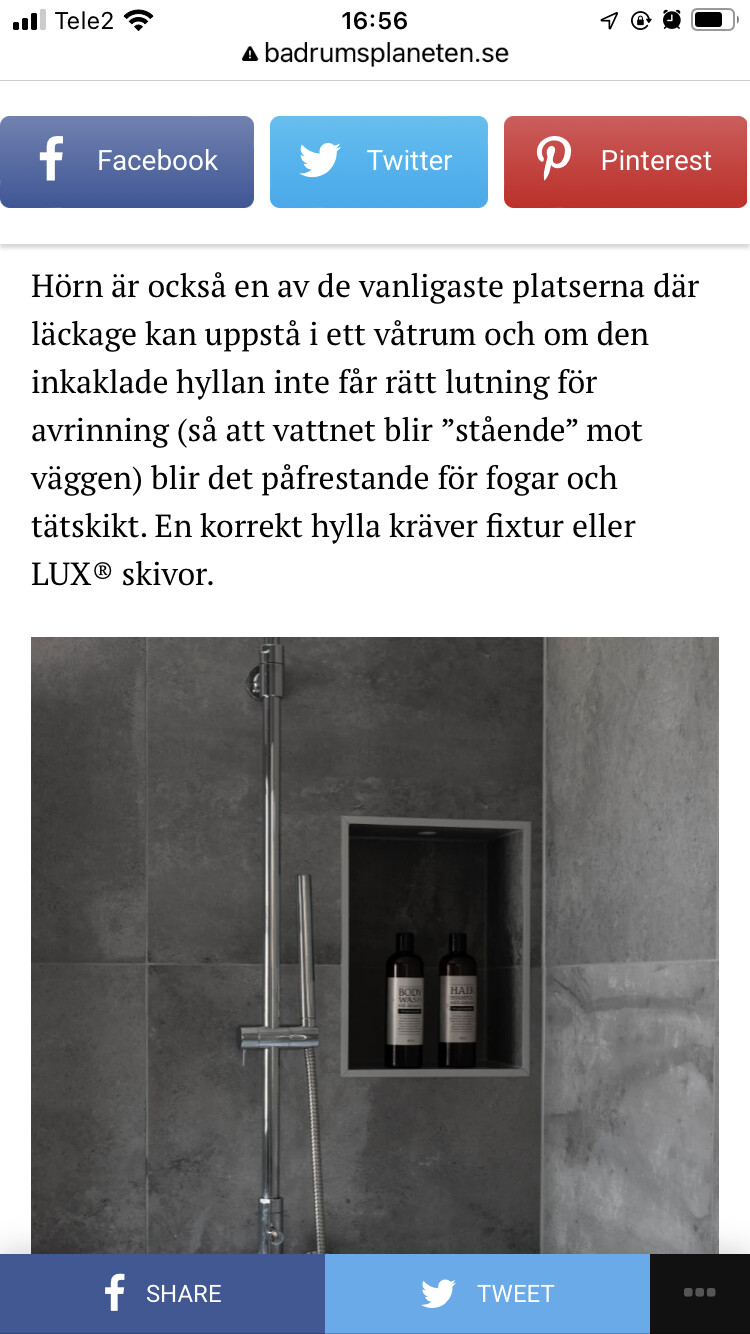
We have made two shelves/niches in the shower corner using a lux board, 80mm thick. Tiled on it afterwards. https://www.google.com/search?q=lux+skiva
Also the same that we clad the fixture for the wall-mounted toilet with, then using 20 or 30mm boards (can't remember the exact thickness).
Also the same that we clad the fixture for the wall-mounted toilet with, then using 20 or 30mm boards (can't remember the exact thickness).
Sounds perfect. Feels just right for me. Thank you 🙏K kniv said:
I can look up some pictures or so if it's interesting. Send a pm if so. Note that these boards are placed inside the waterproofing layer, they are made of cell plastic and have some form of fiber-reinforced surface, so they are moisture resistant. They were extremely easy to saw and work with. The hardest part was getting the large board aligned properly on the wall as it is attached with adhesive and is much harder to press out irregularities as you can when setting tiles.
What type of plaster are you planning to use as the surface layer? Luxakivorna (and other similar ones) have a rather rough surface due to the reinforcement, so a few mm surface layer is needed on top of that. There was absolutely no problem getting tile adhesive to stick, in any case.
I was just thinking about tile adhesive, that I could use it for adhesion in the worst case. It's harder to believe that regular plaster would stick.K kniv said:
==
I also saw a solution on how they apparently handle overhang with lightweight concrete blocks elsewhere.. but still have no indication if it would suffice for my nearly 180cm of free-hanging.

Aerated concrete blocks or multi boards as it says in the picture?just thought about tile adhesive that I could use it for attachment in the worst-case scenario. Have a harder time believing regular plaster would stick.
==
also saw a solution on how to apparently do with overhang of aerated concrete blocks elsewhere.. but still have no indication if it would be enough for my almost 180cm of free-hanging.
[image]
What thickness should you have on the boards, that is what depth do you want?
The one we bought was 600x2500, 80mm thick.
It would probably work to make an overhang with if you keep it as a whole piece and then attach it with tile adhesive to the wall. Good with support underneath while the adhesive cures.
It's 100mm, substantial support will surely be needed, but it's unclear how secure you can be that it won't "fall down" later... use lightweight concrete at the bottom and on the sides, and the solution with wetroom panels for the overhang. Sleep best that wayK kniv said:Lightweight concrete blocks or multi-panels as it says on the picture?
What thickness are you planning for the panels, i.e., what depth do you want?
The one we bought was 600x2500, 80mm thick.
It would probably work to make an overhang if you keep it as a whole piece and then attach it with tile adhesive to the wall. Good to have support underneath while the adhesive cures.

Click here to reply