
33,474 views ·
19 replies
33k views
19 replies
Building scaffolding.
Hi.
Is there any practice on how to cheaply construct scaffolding, any "rules" to follow, lumber dimensions, etc?
I have a whole lot of pallets I plan to use..
Regards/
Is there any practice on how to cheaply construct scaffolding, any "rules" to follow, lumber dimensions, etc?
I have a whole lot of pallets I plan to use..
Regards/
If there is a practice, I don't know, but I can describe how I built my scaffolding a couple of years ago when I was working on, among other things, a façade replacement.
I made the scaffolding in two levels, one 2m up and the other 4m up. I made the poles from 95x45 and used M12 bolts throughout and placed them 2 meters apart. In total, the scaffolding was about 8 meters long, i.e., five poles.
For the floor, I used 145x45, which I laid out and screwed into the poles. I made the floor about one meter wide. I wouldn't have wanted it much narrower than that...
I anchored it to the wall in 6 places, and it was really stable; it was no problem for two people to work there simultaneously.
Don't forget to nail up boards diagonally so the entire scaffolding can't collapse. And make sure the poles are level when you set them up. Some form of railing on the upper level might be appropriate too...
I made the scaffolding in two levels, one 2m up and the other 4m up. I made the poles from 95x45 and used M12 bolts throughout and placed them 2 meters apart. In total, the scaffolding was about 8 meters long, i.e., five poles.
For the floor, I used 145x45, which I laid out and screwed into the poles. I made the floor about one meter wide. I wouldn't have wanted it much narrower than that...
I anchored it to the wall in 6 places, and it was really stable; it was no problem for two people to work there simultaneously.
Don't forget to nail up boards diagonally so the entire scaffolding can't collapse. And make sure the poles are level when you set them up. Some form of railing on the upper level might be appropriate too...
Built some wooden scaffolds. First, I built some "tall legs" with fairly thick timbers 2"x6" or thicker. Imagine an H but with 2 horizontal timbers. Everything is locked with crosses that can be in thinner wood (like paneling). Stand these up along the house and lay planks between them. Screw them in so they can be easily removed. Cross-brace between the tall legs to lock everything.
If you let the timber on one side of the tall legs extend higher, you can easily add a railing.
It's important to secure it to the facade so it can't fall outward (use steel straps, for example) and that it's stable on, for example, garden slabs.
However, with this construction, you might not find much use for the pallets... They are kind of too small. We built a scaffold for roofing work and used a couple of pallets to build shelves outside the scaffold to place the tiles on (which we reused). It’s very worthwhile not having to run up and down with them.
If you let the timber on one side of the tall legs extend higher, you can easily add a railing.
It's important to secure it to the facade so it can't fall outward (use steel straps, for example) and that it's stable on, for example, garden slabs.
However, with this construction, you might not find much use for the pallets... They are kind of too small. We built a scaffold for roofing work and used a couple of pallets to build shelves outside the scaffold to place the tiles on (which we reused). It’s very worthwhile not having to run up and down with them.
I would also need to build it over the roof, have a broken roof and need to go up and fix a leak.
Does anyone have an idea on how to do that?
Kind regards/
Does anyone have an idea on how to do that?
Kind regards/
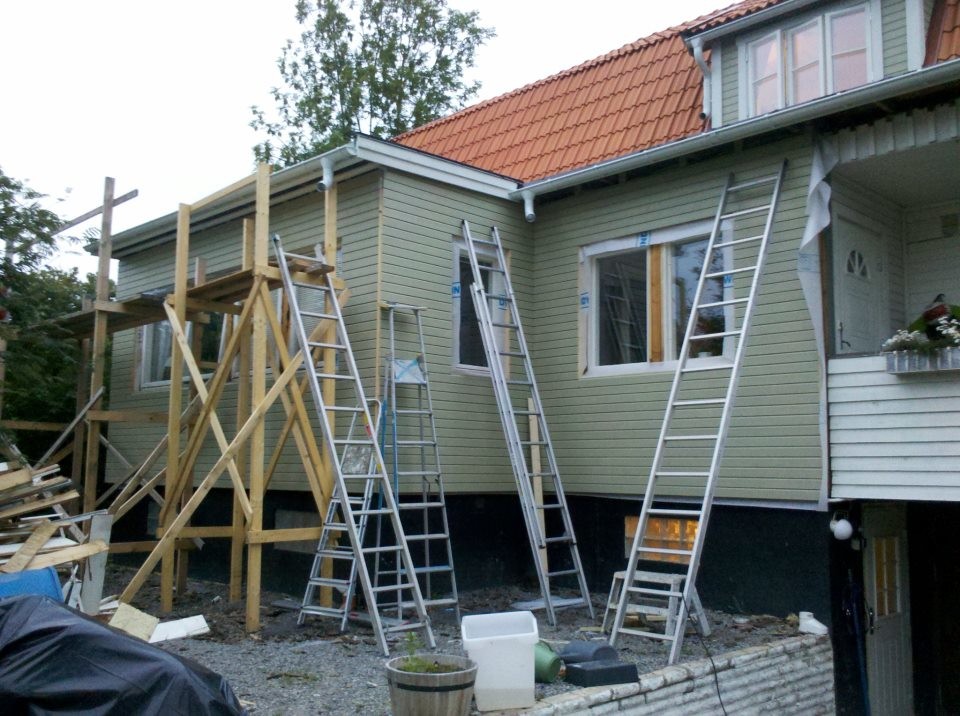
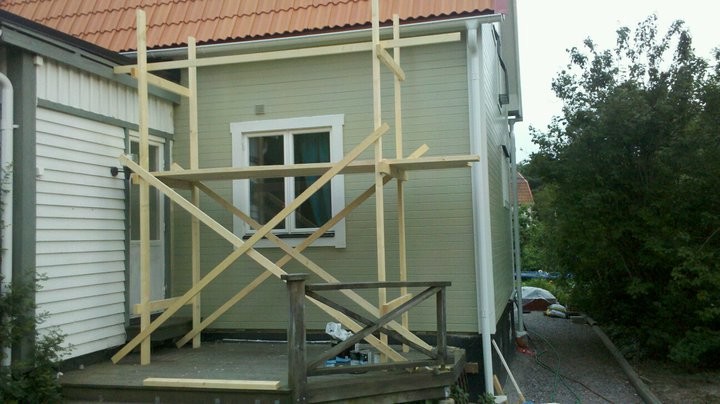
Either I buy a proper scaffold and sell it when I'm done or I build it.
I'll start with the latter option.
But there's so much maintenance on the house that it's impossible to rent since I plan to do a lot myself.
I went shopping so I can build something like in the pictures. The only question is how I'll manage once I'm up on the roof.
Best regards/
I'll start with the latter option.
But there's so much maintenance on the house that it's impossible to rent since I plan to do a lot myself.
I went shopping so I can build something like in the pictures. The only question is how I'll manage once I'm up on the roof.
Best regards/
S
swirve
Electronics enthusiast
· Östergötland
· 1 531 posts
swirve
Electronics enthusiast
- Östergötland
- 1,531 posts
This one seems sensible and I thought about using it, http://www.craftlab.gu.se/digitalAssets/1382/1382930_rapport-trastallningar-2011-web.pdf
Point 1. An acquaintance got a nail through the skull when a homemade scaffolding collapsed. He was never the same again. Since then, I have always advocated buying or renting proper scaffolding. The resale value is also so high that the cost can be less than the cost of timber for a homemade one. If you don't use demolition timber, then you're back at point 1.
S
swirve
Electronics enthusiast
· Östergötland
· 1 531 posts
swirve
Electronics enthusiast
- Östergötland
- 1,531 posts
With that logic, you wouldn't be able to live in a wooden house?! Of course, it's possible to build a stable and good wooden scaffold!Jehu said:Point 1.A friend got a nail through the skull when a homemade scaffold collapsed. He was never the same again. Since then, I have always advocated buying or renting proper scaffolding. The second-hand value is also so high that the cost can be less than the timber cost for a homemade build. If you don't use demolition timber, then you're back at point 1.
Sure, it's almost always fine.
The logic might be that it's not more expensive to buy one in alu.
More expensive than alu, I would think.
5x10x1.2 m 8640:- for the timber, plus nails, screws, bolts, and others.
Low second-hand value.
The logic might be that it's not more expensive to buy one in alu.
That scaffolding was developed for the burned-down Råda Church when they wanted to use authentic old methods.swirve said:
More expensive than alu, I would think.
5x10x1.2 m 8640:- for the timber, plus nails, screws, bolts, and others.
Low second-hand value.
Last edited:

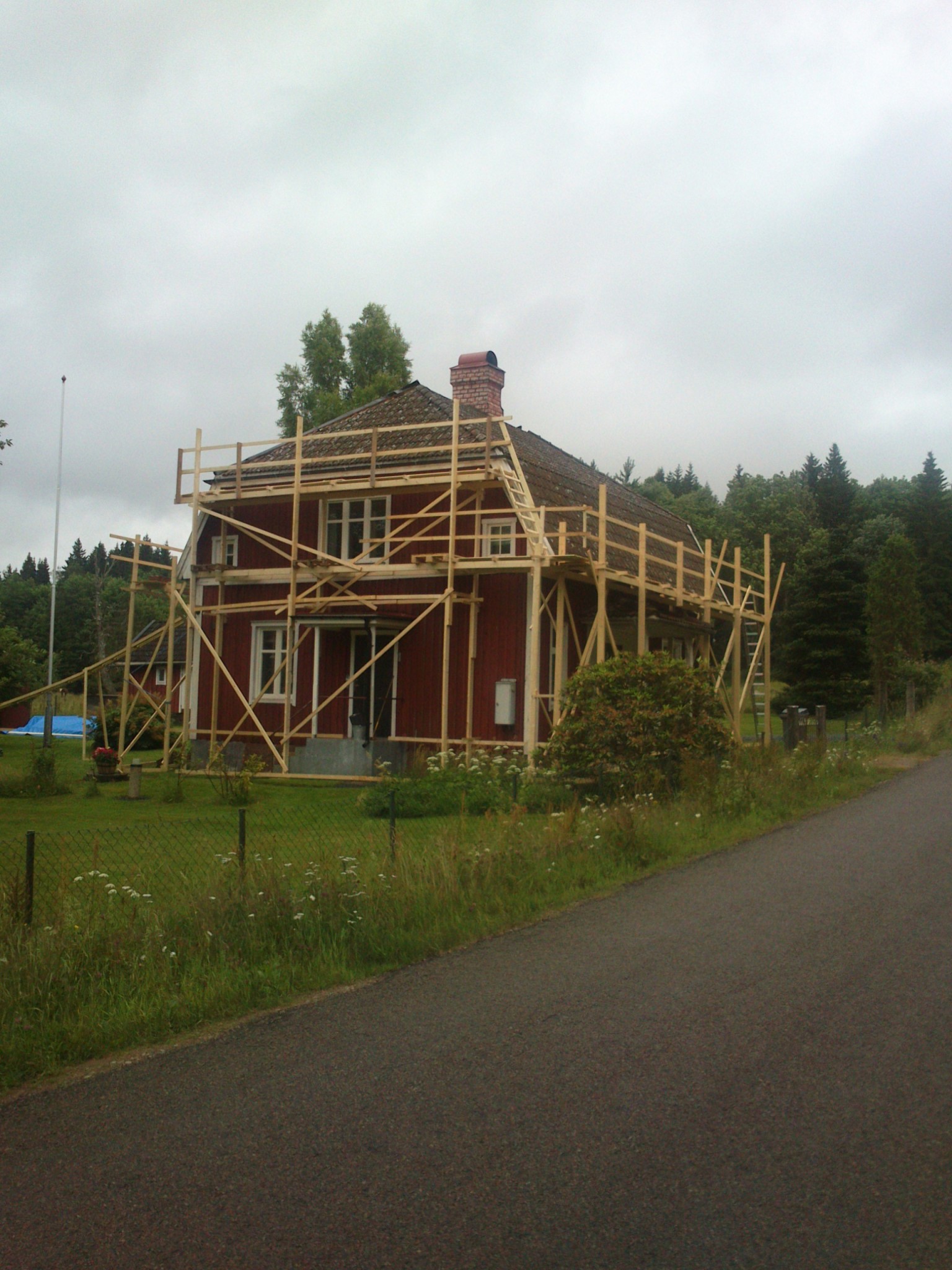
The challenging part is building a wooden scaffolding by yourself, but it can be done. The scaffolding on the gable took me a day alone to set up, but it was raining anyway, preventing roof demolition; otherwise, it was the only rainy day during four weeks of vacation. Mine was a quick fix when it wasn't possible to rent on short notice, and the workplace's scaffolding was elsewhere. The roof had to be replaced during vacation, period.
Mine was built with 45x120 for the bearing parts, ordinary raw planks were used as decking, and the diagonal braces were 28x70 sparse, everything was screwed together with coarse screws. Now all the materials are lying and waiting for me to start the extension of the outhouse, so if you know you're going to build something later, a wooden scaffolding can actually save some money in the longer perspective.
I built a scaffolding following the description linked to earlier when I replaced our roof. I didn't follow it slavishly, but it turned out quite similar anyway.
http://www.craftlab.gu.se/digitalAssets/1382/1382930_rapport-trastallningar-2011-web.pdf
I screwed together double 45x95s into studs with notches for 145x45 beams that supported the planks. Walking planks of various dimensions, 45x120, 45x145, and 45x195. I made the scaffolding wide enough to have the miter saw on the walking plank, which made it incredibly easier when the roof sheathing was replaced.
It turned out really stable to work on, and the lumber that was left over has also been put to good use afterward.
http://www.craftlab.gu.se/digitalAssets/1382/1382930_rapport-trastallningar-2011-web.pdf
I screwed together double 45x95s into studs with notches for 145x45 beams that supported the planks. Walking planks of various dimensions, 45x120, 45x145, and 45x195. I made the scaffolding wide enough to have the miter saw on the walking plank, which made it incredibly easier when the roof sheathing was replaced.
It turned out really stable to work on, and the lumber that was left over has also been put to good use afterward.
