
7,325 views ·
13 replies
7k views
13 replies
Building Interior Wall - Beginner
Hello!
Beginner question as it's my first time.
I plan to build an interior wall, but I've used a "stud finder" on the floor to see where the pipes/power cables are located. There seems to be a pipe near where I plan to attach the wall (I need to get a better stud finder before I start!).
My question is, how long do nails/screws need to be when attaching the floor sill and the frame itself (wall stud/ceiling stud)?
On the wall and ceiling, I'm attaching to concrete. On the floor, there's hardwood, then masonite, and then I guess a concrete joist.
Do you have any tips for a stud finder that is GOOD? This zircon i520 is far too unreliable.
Beginner question as it's my first time.
I plan to build an interior wall, but I've used a "stud finder" on the floor to see where the pipes/power cables are located. There seems to be a pipe near where I plan to attach the wall (I need to get a better stud finder before I start!).
My question is, how long do nails/screws need to be when attaching the floor sill and the frame itself (wall stud/ceiling stud)?
On the wall and ceiling, I'm attaching to concrete. On the floor, there's hardwood, then masonite, and then I guess a concrete joist.
Do you have any tips for a stud finder that is GOOD? This zircon i520 is far too unreliable.
I rented a professional model from Bosch's blue range to locate some blocks under the plaster on the facade. It seemed to work perfectly until I set the drill on the facade; only one out of seven blocks was correctly marked.
In other words, I don't have a good impression of these gadgets!
In other words, I don't have a good impression of these gadgets!

surris
Construction veteran
· Sverige
· 1 692 posts
surris
Construction veteran
- Sverige
- 1,692 posts
Are you worried about underfloor heating pipes? What kind of house/apartment is it and when was it built? They really shouldn't be that high up in the slab. But stud finders are available for rent at places like Cramo. If it's underfloor heating, a thermal camera works really well to see the loops.A andersanders123 said:Hi!
Beginner's question since it's the first time.
I'm planning to build an interior wall but I have used a "stud finder" on the floor to see where the pipes/electrical cables are located. There seems to be a pipe near where I'm going to attach the wall (need to get a better stud finder before I start!).
My question is how long nails/screws do I need when attaching the floor sill and the frame itself (wall plate/ceiling plate)?
On the wall and ceiling, it's concrete I'm attaching to. On the floor, there's parquet, then masonite, and then concrete joists I guess.
Do you have any tips on a stud finder that is GOOD? This zircon i520 is way too unreliable.
But if there's no underfloor heating, I wouldn't be too worried. Use some concrete screws that only go 20mm into the slab, set close together and glue the sill as well. Secure properly to the walls and ceiling if you're not worried about pipes there either.
If you're building a simple interior wall, you don't even need to attach it to the floor. Especially when you're attaching it to both the ceiling and wall. Then you cut the vertical studs to a suitable height so that they are pressed tightly between the floor and ceiling beam. I've just built a house on a concrete slab with embedded floor heating; I didn't want to take chances with the floor heating depth and fastening, so I simply glued the floor joists directly to the concrete (I stapled and glued sill paper to the joist). In your case, you might as well put a screw right through the parquet to avoid any potential movement; that's what I've done before.
Last edited:
U-plate studs for ceiling and floor,
Attach with double-sided Construction Tape (Beijer). + possibly a few screws.
The vertical studs should be of trä...cc 60.
(hopeless to screw gypsum screws into metal studs)....((special screws might work with gypsum and vertical metal studs....))
Otherwise, the tips are good on the following link...
Byggmax tips, build an interior wall with steel studs
Attach with double-sided Construction Tape (Beijer). + possibly a few screws.
The vertical studs should be of trä...cc 60.
(hopeless to screw gypsum screws into metal studs)....((special screws might work with gypsum and vertical metal studs....))
Otherwise, the tips are good on the following link...
Byggmax tips, build an interior wall with steel studs
surris
Construction veteran
· Sverige
· 1 692 posts
surris
Construction veteran
- Sverige
- 1,692 posts
No hell with metal studs...then to put floor trim and ceiling trim in it...G Granatäpple said:U-channel studs for ceiling and floor,
Attach with double-sided Construction Tape (Beijer). + possibly a few screws.
The vertical studs should be of wood...cc 60.
(hopeless to screw drywall screws on metal studs)....((special screws might work with drywall and vertical metal studs....))
Otherwise, the tips are good on the following link...
Byggmax tips how to build an internal wall with steel studs
Metal rails are by far the best option for interior walls. Guaranteed straight walls, easy to attach to the floor and ceiling, convenient to place the studs in just the right spot, etc.
The baseboard is attached to the plywood anyway, so there's no problem in fixing these either.
The baseboard is attached to the plywood anyway, so there's no problem in fixing these either.
How on earth did you manage the vapor barrier then? Sounds completely wrong.HomeboY said:
If you're building a simple interior wall, you don't even need to attach it to the floor. Especially not when you're fastening both to the ceiling and the wall. Then you cut the standing studs to a suitable height so that they are pressed firmly between the floor and ceiling joist. I just built a house on a concrete slab with embedded underfloor heating, I didn't want to gamble with the underfloor heating depth and fastenings, so I simply glued the floor joists directly onto the concrete (I stapled and glued sill paper onto the joist). In your case, you could just as well put a screw right through the parquet to avoid any movement, that's what I've done before.
surris
Construction veteran
· Sverige
· 1 692 posts
surris
Construction veteran
- Sverige
- 1,692 posts
I don't agree with you...metal studs are a damn invention. In my opinion, they should only be used when there's a fire classification requirement or when no organic material can be used. It goes much faster to put up a wooden stud wall and it turns out better.A Emil_K said:
Really great comments, love this forum =)
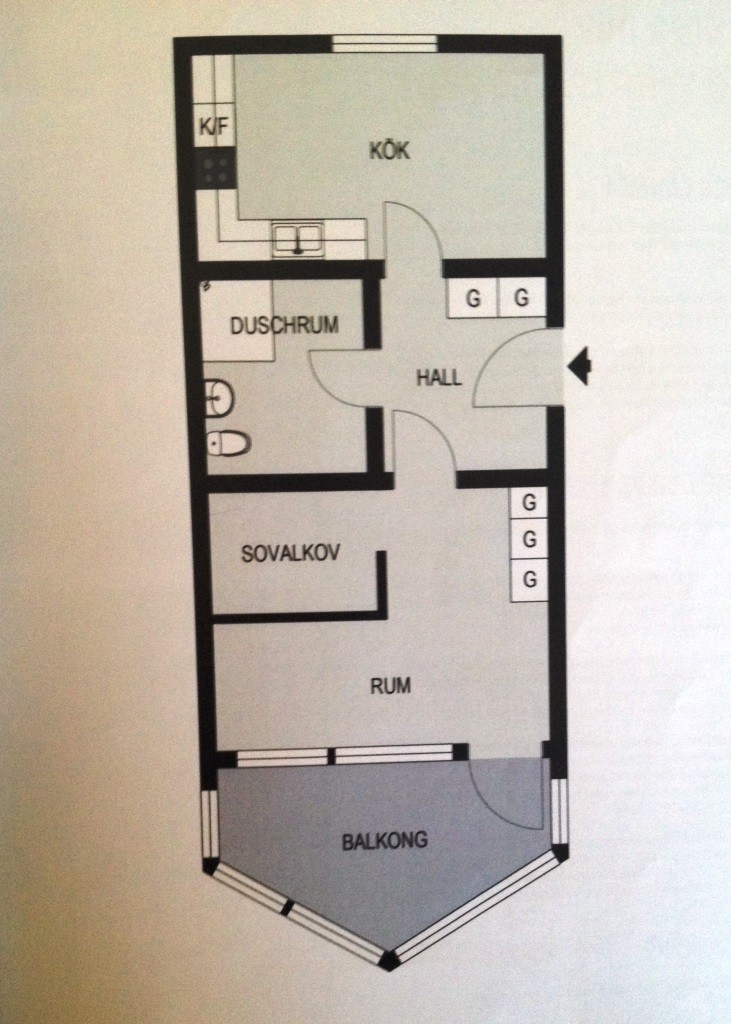
Here I attach an image of how it looks according to the building instructions. It's a condominium, and I live on the ground floor, the building was built in 1974, and the pipes were replaced in the late 90s, I think.
But as I interpret some of you, you don't really need to attach the inner wall to the floor (since I'm attaching it to the ceiling and the side wall)? Good to know before you answer that question is that my inner wall will only be able to be attached on one short side (see attached floor plan, it's the bed alcove's walls I'm building), and as you can see on the floor plan, I can only attach it to ONE concrete wall, as well as to the ceiling, and maybe then glue it to the floor? A bit worried that gluing won't be enough since I'm only attaching it to one side wall... what do you think?
b) How long screws/nails are recommended for attaching the studs to the concrete wall and concrete ceiling?
Thanks, guys!
Here I attach an image of how it looks according to the building instructions. It's a condominium, and I live on the ground floor, the building was built in 1974, and the pipes were replaced in the late 90s, I think.
But as I interpret some of you, you don't really need to attach the inner wall to the floor (since I'm attaching it to the ceiling and the side wall)? Good to know before you answer that question is that my inner wall will only be able to be attached on one short side (see attached floor plan, it's the bed alcove's walls I'm building), and as you can see on the floor plan, I can only attach it to ONE concrete wall, as well as to the ceiling, and maybe then glue it to the floor? A bit worried that gluing won't be enough since I'm only attaching it to one side wall... what do you think?
b) How long screws/nails are recommended for attaching the studs to the concrete wall and concrete ceiling?
Thanks, guys!

Last edited:
Yes, metal studs are a nightmare to deal with. Steel tracks and wooden pieces, on the other hand, as I mentioned, are extremely convenient
Click here to reply
Similar threads
-
Riva och bygga upp ny icke-bärande innervägg
Utbyggnad och tillbyggnad -
Is it possible to build a load-bearing internal wall on EPS concrete with 40 mm leveling compound?
Building Materials and Construction Technology -
Building interior wall - some questions
Building Materials and Construction Technology