Hello!
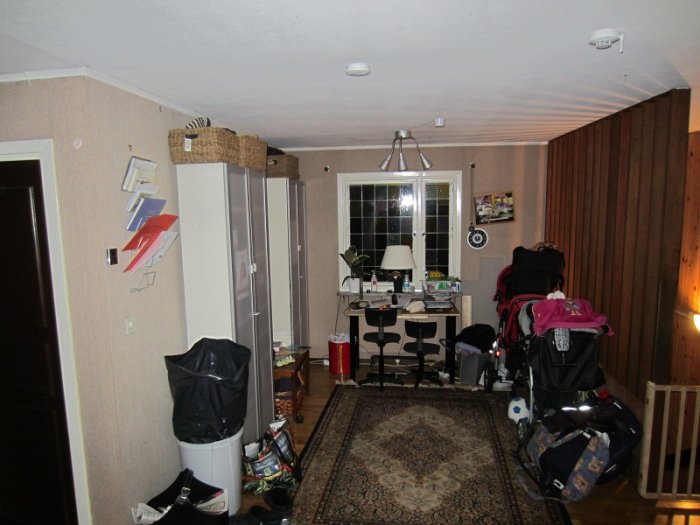
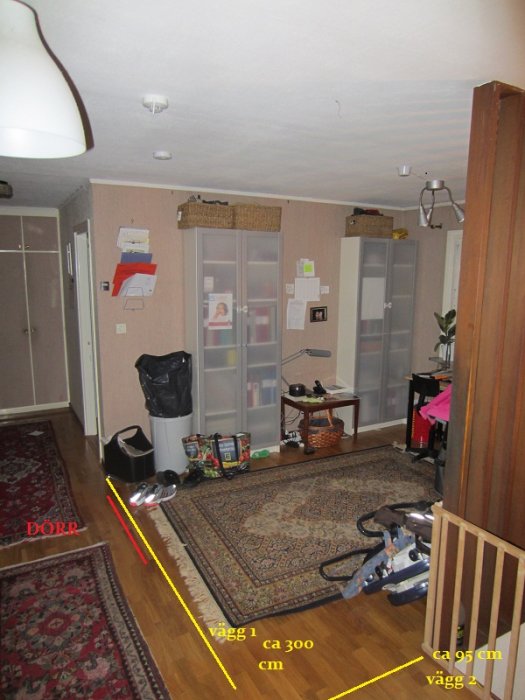
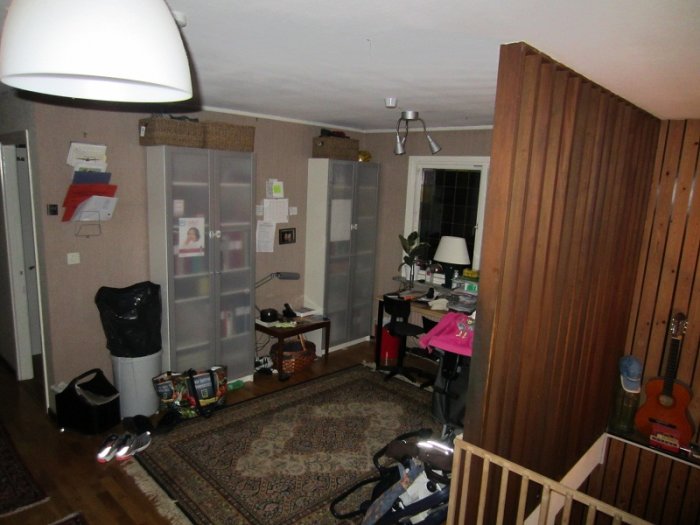
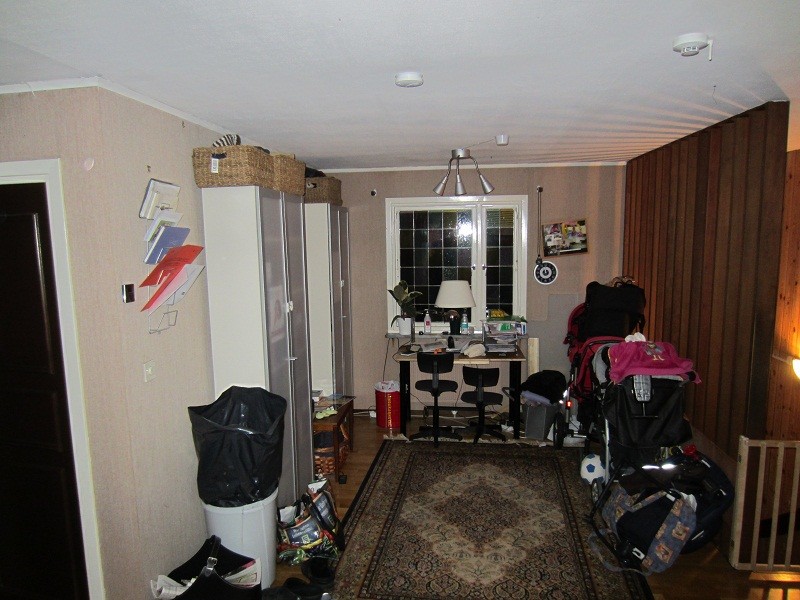
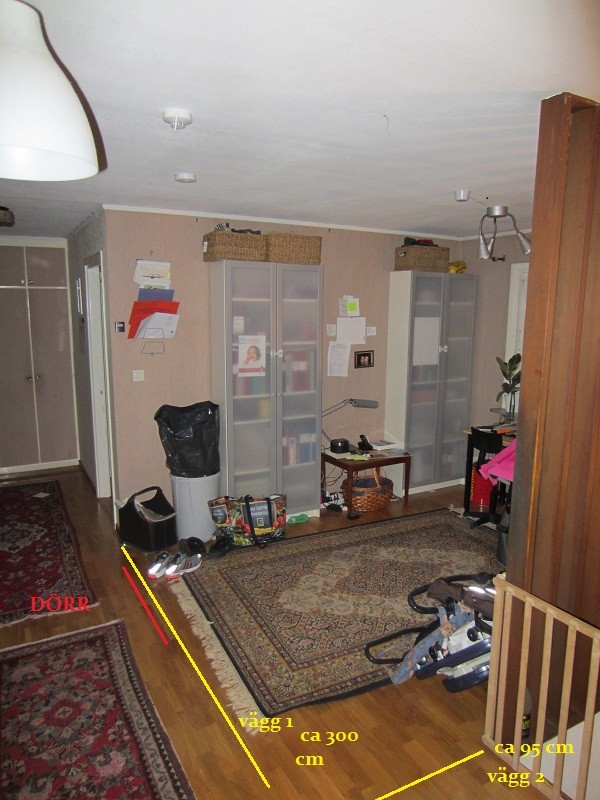
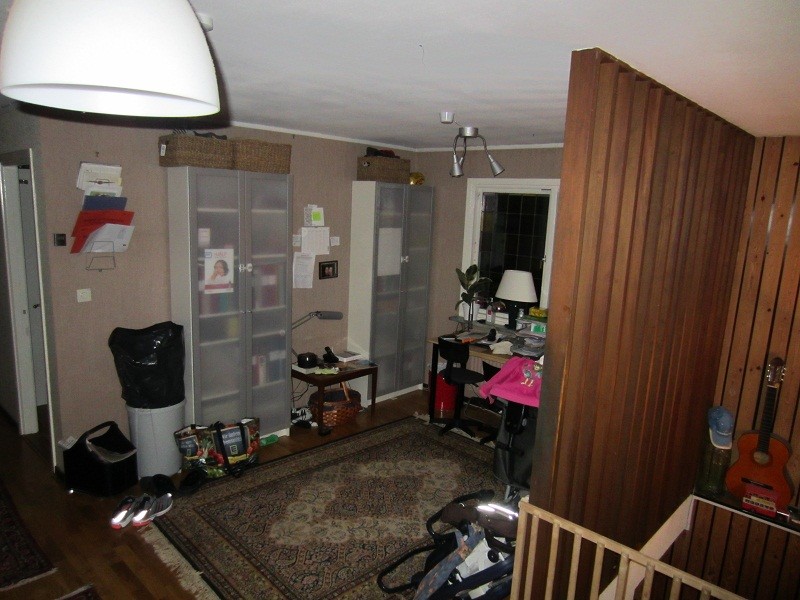
I'm about to build a small boys' room in the hallway for the eldest son.
See images below:
The idea is to make it as simple and relatively economical as possible, but with a certain level in terms of safety and appearance.
As can be seen, all that's really needed is a door and two partition walls, then it's done.
Regarding wall no. 2, I'm simply building a continuation of the railing towards the basement stairs - about 95 cm to the adjoining wall.
Now, of course, the question is, how do you do it? I've done some indoor construction before at a DIY level, but here I gladly take advice from more skilled amateurs or semi-professionals.
It is mainly the following points that I welcome opinions on:
Is there anything specific, besides precision, that I should think about when measuring wall no. 1?
It must naturally, and preferably, be a dead straight continuation of the already existing wall (especially wall 1). How do you make the intended line as straight as possible?
- What board material would you use? I will, unless someone with good reason protests, go with 13 mm gypsum with some kind of thin particle board as reinforcement, alternatively go with double gypsum. I plan to have a fairly dense framework - also with crossbars - marking their positions, to securely hang TVs and other heavy items on the inside of the room in the future.
- How do you best insulate interior walls in terms of sound? Is it fiber wool or polystyrene that's better? Is it really necessary to use construction plastic on these two interior walls? I've heard some say it's unnecessary on interior walls and only increases the risk of mold. My plan is otherwise to simply place insulation in the wall cavities and then just cover it with gypsum boards. Is there any risk or disadvantage in doing so?
- How do I attach the wall frame and door frame to the parquet floor in the best way? It's a basement floor underneath, but as far as I can understand, there is no electricity or other complications in the floor.
I've read some threads here and on other forums. When it comes to attaching new sills//studs to parquet, I've seen some advocate both glue and adhesive tape. However, that feels a bit uncertain - not least since TVs and other things might be hung on the walls, and the boys in the family often throw themselves against baseboards and walls.
How would you go about attaching the wall to the underlying floor?
My plan is to simply screw it on, about 2.5 cm down into the parquet.
- For an interior door, I was thinking of going with a standard white model from Dooria 21*7. Are there any specific warnings to consider here, or is it just full steam ahead?
It will probably be an excellent room, and I think you're absolutely right about materials, etc. It should be mineral wool/glass wool for soundproofing, not polystyrene. If you want extra good insulation, go for double gypsum. However, sound will still leak through the door, so it might be overkill.
But
1)
Are you also closing off the trellis towards the stairs? The "framework" seems to be ready there, so it just needs a gypsum board on each side.
2)
Ventilation! Supply air is needed in the new room. Exhaust air is probably arranged in the wet rooms.
1: Yes, exactly - I was probably unclear there, the trellis is being enclosed so that I utilize the existing studs, so to speak. I might even consider saving costs and using single plasterboard on the side facing the stairs, as that wall is high up in the air and protected from violence and impacts from outside.
2. I missed mentioning that. Yes, I was thinking of using some kind of nice continuous metal vent, possibly above the door to the room. Exhaust air exists in both the kitchen and the toilet nearby.
Who has said that you should have plastic in the inner walls? It is totally unnecessary. If you put plywood behind the drywall, you likely won't need any noggings in the wall. Regarding the sole plate, it might not be optimal to screw it if the parquet is floating. Also, I think a 70 cm wide door is far too narrow. Remember that it's the outer dimension of the frame that's referred to and that the door leaf is about a decimeter smaller.
Thank you Strevert and KnockonWood regarding the fresh air, apparently one shouldn't try to think late in the evening....
Yes, I will install trickle vents in the window - which should also be done in other places in the house.
@Mattiax: I take that warning to heart. 60 cm is far too narrow, so I guess I'll have to increase the frame width by a decimeter instead. The parquet is floating, - how on earth should I attach the wall at the bottom? Glue solutions? It doesn't feel quite right in terms of durability. What would you have done?
The parquet should be able to move, otherwise it can buckle, it doesn't matter if you screw or glue it in that case. I would have cut out where the bottom plate should be placed and attached it to the subfloor instead.
Place a ruler on the parquet where the wall should be and trace it. Add the measurement for the wall panels on each side, then add about 10mm extra on each side (for movement allowance). Then cut away the parquet with a plunge saw or circular saw. Set the saw so you have a few mm clearance down to the cellar floor (if it is stone). Afterwards, chisel away the last part with a chisel or similar tool. The gap between the parquet and the wall is finally covered with a skirting board!
Thank you - I understand. It will require a bit more effort, but at the same time, it would be really boring if the floor starts to rise once the wall is in place with wallpaper and electrical wiring, etc. I guess I'll start sketching a solution based on your suggestions about sawing.
one thing you should consider is whether the ceiling lights in the room have a staircase connection, i.e., if the son turns off the light in his room, the whole floor goes dark, or if someone gets up in the middle of the night and turns on the ceiling light on the floor and in his room.
The wall with the door I would place after the parquet... that is, it's better for it to look straight than to be straight... I wouldn't have cut the parquet for this... glue or good double-sided tape works perfectly... maybe some thinner screws in the parquet... the wall might need to be removed in a few years and then it's easy to restore...
I like your thought ENK, this will require some serious consideration. Junior will eventually move out one day, it feels uncomfortable to have to redo an otherwise nice parquet floor if it's not absolutely necessary.
The electrical connections have been checked, i.e., the switch that controls the room's main lighting does not affect the hall and vice versa. But I appreciate the remark.
A small thought, apropos of restoring the existing hallway/living area, or whatever you call it:
Kinshasa, if you skip wall 2, 95 cm, and draw wall 1 directly from the stair railing to the opposite wall, the wall construction becomes much simpler and more stable.
There is no need to screw/nail/saw into the parquet then. A couple of sealing strips against the floor under the wall frame will suffice for soundproofing.
A) It will be easier to restore the hallway when the need for the boy's room disappears.
B) The corridor/hallway will be a bit more airy in the passage to the other rooms on this floor.
Assuming, of course, that the boy's room is still sufficiently large.
I had installed OSB+gypsum and only secured it to the ceiling, not the floor, so it could be restored. You should get a sufficiently stable wall without needing floor mounting. It feels unfortunate to ruin the floor.
Once again, thanks for the input.
I will probably go with the parquet, just as some of you have suggested. The risk of possible shifts is something I'll simply have to take into account.
However, due to the desired size of the room, I'm forced to go with the plan with wall number two, even though a cross wall between the trellis and the opposite side would have been stronger. Unfortunately, the space becomes too small in this case.
I'm currently looking into mounting glue and double-sided tape for fastening the sill on the parquet.
Are there any specific brands that hold extra well?
TESA has a tape that I've heard good things about: http://www.verktygsboden.se/dubbelhaeftande/dubbelhaeftande-tejp
Thanks for the tips.
Vi vill skicka notiser för ämnen du bevakar och händelser som berör dig.