
Hello!
I have renovated the attic and, with the help of a friend, am going to build a staircase of the "floating stairs" model, meaning the steps will come out from the wall. I'm going to tear down the wall where the steps are to be mounted, so I have a good chance to build the framework for how the steps should be attached. However, I don't know how it should be built. Has anyone done a project like this and would like to share? I'm mostly interested in how to build behind the wall with battens, etc., so it can support the steps. The wall is an interior wall against another room, so I don't know how many load-bearing studs there are behind, but maybe that can be supplemented??:S
Grateful for any tips!
I have renovated the attic and, with the help of a friend, am going to build a staircase of the "floating stairs" model, meaning the steps will come out from the wall. I'm going to tear down the wall where the steps are to be mounted, so I have a good chance to build the framework for how the steps should be attached. However, I don't know how it should be built. Has anyone done a project like this and would like to share? I'm mostly interested in how to build behind the wall with battens, etc., so it can support the steps. The wall is an interior wall against another room, so I don't know how many load-bearing studs there are behind, but maybe that can be supplemented??:S
Grateful for any tips!
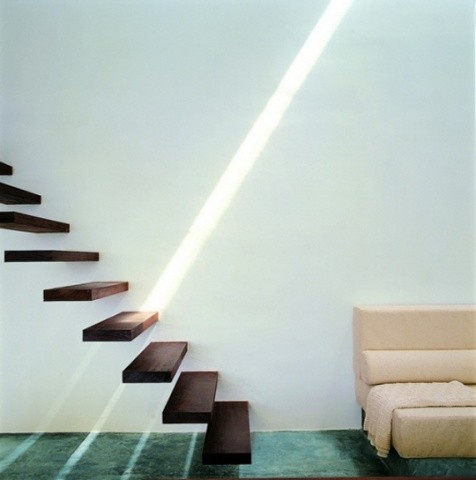

Unfortunately, I don't have an answer, but I'm also curious about this. Since there are stairs with glass steps like this, I guess it's some kind of metal construction with "slots" where the steps are inserted, at least in those cases. For example:
http://www.snickarlaget.se/swe/nyheter/furniture2009.html
It can hardly be built with materials that move and stretch the slightest. But hopefully someone on the forum knows how it actually is.
http://www.snickarlaget.se/swe/nyheter/furniture2009.html
It can hardly be built with materials that move and stretch the slightest. But hopefully someone on the forum knows how it actually is.

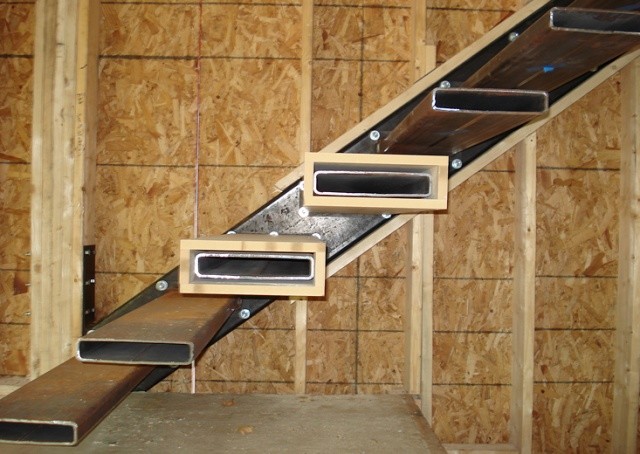
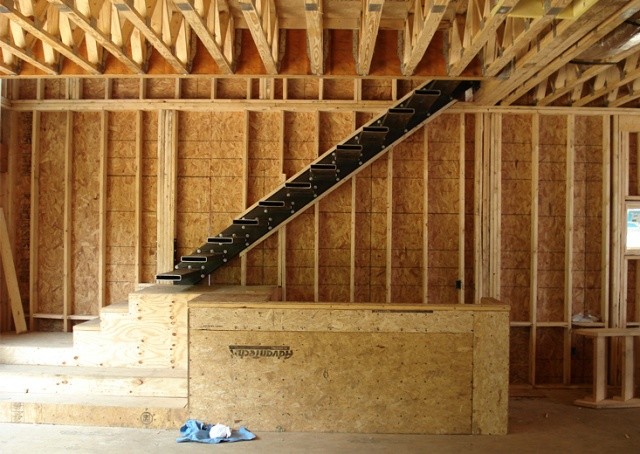
Actually quite a simple construction as there is an iron beam inside the wall, slanted up towards the upper floor, from which the steps protrude and are welded to the beam.. They are in turn only clad with wood so that it looks like the wooden steps are sticking out from the wall  So the beam is completely hidden inside the wall when everything is finished...
So the beam is completely hidden inside the wall when everything is finished...
In the program series "Grand Design" from England, there is an episode where you get to follow a family building a house with such a glass staircase. I seem to remember they discussed the construction a little. Maybe it can be an inspiration anyway? The episode is called "The Loch House" and is the first episode from the sixth series.


Are you allowed to build like that in Sweden? I almost assumed that there was a socialstyrelse or something similar that would intervene and claim it's a death trap without railings etc. etc.
It's nice anyway!
/U
It's nice anyway!
/U
Click here to reply