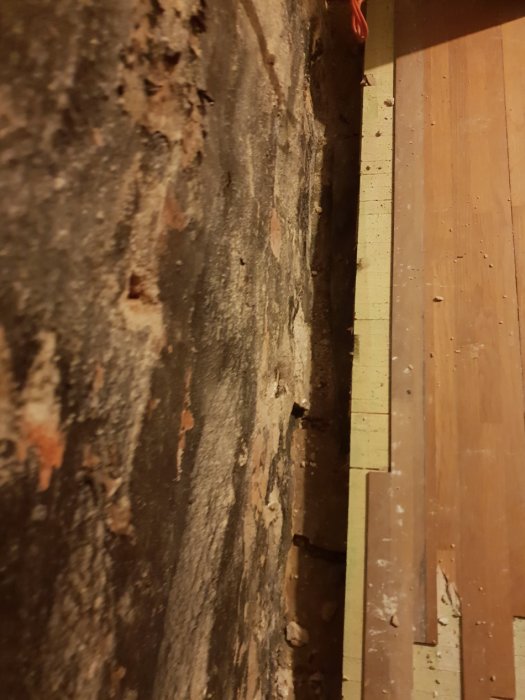
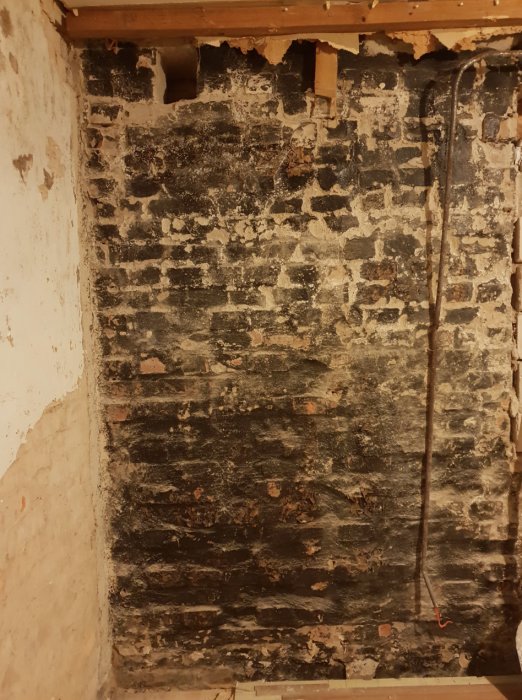
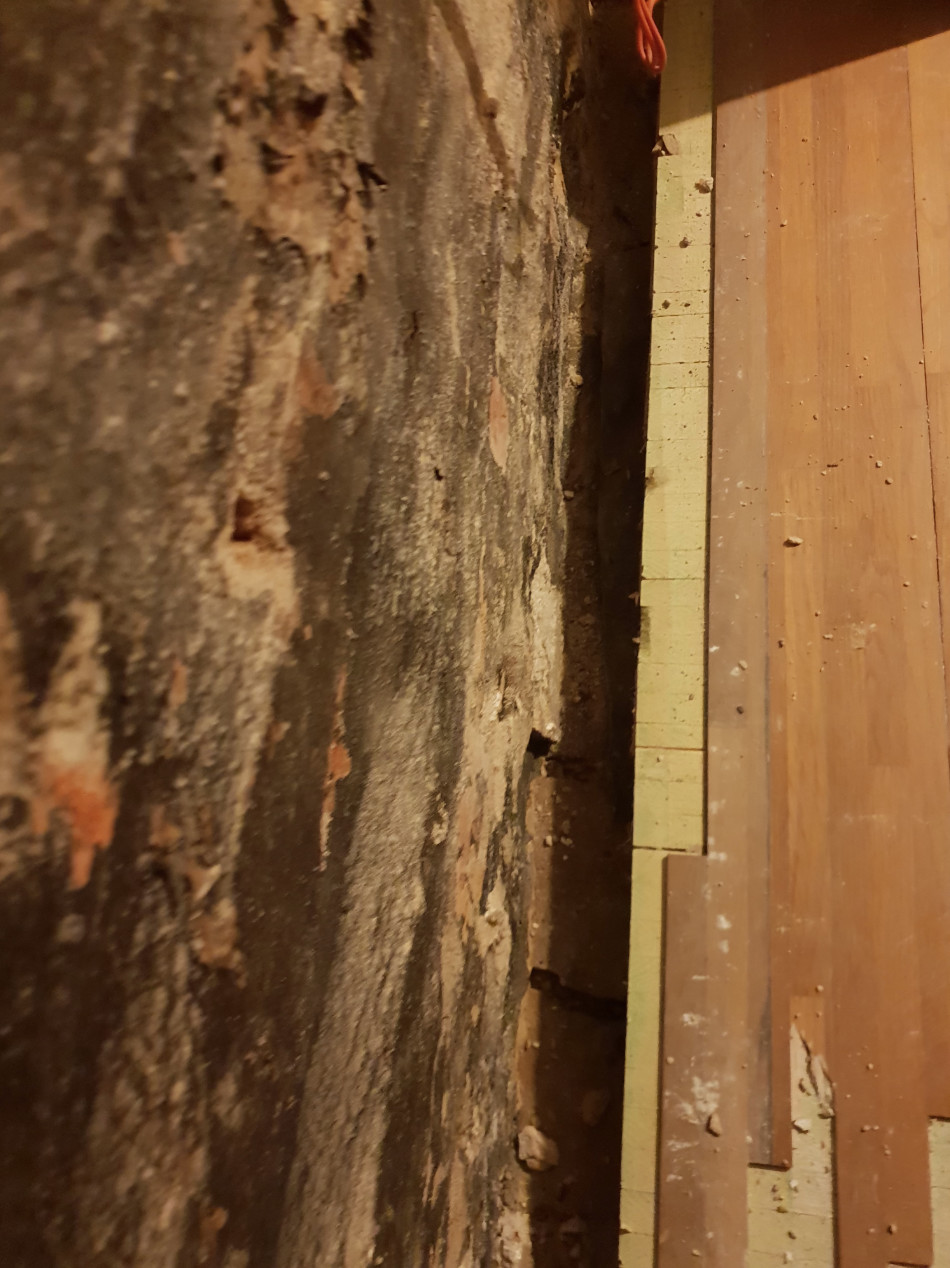
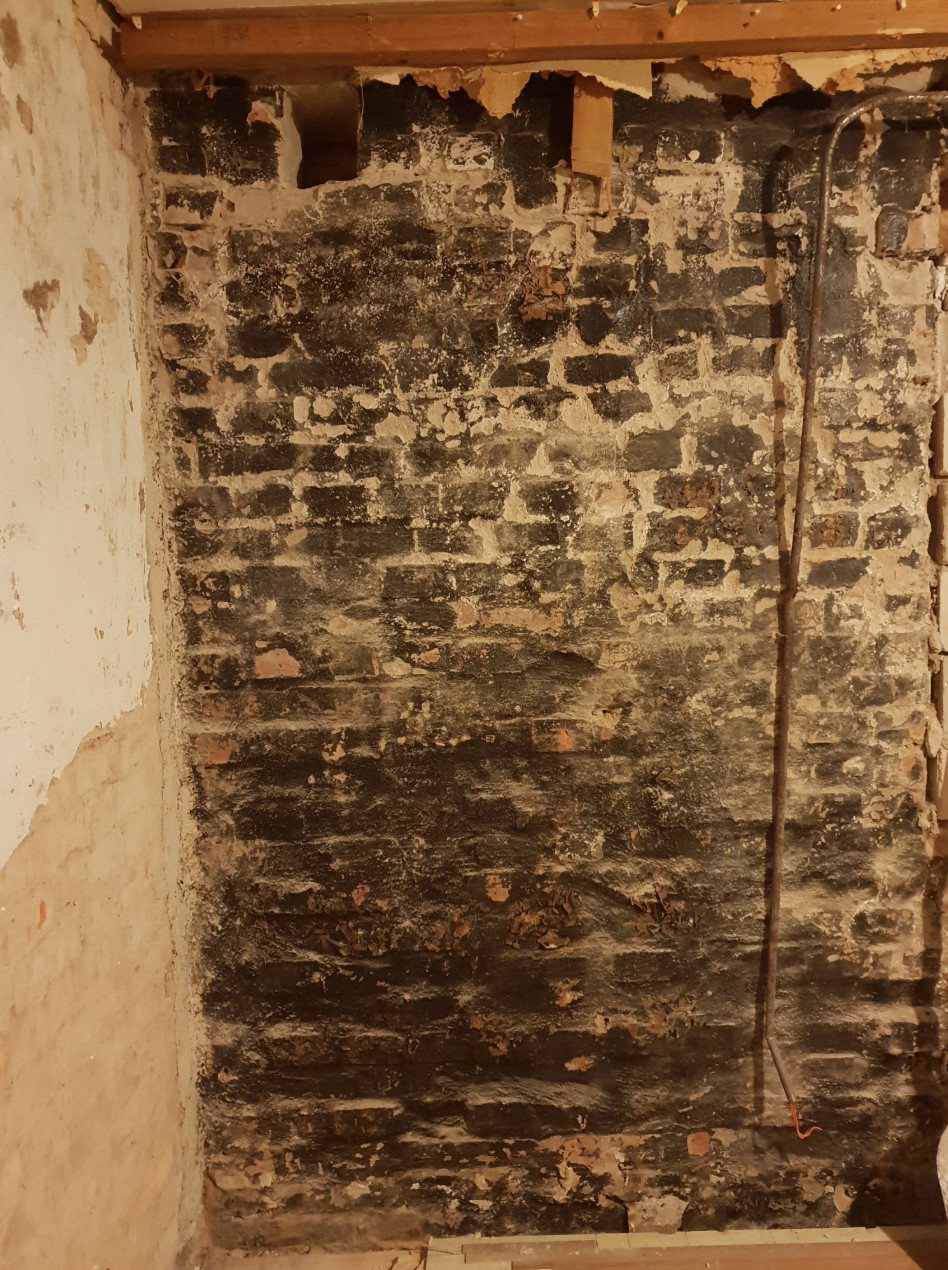
we have recently bought an old house and have torn down the wall that was against the outer wall due to moisture and would like some tips on what to do at the bottom as there is a gap between the outer wall and the floor and you can get your fingers between the floor and the crawl space (this is where it has been drafty and caused moisture damage to a couple of joists).
In one picture, you see the wall itself and in the other, the gap between the wall and the floor where you can access the crawl space. I'm thinking I might have to go down into the crawl space and pull some plastic or similar (?) from there that goes up and ends up under the actual joist that I set later.
Welcome to Byggahus fforum!
You need to provide a more detailed description of how the exterior wall is constructed to get useful answers. Does the brick wall rest on a wooden sill? How thick is the brick wall, full or half brick? What is the foundation made of? Where in the country is the house located? In Skåne?
Welcome to the Byggahus forum!
You need to provide a more detailed description of how the exterior wall is constructed in order to receive useful answers. Does the brick wall rest on a träsyll? How thick is the brick wall, full or half-brick? What is the foundation made of? Where in the country is the house located? In Skåne?
Thanks! It's in Skåne. The exterior wall is brick (as you can see in the picture) and is 30 cm thick with an air gap, and it does not rest on a träsyll.
The foundation is a crawl space as I mentioned, and the question is what I should do at the floor level where the gap is, as it is the cause of the moisture damage to the wooden beams.
The wooden floor beneath the parquet is in perfect condition.
I have a need to understand the construction in order to provide good feedback. Is the log seen in the picture lying next to the brick wall? I am not at all convinced that the gap is what caused the rot damage. Crawl spaces in old houses usually work well as long as they are not too well-insulated (through additional insulation). Waste heat from the heated space keeps the crawl space dry. If you have a gap, even more heat leaks down. It's never a good idea to place wood directly against a brick wall without intermediate moisture insulation. If the wall construction is also moisture-sealed with a plastic film, it's even worse.
I have a need to understand the construction to be able to provide good feedback. Is the log seen in the picture next to the brick wall? I'm not at all convinced that the gap is what caused the rot damage. Crawl spaces in old houses usually work well as long as they are not too well insulated (through additional insulation). Waste heat from the heated area keeps the crawl space dry. If you have a gap, even more heat leaks down. It's never successful to place wood directly against a brick wall without intervening moisture insulation. If the wall construction is also moisture-sealed with a plastic sheet, it's even worse.
There is a wooden beam up against the ceiling that was used for the previous interior wall that hasn't been removed yet. The plan is to build the interior wall with metal studs.
The wooden beams that were there before had suffered the most damage at the bottom where the gap between the floor is, so that's why I suspect that might be the cause.
There are so many different ways to build an interior wall against an exterior wall that it gets a bit confusing.
I am sure the gap can be dismissed as the cause of the rot damage. They were probably caused by moisture transfer from the brick wall. Steel studs are safer in that environment, but if they are galvanized, they should not be in contact with the brick either. Do not use plastic sheeting on the exterior. It traps moisture. You can seal the gap most easily with an insulation material that is insensitive to moisture, such as mineral wool.
Stud walls on the inside of solid brick walls (i.e., not facing brick) are the easiest to build but not the best solution. Aerated concrete or lightweight concrete block that is plastered is a safer option in the long term.
I am sure that the gap can be ruled out as the cause of the rot damage. They were likely caused by moisture transfer from the brick wall. Steel studs are safer in that environment, but if they are galvanized/zinced they should not be in contact with the brick either. Do not use any plastic film on the outside. It traps the moisture. The gap can be sealed most easily with an insulation material that is insensitive to moisture, such as mineral wool.
Stud walls on the inside of solid brick walls (i.e., not façade bricks) are easiest to build but not the best solution. Lightweight concrete or lecablock with plaster is safer in the long term.
Wonder if it could be a cavity wall, i.e., two half-brick walls with a 5 cm air gap between them "The outer wall is made of brick (as seen in the picture) and is 30 cm thick with an air gap."
In that case, the inner wall should be dry.
I don't think the masonry bond suggests that it is a cavity wall, but the thickness does. It depends on the year of construction. It is, after all, a relatively modern phenomenon.
I don't think the brick bond suggests that it is a cavity wall, but rather the thickness. It depends on the year of construction. It is a relatively modern occurrence.
"30 cm thick but with an air gap" made me think of a cavity wall. With standard brick, the measurement fits too, with large brick the measurement would fit for a full brick wall. Here in Dalarna, cavity walls have been common in stables and barns for a long time.
I am not knowledgeable enough in Scanian building tradition to confidently say how long cavity walls have been used. A guess could be the first half of the 20th century.
Click here to reply
Vi vill skicka notiser för ämnen du bevakar och händelser som berör dig.